
Oil is back above $100, and markets are suddenly bracing for more interest rate hikes. Allworth Chief Investment Officer Andy Stout examines what’s driving the shift, what history tells us about oil’s impact on inflation, and what it could all mean for investors.
Oil Sets the Agenda
The Federal Reserve is, once again, at the center of an inflation problem. In mid-August, markets expected only one rate hike over the next six months. Nothing changed at the central bank over the past month, but markets are now pricing in almost three hikes over that same period. The change came from the oil market, as WTI crude traded above $100 last week for the first time since May 21.
The Fed can’t do anything about oil prices or the supply issues behind them, but the committee is responsible for keeping inflation in check, and right now, that starts with how tight oil supply has become.
Supply Is Driving Oil, But Supply Is Tight
While oil, at the time of this writing, is below its $119 peak price set in March, it’s nearly 80% higher this year. The latest leg up traces to supply constraints and fears that the disruption could get worse. Before the war, about 20% of global oil flows moved through the Strait of Hormuz, a narrow passage between Iran and Oman, and 100-140 vessels commonly passed through the strait each day. That traffic has since dropped to single digits over the past few months, according to Bloomberg data. In addition, Saudi Arabia, one of the world’s largest oil producers, said its August output was the lowest since 1990.
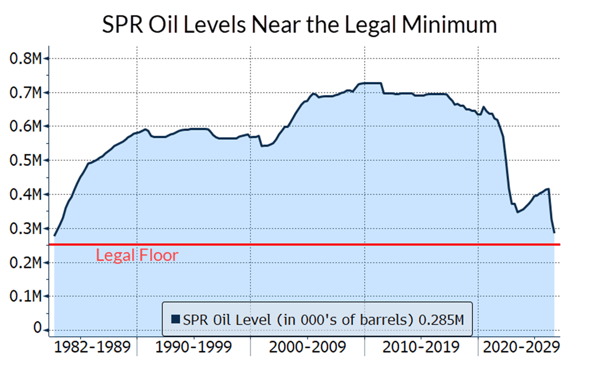
Against this backdrop, the U.S. Strategic Petroleum Reserve (SPR) is facing its own issues. The SPR is a government-owned stockpile of oil stored in underground salt caverns along the Gulf Coast of Texas and Louisiana. It serves as an emergency supply source that the government can tap to ease energy shortages. The issue is that it sits at just 285 million barrels, its lowest level since the early 1980s and just above the legal floor of 252 million barrels. This leaves the government with limited capacity to calm markets if the situation deteriorates.
Consumers are feeling these supply issues, with prices at the pump setting a Labor Day record. Gas prices feed into the inflation reports the Fed uses to help set monetary policy (i.e., adjust interest rates). However, oil prices have surged in September, and that’s not captured in last week’s August inflation release.
Headline Inflation Follows Oil, and Core Mostly Hasn't
Consumer prices (CPI) rose 0.4% in August, leaving the annual rate at 3.4%. Core CPI, which excludes food and energy, climbed 0.3% last month and slowed to 2.4% year over year, its lowest 12-month change reading since 2021.
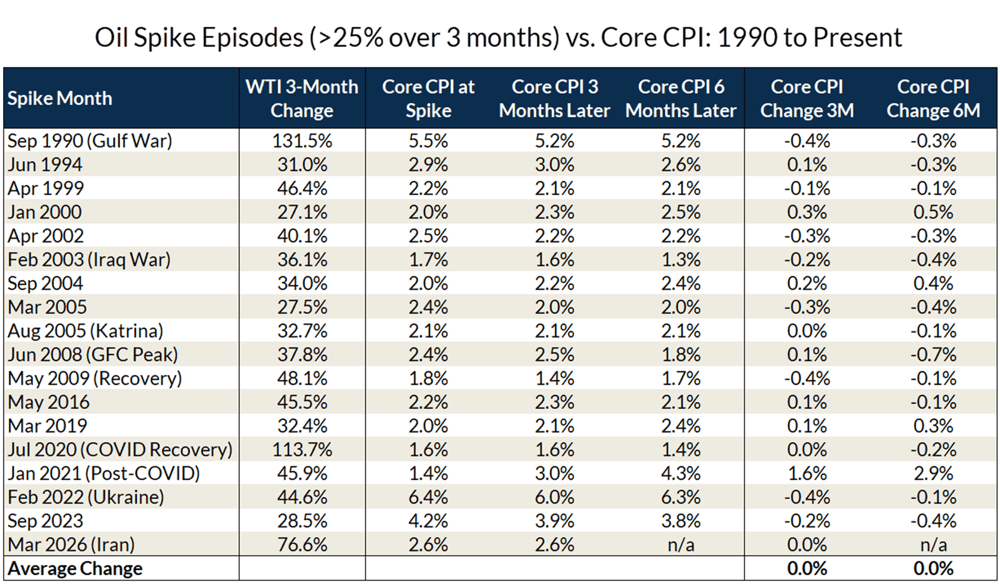
Economists pay close attention to core CPI because it’s less impacted by wild swings in energy prices, making it a good proxy for underlying inflation in the broad economy. The data backs this up. Since 1990, WTI oil price spikes of 25% or more over a three-month period have shown a weak and inconsistent pass-through to core CPI. Across the episodes, on average, core CPI was essentially unchanged over the following three and six months.
The tame reaction in core CPI is not simply due to oil reversing, as crude continued rising in several of those cases. The deeper explanation is structural. High oil prices are largely self-correcting because energy takes up a larger portion of household budgets, reducing demand for other goods and services. This is the backbone of one of the most classic Wall Street adages: the cure for high prices is high prices.
That does not mean oil at $100 is harmless. A prolonged period of higher energy prices strains consumers, increases recession risk, and complicates Fed policy. Even though the historical pattern described above is somewhat reassuring, it’s not a guarantee.
It's time to give your wealth an advantage.
With the right plan and partner in place, your wealth can reach its full potential. Meet with a dedicated Allworth advisor to experience how our comprehensive and advanced wealth planning process connects all the dots of your financial life.
Why Rate Hikes Are On the Table Anyway
Raising interest rates does not result in more oil; it does not solve the supply problem. Higher rates can help stop an energy shock from becoming a broad inflation shock. This can occur because elevated interest rates cool the demand side of the economy, making it harder for businesses to pass higher energy costs on to consumers.
The Fed is fully aware of this relationship. Chair Kevin Warsh said last month that the central bank has work to do if it cannot be confident the underlying trend is improving. At Jackson Hole, he called medium-term inflation expectations stable, but he also noted that such expectations tend to look strong and durable until they don't.
With concerns that energy prices are affecting other parts of the economy, those expectations that Warsh noted look less durable. Consequently, the bond market took Warsh at his word, and yields have moved before the Fed has had a chance to act.
The Curve Repriced From the Front
Earlier this year, investors expected the Fed to cut rates. But when oil started to climb in late February, interest rates did too. Treasury yields bottomed out on February 27, and since then, every part of the yield curve has jumped higher. In fact, the 30-year is near its highest since June 2007, the 10-year since October 2023, and the 2-year since July 2024.
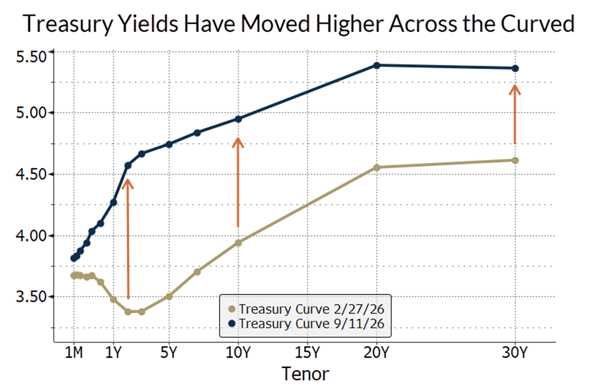
Short maturities moved the most because that is where expectations for the Fed live. In February, the 2-year was priced for rate cuts, but today it is priced for hikes. That swing alone is worth more than a percentage point. Meanwhile, long maturities have risen due to doubts that inflation will soon return to normal levels.
Rising debt and annual deficits are two other reasons cited for higher long-term interest rates. This fiscal issue is a problem; however, it's slow-moving. Two items we’re watching for stress are the term premium on long-dated Treasuries and foreign demand at future auctions. The clock is ticking, but it's not yet ticking loudly.
What You Control, and What You Don't
It is reasonable to feel uneasy, with oil above $100, government debt continuing to climb, and rate hikes priced in. Periods like this are not new, and the very recent past is littered with examples: the record-long government shutdown late last year, rising private credit concerns in January and February, fears AI would make all software obsolete in February, oil’s first rise above $100 in March, and new Fed Chair Warsh’s policy to provide markets with much less information in June.
Yet all major stock indexes – the S&P 500, Dow Jones Industrial Average, Nasdaq, Russell 2000, MSCI EAFE, and MSCI Emerging Markets – are positive this year through the end of August. Further, since 1980, the S&P 500 has finished higher 83% of the time while posting an average return of +13%, despite the market falling an average of 14% at some point during the year.
This resilience is normal. That said, it's not uncommon to feel nervous when negativity dominates the headlines. That's why your portfolio should have the right mix of assets to withstand market turbulence. Beyond your investment mix, your portfolio should be aligned with your investment needs. Whether you need solutions to manage downside risk or hedge concentrated stock exposure, the right structure is critical to your long-term financial success.