

allworth-financial-logo-color
    • Wealth Management
      • Financial Planning
      • Investment Management
      • Tax Planning
      • Estate Planning
      • Insurance Services
    • 401(k) For Employers
    • For Airline Employees
    • Our Approach
    • Why People Work With Us
    • Office Locations
    • FAQs
    • Our Fees
    • Our Story
    • Advisors
    • Our Leadership
    • Advisory Firm Partnerships
    • Allworth Kids
    • Webinars & Events
    • Podcasts
    • Financial Planning
    • Investment Management
    • Tax Planning
Meet With Us
  • Locations
  • Login
  • Contact
March 3, 2026

Markets, Oil, and Risk

The Allworth Team The Allworth Team
  • Share this post

As geopolitical tensions rise and oil markets react, this update examines the potential economic paths ahead, how energy disruptions could shape inflation and growth, and what disciplined portfolio positioning looks like during periods of global uncertainty.


Economic Backdrop

The United States and Israel launched coordinated strikes across Iran, targeting military and government infrastructure, with Tehran responding across the region. The conflict immediately broadened beyond a limited tactical episode into a broader regional confrontation with uncertain duration.

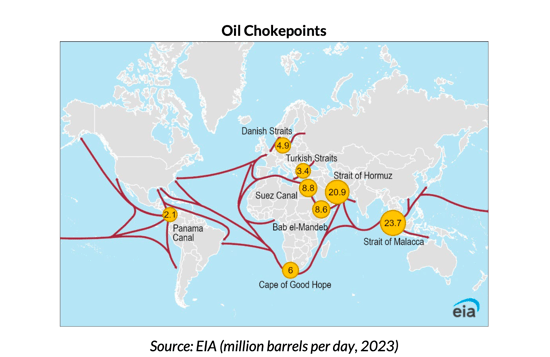
The economic lens is still mostly an energy and logistics story. The key factors are whether energy infrastructure stays functional and shipping lanes are open. The Strait of Hormuz is the epicenter from an energy perspective because roughly 20% of oil moves through that corridor. Additionally, Iran’s supply is important, as its crude production is roughly 3.4 million barrels per day in 2025, representing 4.2% of the global 79 million output.
Screenshot 2026-03-02 at 4.21.02 PM


Paths We’re Watching

While there are infinite paths this conflict can take, there are three broad ones we can group them into from an energy perspective:

  1. Contained conflict: In this scenario, strikes remain focused, infrastructure is largely undamaged, and Hormuz remains passable after the first week or so since the start of the attack. Oil could still gap higher on fear and logistics friction, but the premium could fade as flows prove resilient. The US economy feels it mostly through gasoline prices, and through inflation expectations at the margin, not through an immediate hit to GDP.

  2. Infrastructure impairment: If Iran’s export chain is degraded or other countries have material infrastructure damage, the market will price a real supply loss. Higher crude prices would lift headline inflation and squeeze real consumer purchasing power. That would not necessarily cause the US to fall into recession on its own, but it would reduce the economy’s cushion and complicate the Fed’s path if inflation is already running sticky.

  3. Shipping disruption: Anything that credibly constrains Hormuz for much more than a week is the scenario that changes the macro conversation. To be fair, even partial disruption can have an impact through higher freight and insurance costs, as well as inflation psychology. The US is less energy-vulnerable than in prior decades, but oil remains a global commodity with a global impact. Sustained price spikes work like a tax on consumption and can slow global demand, which would create the biggest drag on our economy of all three scenarios.


Historical Market Reaction

Markets tend to treat geopolitics as a volatility catalyst first and a trend changer only if it alters the economic trajectory. The common pattern is an initial risk-off move, a flight to liquidity and defensives, and then a reassessment that separates fear from fundamentals. There are exceptions, though. If the attacks result in a sustained oil spike, the market reaction can last longer.

In most cases, geopolitics alone are rarely sufficient to create a durable bear market without a concurrent earnings recession or a meaningful tightening in financial conditions. The checklist is simple: energy, rates, credit spreads, and corporate profit expectations. While nothing is ever guaranteed, if those stay contained, equity weakness can be temporary.

The table below highlights stock and bond market reactions following some of the more well-known international episodes over the past 40 years. While some of them resulted in near-term weakness, both equities and bonds performed well over the intermediate term, with positive returns at least 75% of the time in the 3-12 months following major geopolitical events.
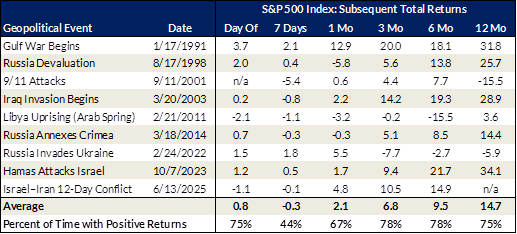
 

image010-Mar-03-2026-12-14-21-7477-AM

Portfolio Planning

Portfolios are built for shocks because market volatility is a normal part of investing. The objective is not to predict every headline. It is to own a mix of assets that can absorb multiple regimes, with enough liquidity to act rather than react.

In events like this, discipline is key. Headlines can push investors toward concentrated, single-factor bets at exactly the wrong time. A more durable approach is to keep the portfolio anchored to its long-term plan and make sure investment solutions align with investment needs.

If the conflict remains contained, the market’s initial move may look worse than the lasting economic impact. If it escalates into sustained energy disruption, diversification and quality balance sheets become more valuable. Either way, stay diversified, and let the plan drive the decisions.


All data unless otherwise noted is from Bloomberg. Past performance does not guarantee future results. Any stock market transaction can result in either profit or loss. Additionally, the commentary should also be viewed in the context of the broad market and general economic conditions prevailing during the periods covered by the provided information. Market and economic conditions could change in the future, producing materially different returns. Investment strategies may be subject to various types of risk of loss including, but not limited to, market risk, credit risk, interest rate risk, inflation risk, currency risk and political risk.

Large-cap stocks are represented by the S&P 500® Index; small-cap stocks are represented by the Russell 2000® Index; international stocks are represented by the MSCI ACWI ex USA Index; bonds are represented by the Bloomberg U.S. Aggregate Bond Index; and longer-term interest rates are represented by the yield on the 10-Year U.S. Treasury Note.

These indices are unmanaged, are not available for direct investment, and do not reflect the deduction of advisory fees, transaction costs, or other expenses. Index performance is shown for illustrative purposes only and is not intended to represent the performance of any specific investment or portfolio.

This commentary has been prepared solely for informational purposes, and is not an offer to buy or sell, or a solicitation of an offer to buy or sell, any security or instrument or to participate in any particular trading strategy or an offer of investment advisory services. Investment advisory and management services are offered only pursuant to a written Investment Advisory Agreement, which investors are urged to read and consider carefully in determining whether such agreement is suitable for their individual needs and circumstances.

Allworth Financial and its affiliates and its employees may have positions in and may affect transactions in securities and instruments mentioned in these profiles and reports. Some of the investments discussed or recommended may be unsuitable for certain investors depending on their specific investment objectives and financial position.

Allworth Financial is an SEC-registered investment advisor that provides advisory services for discretionary individually managed accounts. To request a copy of Allworth Financial’s current Form ADV Part 2, please call our Compliance department at 916-482-2196 or via email at compliance@allworthfinancial.com.



Related Articles
See more articles
February 24, 2026 Pre-Tax, Roth, and After-Tax Dollars in Your 401(k): What They Are and Why It Matters

Choosing between pre-tax, Roth, and after-tax 401(k) contributions can significantly shape your long-term tax outcome, and understanding how each …

Read Now
February 09, 2026 Why a Single Withdrawal Rate Isn’t Enough and What to Do Instead

Relying on a single withdrawal rate can leave your retirement plan exposed to market swings, but a bucketed approach helps protect short-term income …

Read Now
February 03, 2026 Why a Real Financial Advisor Matters in an AI World

AI can be a powerful tool, but when it comes to building a personalized, adaptable financial plan, there’s no substitute for the judgment, …

Read Now
Allworth Financial logo
Talk with an Advisor Contact us
  • Services
    • Wealth Management
    • 401(k) For Employers
    • For Airline Employees
  • Working With Us
    • Why People Work With Us
    • Office Locations
    • FAQs
    • Our Fees
    • Client Login
  • About Us
    • Advisors
    • Our Leadership
    • Advisory Firm Partnerships
    • Allworth Kids
    • Careers
    • Form CRS
  • Insights
    • Workshops & Events
    • Podcasts
    • Financial Planning
    • Investment Management
    • Tax Planning

Newsletter

Subscribe to receive monthly insights from our Chief Investment Officer, and be the first to know about upcoming educational webinars.

©1993-2026 Allworth Financial. All rights reserved.
  • Privacy Policy
  • Disclosures
  • Cookie Preferences
  • Do Not Sell or Share My Personal Information

Advisory services offered through Allworth Financial, a Registered Investment Advisor

Securities offered through AW Securities, a Registered Broker/Dealer, member FINRA/SIPC. Check the background of this firm on FINRA's BrokerCheck.

HMRN Insurance Agency, LLC license #0D34087

Rankings and/or recognition by unaffiliated rating services and/or publications should not be construed by a client or prospective client as a guarantee that he/she will experience a certain level of results if Allworth is engaged, or continues to be engaged, to provide investment advisory services.  Rankings should not be considered an endorsement of the advisor by any client nor are they representative of any one client’s evaluation or experience. Rankings published by magazines, and others, generally base their selections exclusively on information prepared and/or submitted by the recognized advisor.  Therefore, those who did not submit an application for consideration were excluded and may be equally qualified.

1.  Barron’s Top 100 RIA Firms: Barron’s ranking of independent advisory companies is based on assets managed by the firms, technology spending, staff diversity, succession planning and other metrics. Firms who wish to be ranked fill out a comprehensive survey about their practice. Allworth did not pay a fee to be considered for the ranking.  Allworth has received the following rankings in Barron’s Top 100 RIA Firms: #11 in 2025, #14 in 2024, #20 in 2023 and #31 in 2022. #23 in 2021, #27 in 2020.

2.  Retention Rate Source: Allworth Internal Data, FY 2022

3 & 9.  NBRI Circle of Excellence and Best in Class Ethics:  National Business Research Institute, Inc. (NBRI) is an independent research firm hired by Allworth to survey our customers. The survey contains eighteen (18) scaled and benchmarked questions covering a total of seven (7) topics, and a range of additional scaled, multiple choice, multiple select and open-ended question and is deployed biannually. NBRI compares responses across its company universe by industry and ranks the participating companies in each topic. The Circle of Excellence level is bestowed upon clients receiving a total company score at or above the 75th percentile of the NBRI ClearPath Benchmarking database.  Allworth’s 2023 results were compiled from 1,470 completed surveys, with results in the 92nd percentile. Allworth pays NBRI a fee to conduct the survey.

4.  As of 2/17/2026, Allworth Financial, an SEC registered investment adviser and AW Securities, a registered broker/dealer have approximately $35 billion in total assets under management and administration.

5.  Investment News Best Places to Work for Financial Advisors:  Investment News ranking of Best Places to Work for Financial Advisors is based on being a United States based Registered Investment Adviser with a minimum of 15 full or part-time employees working in the United States and having been in business for over a year.  Firms who meet Investment News’ criteria fill out an in-depth questionnaire and employees were asked to take part in a companywide survey.  Results of the questionnaire and employee surveys were analyzed by Investment News to determine recipients.  Allworth Financial did not pay a fee to be considered for the ranking.  Allworth Financial has received the ranking in 2020 and 2021.

6.  2021 Value of an Advisor Study / Russel Investments

7.  RIA Channel Top 50 Wealth Managers by Growth in Assets:  RIA Channel’s ranking of the Top 50 Wealth Managers by Growth in Assets is based on being an active Registered Investment Adviser with the Securities and Exchange Commission with no regulatory, criminal or administrative violations at the time of the ranking, provide wealth management services as their primary business and have a two year growth rate of 30% based on assets reported on Form ADV Part 1 at the time of ranking.  Allworth Financial did not pay a fee to be considered for the ranking.  Allworth Financial received the ranking in 2022.

8.  USA Today Best Financial Advisory Firms: USA Today’s ranking of Best Financial Advisory Firms was compiled from recommendations collected through an independent survey and a firm’s short and long-term AUM growth obtained from public sources. Allworth Financial did not participate in the survey, as self-recommendations are prohibited from consideration, and all surveyed individuals were selected at random. Allworth Financial did not pay a fee to be considered for the ranking. Allworth Financial received the ranking in 2024.

Tax services are provided by Allworth Tax Solutions, an affiliate of Allworth Financial. Allworth Financial does not provide tax preparation services or advice.

Certified Financial Planner Board of Standards Inc. owns the certification marks CFP®, CERTIFIED FINANCIAL PLANNER™, CFP® (with plaque design) and CFP® (with flame design) in the U.S., which it awards to individuals who successfully complete CFP Board's initial and ongoing certification requirements.

Important Information

The information presented is for educational purposes only and is not intended to be a comprehensive analysis of the topics discussed. It should not be interpreted as personalized investment advice or relied upon as such.

Allworth Financial, LP (“Allworth”) makes no representations or warranties as to the accuracy, timeliness, suitability, completeness, or relevance of the information presented. While efforts are made to ensure the information’s accuracy, it is subject to change without notice. Allworth conducts a reasonable inquiry to determine that information provided by third party sources is reasonable, but cannot guarantee its accuracy or completeness. Opinions expressed are also subject to change without notice and should not be construed as investment advice.

The information is not intended to convey any implicit or explicit guarantee or sense of assurance that, if followed, any investment strategies referenced will produce a positive or desired outcome. All investments involve risk, including the potential loss of principal. There can be no assurance that any investment strategy or decision will achieve its intended objectives or result in a positive return. It is important to carefully consider your investment goals, risk tolerance, and seek professional advice before making any investment decisions.