
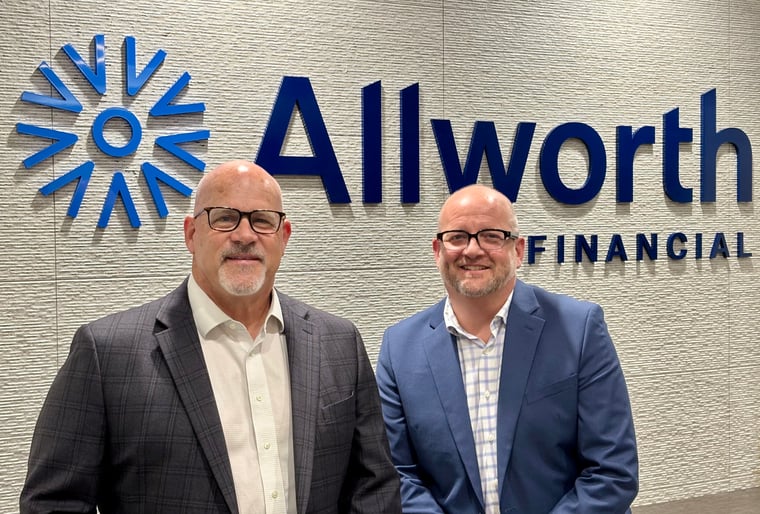
The One Thing That Can Wreck Your Retirement—Even With Millions Saved
On this episode of Simply Money presented by Allworth Financial, Bob and Brian explain why having millions saved for retirement still doesn’t guarantee financial freedom—and how many high earners unknowingly sabotage their own retirement plans through lifestyle creep, unchecked spending, and poor cash-flow awareness. They also discuss the psychological dangers of sudden wealth and inheritances, why some people lose massive windfalls within just a few years, how to thoughtfully manage newly inherited money, and the smartest order to draw income from pensions, Social Security, deferred comp, and investment accounts in retirement.
Plus, they break down what employees should be doing before a company IPO or liquidity event and the hidden costs that can turn a dream vacation home into an ongoing financial burden.
Download and rate our podcast here.
Well, we hope everyone had a nice, long Memorial Day weekend. And, you know, as always, we thank all of the families out there who have sacrificed loved ones over the years and decades to defend our freedom here in America. We are truly grateful for your family's service and are grateful to you as well. Back to some news here on the economy, Brian. Consumer sentiment. U.S. consumer sentiment fell to a record low number in May, underscoring those higher gas pump prices and rising costs from the ongoing U.S.-Iran conflict, and that's continuing to weigh on consumers' minds here throughout the American economy, Brian.
Brian: We appear to have a disparity between what people think and what's actually happening. The economy is actually looking halfway okay, but people don't seem to feel that way. University of Michigan's Index of Consumer Sentiment, that's the resource we always look to, it's been around for a very long time, showed consumer sentiment declining to 44.8 for the month of May. The number isn't all that relevant, but that's the lowest level on record, so that's not a good sign.
Bob: You mean, like, lowest record ever?
Brian: That's what they're telling us here. So, people are feeling worse about the economy. You know, now that we are worse than COVID-19, the financial crisis, and following 9/11. This is not surfacing, of course, in the stock market. It's not surfacing in a lot of areas we would normally expect to see it in the economy. But people seem to be anticipating bumpy times ahead for whatever reason. So, you know, Friday's reading from the University of Michigan also showed year ahead inflation forecasts rising to 4.8% this month. Remember, this is what people think. Well, compared to 4.7% in April and a preliminary reading earlier this month of 4.5%, so your average consumer thinks that prices are gonna continue to rise and are starting to make decisions based on that.
Bob: Yeah, I think this is an interesting survey. I don't put a whole lot of stock in it. Obviously, if you ask anybody out on the street if they're concerned about gas prices being at above $4.50 a gallon, you're gonna get 100% answer of yes on that. But meanwhile, we got retailer numbers last night, earnings and revenue reports from Home Depot, Target, you know, Walmart. You know, people are still spending money. The airports are full. The restaurants are full. People seem to have money in their pockets and spending it. But I totally get, you know, people are a little concerned about what could inflation look like moving forward if we don't get things, you know, settled in Iran. So, it's one survey number, interesting to keep an eye on. And, yeah, if we have oil at 100 bucks to 120 bucks a barrel for an extended period of time, yep, that is gonna manifest itself in ongoing inflation.
Brian: Yeah, there are some, longer term is a little bit better. So, the survey phrases questions in kind of timeframes. So, when asked about the longer term inflation expectations, that rose to 3.9%. So, that's a percentage point lower than where we were. That was in May, up from 3.5% in April. That's the highest level since October '25. So, still high. So, in other words, this is a long-winded way of saying people think, in the shorter term, inflation's gonna be more of an issue than it will be in the longer term So, long-term inflation expectations have hung consistently higher than the levels around 2.8% that we saw in 2019 and 2020, but well above the 2.8% to 3.2% range we saw in 2024. So, again, people are anticipating inflation to be higher in the short run and still high, but not as high in the longer term.
Bob: Yeah, you know, obviously, we're heading here into the midterm elections later this fall. So, you know, expectation of inflation and how people are feeling about inflation and gas prices is certainly gonna be an issue here come November. All right, moving on now to the Federal Reserve. Kevin Warsh is now officially the new head of the Federal Reserve, sworn in on Friday. At least President Trump, according to the media, is saying that he's gonna leave him alone. That was a big story when Kevin Warsh was first nominated. I mean, we've talked about it often on this show. The president, you know, just really bullying Chair Powell about lowering rates, kind of in spite of what the economics dictated and the data dictated. And, you know, Kevin Warsh is now in there, again, President Trump's handpicked guy. I know he expects rates to come down.
But I think, you know, a lot obviously has changed from the time Kevin Warsh was nominated to now him taking, you know, office. A little thing called the Iran war has taken place. And, you know, I think Kevin Warsh is gonna be data-dependent just like all of them are. And, Brian, we're seeing, you know, the probability now starting to rear its head of a rate increase in the short term rather than decrease. Obviously, President Trump has a lot of other things on his plate now, you know, with Iran, but this will be interesting to watch as well because of some of the drama and rhetoric and everything going on with the Fed that we've been talking about for, you know, well over a year now.
Brian: Well, he says he'll leave him alone. I'm still in a, I'll believe it when I see it, because there aren't very many of President Trump's handpicked officials who haven't, at some point, gone under the bus for one reason or another whenever things don't work out the way The President would prefer. So, you know, remains to be seen there. Now, as for Wall Street, Wall Street investors are betting that the Fed is gonna raise rates this year. So, they would be in support of the idea that, yes, President Trump is gonna let Kevin Warsh alone and let him react to the economy as he sees fit, which is fairly obvious right now.
If we are a continued rising rate environment, well, then the next move for interest rates, if anything, is gonna be up, not down. So, Wall Street investors are betting that the Fed's gonna raise rates. The Fed Watch tool is now showing that as well, but not until its final meeting in December after midterm congressional elections. Go figure. We don't want that talking point during elections. So, you know, the catalyst for this change of heart among Wall Street, that was a speech by Fed Governor Chris Waller last Friday, in which he said, and I'm quoting here, "You can no longer rule out rate hikes further down the road if inflation does not abate soon." That's not rocket science, Bob.
Bob: No.
Brian: We're in an environment where that's the tool you use, right? If I'm trying to hit a nail into a board, I'm gonna use a hammer, not a screwdriver. So, we need to make sure we still kind of stay rational here despite, you know, President Trump's campaign promises of lower interest rates basically forever. Is what I remember him talking about.
Bob: Yeah. And so, I think this all comes down to when this stuff gets, you know, resolved with the Strait of Hormuz and oil flowing together again. We're not saying anything that everybody doesn't already know out there. It's just gonna be very interesting. The timing of how this whole war gets negotiated, ended, whatever you wanna call it, between now and the midterms, because time is flying and November will be here before you know it.
All right, another topic we wanna cover now that we're through earnings season. It turns out the Magnificent Seven stocks aren't the only shining lights here anymore. The companies that are not in the Magnificent Seven are starting to contribute more to earnings growth than a lot of these Magnificent stocks themselves have been doing. Brian, you and I have talked about this for six, seven, eight months now, and we're actually seeing the data bear this out.
Brian: Yeah, we've talked about... I'll be honest, Bob, I've gotten sick of talking about the Magnificent Seven because, you know, it's the same thing again and again. But actually, this morning's headline drives in the other direction from the standpoint of, well, the S&P 500 is primarily driven by these seven companies. Now, we're going the other way.
So, Magnificent Seven companies drove the first quarter S&P 500 earnings per share growth by about 63%, while other companies gained 17.2%. Now, that 17.4%, while it does still pale in comparison to, you know, what the Mag Seven's putting up, that's the highest earnings growth rate for those companies since the fourth quarter of 2021. So, the whole point of this is, basically, that our bench players are contributing more to the S&P 500 than they have in the past. At the moment it's not only about the superstars.
Bob: Yeah, and again, we've talked about this as well, and I think we're gonna be continuing to talk about this, you know, AI. This is gonna be a productivity boost for all companies that are smart enough to get on board and integrate this into their daily operations, and we're starting to see that, 17.4% earnings growth for companies that are not in the Mag Seven. That's a wonderful report card most recently, and we'll see what happens here as we proceed throughout the year.
Brian: Now, it is. I think this is the point we were talking about earlier when we first kicked off this segment here about the disparity between what consumers are saying based on the University of Michigan survey, and what the economic results are. So, S&P 500 earnings overall up 28.4% for the first quarter when you're combining the actual and the estimated results. Some of those gains, Bob, have come from areas that don't get the same attention as big tech. These other earnings, so we talked about the Mag Seven, well, what are the other ones?
The materials industry that's coming in a surge of demand for things like fertilizer and lithium. Well, go figure. That's due to some of the energy shocks and things we've had. Natural gas is a huge component of fertilizer, so there's a pretty big demand, I think, as people are stockpiling things kind of staying ahead of the headlines there. Ten of those eleven industry sectors reported earnings growth with growth for most of them in the double digits. So, again, the whole point of this is the economy is broadening out. We are seeing economic success in different sectors than the ones we've seen before. However, consumers don't seem to be seeing it, or are having a very different experience based on the way they're talking to the University of Michigan.
Bob: Yeah, and it all depends on who they talk to and which questions they ask. You and I don't know that. I don't think we need to spend a... Well, I'm gonna speak for myself. I never put a whole lot of stock in the Michigan consumer sentiment. I look at earnings, I look at revenue growth, I look at how people actually spend their money, and whether they have money to spend, and it appears that they do. But, hey, we get these reports all the time, you know. We have to talk about them because it does move markets. And I think the main point we're trying to make here tonight is relative, as you said, to the broadening out of the economy, all of these industries throughout the economy are generating positive earnings growth. All of this is fantastic news if you have a truly diversified portfolio.
Brian: Yeah, and I wanna throw out there too, let's kind of knit some things together with what we've been talking about so far. The other piece of this is, remember, we have a changing of the guard at the top of the Federal Reserve, and we're gonna see some probably different behavior than we've seen in the past. So, let's talk a little bit about, you know, this. I mentioned Chris Waller, the one Fed governor that, basically, was pointing out, he was the loudest voice saying that we should probably be on the lookout for rate hikes coming soon.
He's not new to this. He was a driving force behind the three rate cuts we had in the second half of last year. So, he's not necessarily somebody who has been, you know, an inflation hawk, always wanting to raise rates to bring inflation down. At that time, he was arguing that the U.S. job market was weak and it needed support. And then, of course, what sealed the deal for him was we did in fact get a sufficient slowdown in inflation that gave the Fed cover to actually lower rates. So, the point of all this, Waller is arguably the most influential Fed official right now with Jerome Powell's chairmanship having ended and Kevin Warsh having not quite established himself, yet. He's the loudest voice, and he's the one that's saying, "Heads up, we might be looking at rate hikes."
Bob: Yeah, I'd love to be a fly on the wall in those Federal Reserve meetings. I don't know who's more influential than... It's gonna be interesting to watch. I just hope we get this Iran situation figured out for all parties involved. All right, what's the one thing that can wreck your retirement even if you've saved millions of dollars? It's probably not the stock market, and it's not even inflation, and it's not taxes. We'll explain what we're talking about next. You're listening "Simply Money", presented by Allworth Financial on 55KRC, THE Talk Station.
You're listening to "Simply Money", presented by Allworth Financial. I'm Bob Sponseller along with Brian James. If you can't listen to "Simply Money" live every night, subscribe and get our daily podcast. Just search "Simply Money" on the iHeart app or wherever you find your podcasts. Straight ahead, from the smartest way to draw income in retirement, to the emotional side of inheriting wealth, we're tackling the financial decisions that can literally shape your future for decades.
Well, there's a new retirement study out there that Brian and I think often gets misunderstood if you just read the headline, and the headline here is, "Fewer than half of Americans are on track to maintain their lifestyle in retirement." And a lot of people hear that, and they immediately think, "All right, here's another segment. They're gonna tell us about, we need to save more, save more, save more. We're not saving enough." That's not the case at all. Brian, let's dig into this newest retirement study because I think this is a great example of, read the actual article, not just the headline.
Brian: Not the headline
Bob: ...or the clickbait.
Brian: Yeah, read more than the headline. Takes a little more energy, a little more time, but if we're gonna react to these things, we probably gotta be a little better informed, otherwise, we're just burning energy for no reason. You know, so a lot of people who struggle in retirement, Bob, actually do have substantial nest eggs. And we meet people all the time with $2 million, $4 million, sometimes even more than that, and yet they're still somehow financially stressed. And there's a lot of people out there who are hearing, who are screaming at their windshields right now because they're saying, "If I only had that amount of money, then everything would be fine. I'd never have another worry again." However, we're talking about some people who were once in that situation, and now, do have those dollars, and they're still finding stress.
So, the reason behind this, well, lots of people know their net worth down to the penny, right? There's plenty of people out there who bring up... Especially when the market's rising. When the market's on the way up, it's fun to watch it go up. Nobody watches it on the way down. But we look at it every day when we know that it's gonna be a bigger number than we've ever seen before with our names attached to it. But the key here though, Bob, is that they don't know how much they spend. So, this is really, really common.
Let's take a hypothetical through here. You know, honestly, if people are listening and thinking that this isn't me, well, there's a good chance that we are talking about you. You know, here's our hypothetical couple. Let's say they're mid-60s. Maybe they just sold a business. They've been diligent savers for decades, whatever. Somehow they've got about $5 million, and they think, "Well, we've made it," right? "This is a big number. We've never seen this much money in our lives, so we must be fine." And then we ask them a very simple question. "Well, what do you spend every month?" And we get what? A wide stare.
Bob: And this is where you get to say, "Hey," Brian, you get to tell your client, "yeah, you got $5 million, but you're really broke," right? You're spending like you have $10 million. It's an emergency. So, what's the problem here? How can you be worth millions of dollars and still not be financially secure in retirement? What's the problem?
Brian: Exactly. Because you might be worth millions, but you're spending like you have tens of millions of dollars. And a lot of people don't even know this. Some people are stressed out for no reason because they are fine, you know, with their couple million dollars, whatever they have, but they have no idea what they're expecting out of it. And so, we start to analyze this. You know, so what are you spending every month? Well, is it $12,000? Is it $15,000? Well, let's look at the details. There's a primary home that needs to not fall down. There's a condo in Florida. Both of those come along with property taxes, insurance, and then a hurricane hits, and all that stuff goes up.
Travel back and forth, dining out, gifting to the kids, all the things that we've got time to do, and we wanna live our lives and all that which is, which is why we're here. But it all stacks up. Golf memberships, healthcare, car leases, country club dues, of course, the Amazon cardboard boxes that we have to have on our porches every single day, streaming to every network that we pretend is we've cut the cord, and thank God we're not paying the cable company anymore. We're just gonna pay these fifteen different subscriptions. All that stuff adds up. And suddenly, we're spending $30,000 a month, $360 a year before taxes in spending, not income. Now, all of a sudden, that $5 million, Bob, that math starts to look a little rickety.
Bob: Yeah, and I'm sure no one out there listening to this show right now is feeling sorry for anyone who has $5 million and wants to spend $360,000 a year. It's like boo-hoo-hoo. But, hey, we talk to people like this sometimes, and they are shocked when we ask them a simple question, what is your lifestyle gonna be in retirement? How much money do you need coming in every month after taxes once you stop working? Because a lot of these people that have these high net worths and high lifestyle, they have high paychecks, and they're like, "Hey, I'm maxing out my 401(k). I'm making a boatload of money, high salaries, high bonuses, all that. I'm gonna be absolutely fine," until it dawns on them that you gotta build and turn a pile of money into an income replacement sometime, and that's when the sticker shock comes in on whether the plan will actually hold up when the paychecks stop.
Brian: And I think, Bob, it's really important to actually not just, you know, lick your thumb and hold it up to the wind to get an idea of what the spending is. I think it's really important for pending retirees to really look at the details of what they spend. Because we all, I think we all kind of lie to ourselves a little bit, and I'll include myself there. I haven't told my story in a while, so I'm gonna, I'm gonna tell you my Kroger story again.
So, I, at one point, just about 10 years ago, wanted to know, you know, "Where is our money going? Why do we spend so much on groceries?" I really didn't know what we spent on groceries. I just knew I felt like we went there all the time, and it had to be a lot of money. So, I called the Kroger loyalty people, and I asked them for my entire report. I said, "Give me what you... I know you track every time I punch my phone number in."
Bob: Of course, you did. You're a financial advisor.
Brian: You know how I do this, right? You know how I roll. But they did. They sent me. You know, because we give them our phone number every single time we buy food and whatever. And so, they sent me this 750 page, I'm not exaggerating, 750 page PDF, and I had to go through heck and high water to get it into Excel. But I did it, and I broke it all down by categories. Because here's what I thought, Bob. I thought, "Well, I got little kids. We're buying cereal. We're buying all this pre-packaged garbage and blah, blah, blah." And it wasn't that. It was it was cheese. Cheese was by far the largest category. So, apparently we're a bunch of cheese eaters.
But the larger thing I learned out of that, Bob, I had a number in my head. I thought, "You know what? Here's what we spend. There's a couple big trips a month, and then there's probably one or two every week." Then I looked at the data. We're at Kroger's every other day spending $20, $30, and it literally came up to twice as much as what I had in my head. So, my point of this is, at some point, if you really wanna feel confident in your finances, understand that spending. Dig deep into that checking account, dig deep into those credit card reports, see where it's going. This is not about building a budget and staying to it. This is about, at least at one point in your life, understanding where it goes. You've gotta start there.
Bob: And maybe consider stopping eating cheese. You know, there's a dual benefit there.
Brian: Never.
Bob: You could save a bunch of money. And Brian, you do look a lot fitter and trimmer, come to think of it. You do look like you've dropped about 15 to 20 pounds.
Brian: That is so true.
Bob: Is that from getting rid of the cheese?
Brian: I think it's the opposite. Havarti till I die.
Bob: All right. Here's the Allworth advice, retirement success is not determined by how much money you've accumulated, it's determined by whether you understand how much your lifestyle is actually going to cost to maintain during retirement. Coming up next, why sudden money can actually make you broke, and how to make sure your windfall doesn't just blow away. You're listening to "Simply Money", presented by Allworth Financial on 55KRC, THE Talk Station.
You're listening to "Simply Money", presented by Allworth Financial. I'm Bob Sponseller along with Brian James. Well, everyone dreams of a big financial windfall, a sudden inheritance, a business sale, maybe that stock you've been sitting on that finally goes through the roof. But new research shows that suddenly, sudden money, you know, money that you can get your hands on quickly, can actually destroy wealth faster than it creates it. Brian, there's some new research out there, and walk us through it today
Brian: Yep. Newsflash. New research, one in five people who inherit a million dollars or more lose half of it within five years. Well, every now, we hear these stories every now and then from people who, you know, win the lottery, those kinds of things, and you hear the horror stories about how they just weren't prepared for it and their brains simply couldn't handle that situation. That's not bad luck. It's normally bad behavior, bad decision-making. This isn't just lottery winners, though, Bob, it's people who sell a business, you know, and really anybody who has some kind of a massive windfall where a bunch of cash falls out of the sky with no strings attached at a relatively short period of time. This can be cashing out of a career, getting a large inheritance, those kinds of things.
The faster the money comes, Bob, the faster it can leave. So, we're gonna kind of jump into the different effects here that can happen and how to handle it. So, if you're in this situation, we're gonna... We'll start off with the first one the, the windfall effect here. What really happens when you get a windfall? Well, psychologists have actually done some work on this. They call it sudden wealth syndrome, which sounds completely fake, but this is a real thing. You literally go from thinking in terms of thousands of dollars to thinking in millions overnight, and this will give your brain whiplash.
Think of it this way. You, you've been driving a nice, compact, reasonable car for 20 years, and all of a sudden, you have the keys to a Formula One race car that you have all the complete freedom to go do whatever you wanna do with. Obviously, it's pretty powerful and fast, but if you don't know how to drive that kind of car, you're gonna have some kind of accident. So, it happens financially. The reigns come off, and all of a sudden, you don't have the same sets of habits and the guardrails because everything just drops. You think, "I can afford it," and you can.
We see this all the time with this kind of a windfall. It's very easy to throw money at problems when there is money around with which to do so. But then if that gets baked into the ongoing spending, you know, that can come alongside. The investments start to get riskier because I feel like, "I've got a bigger cushion. I can afford some riskier stuff." And a lot of the discipline that you had that got you to this pace starts to go away. So, eventually, you get to a point where that money is controlling you instead of vice versa.
Bob: It's funny you brought up that Formula One race car analogy because that reminds me of an actual client situation. You know, business sale, millions of dollars coming in the door. And this client went from buying one kind of exotic collector car to now they own, like, 8 to 10. Well, what happened after that? They needed to build a big barn or garage to hold all the cars. And then you've got the trips going to custom car shows, transporting these cars. You know, it becomes a lifestyle. You're hanging out with people that can afford, you know, 8 to 10 different cars and shipping them all over the country. And it leads to our next example, which is just lifestyle creep or lifestyle inflation. You treat yourself a little bit, and then all of a sudden, you've really ramped up into an overall lifestyle that costs thousands and thousands more dollars per year. And some people forget to just check and say, "Can we really afford this?" Is this sustainable, Brian?"
Brian: Yeah, that big house comes along a lot of times with maybe it's a homeowner's association fee that you didn't really account for. Definitely property taxes can sneak up. And I'll throw another one out there. Ever spent $15,000 on a tractor to mow your new acreage? You know, there are lots of things out there that you don't really see coming until you're actually living in this situation. So, we've seen people spend like they won the lottery, except they really didn't. They inherited a million or more, and it became $10 million in their minds. But not to mention, you have to pay taxes on all these things. So, it's not nearly, you know, as a bottomless supply of money as it seems like. It's kind of like eating your Thanksgiving dinner every night. It sounds great at first, but eventually, it's gonna make you throw up. So, indulging ourselves too much can kind of ruin the fun that comes along with it.
Bob: All right, here's another big behavioral area to look out for, and it's just the area of overconfidence. People that make a lot of money or have sold a business for a big chunk of money, you know, their mind says, "Hey, I made a fortune. I'm really good with money." But, Brian, you and I know this all too well. There is a big difference between the ability to make money in some other industry versus actually managing money once you've got it in your account.
And a lot of people have to learn that lesson the hard way. They jump into a bunch of private investment deals, you know, get over-allocated to crypto or high-risk startups. They forget that wealth preservation is a completely different skill set. And I think sometimes, Brian, these people are bored by just, you know, traditional asset allocation stuff. They're addicted to the adrenaline rush, and they always constantly need to be going out and taking risks. And you just gotta put the governor switch on that sometimes to keep from losing something that you've spent a lifetime building.
Brian: Making money is not the same as keeping money. It's two different mindsets, two different approaches. So, people who build wealth over decades, these might be entrepreneurs, savers or just disciplined investors pumping money into their 401(k)s, 403(b)s for years. They tend to respect money more because they know how hard it was to earn. Then we see, you know, sometimes it's Generation 2 that doesn't have that same benefit of having built it from nothing, and so, doesn't value it as much. It appears to them to have been easy to acquire, therefore they treat it as such.
So, what should we do? First step, Bob, build a team. Make sure you've got people around you, a financial planner to quarterback everything, a CPA or, you know, some kind of accounting outlet to help you with the taxes, and an estate planning attorney if this is a truly a significant pile of money. Not the people selling you something. These are people who behave in fiduciary manners on what will help you with their future. So, the next step is figure out what you want. Once you've got your team in place, now, think about what it is that you want. And this also assumes that we didn't go out and do a bunch of things immediately. Really, I'm gonna call it, step zero is don't do anything. Just stop and think before you build that team. Then you need to have that discussion about, "What is it that I want. Do I wanna use this to retire earlier? Do I wanna benefit myself, my family, maybe charities or something like that, generational wealth?" Without some kind of purpose, money tends to get spent just because it's sitting there.
Bob: Here's the Allworth advice, wealth is not a finish line, it's a responsibility. The more you have, the more discipline it takes to keep it. You're listening to "Simply Money", presented by Allworth Financial on 55KRC, THE Talk Station.
You're listening to "Simply Money", presented by Allworth Financial. I'm Bob Sponseller along with Brian James. If you have a financial question you'd like for us to answer, there's a red button you could click while you're listening to the show if you're listening on the iHeart app. Simply record your question there, and it will come straight to us. Dan in Sharonville leads us off tonight, Brian. He says, "I'm approaching retirement with a pension, Social Security, deferred comp, and several investment accounts. And I honestly don't know which income sources should be tapped first." Have any advice for Dan?
Brian: Yeah. Well, so you've got a lot of pieces to the puzzle here, and fortunately, that's what we spend most of our time doing. When people come in and we do build a financial plan, and we literally, the first part of it, when I first build something for somebody, it really feels like we got a box of jigsaw puzzle pieces. We just dump them all on the table. Let's get it all out where we can see everything, and let's start with the ones that look like they might be an edge or a corner. So, that's what we're doing here. The easiest thing to do is identify the predictable stuff, which is what this is. Now, your income sources are all different. One of the biggest mistakes retirees make is treating them the same. They're not. The order you can tap into them has a huge impact on taxes, portfolio longevity, and even your Medicare premiums, right? That's a moving part, but we don't start there.
So, here's the framework we walk through. First off, cover those fixed expenses with guaranteed income whenever possible. This is what I meant when I said, let's look for those puzzle pieces that look like they're an edge. The obvious things cover the obvious expenses. That's your pension, Social Security, that's the foundation. They're predictable, and they take that pressure off your investments during the bad markets if you can kind of assign those there. Next would be deferred compensation, those tax-deferred retirement accounts. This is where strategy matters. Lots of people wait a little too long to withdraw from those accounts, then they get hit later with large Required Minimum Distributions.
We get spooked by the fact that, "Well, this is ordinary income. Don't wanna touch that because ordinary income is our least favorite of all the taxes." And we don't have a favorite tax, but there is a ranking of least favorite to most hated. But anyway, so RMDs will sneak up on you. All you're doing, if you are ignoring those taxable accounts, then you're just gonna create, if you're grumpy now thinking about it, wait till you actually have to do it at age 73 or 75. So, there's a sweet spot in those early retirement years before Social Security starts and before RMDs kick in. Taking those moderate withdrawals, you know, using those to pay your bills and paying taxes can actually reduce your lifetime taxes because you'll be doing it at a lower bracket.
But again, this all starts with knowing exactly, you know, what your expenses are and what you need. Those Roth accounts, those are the last dollars touched because those are gonna grow tax-free, no taxable income. Those are the best legacy assets for your heir. So, yes, hopefully, that helps. There is a sort of an order of operations you'll wanna think about there, Dan. Let's move on to Jonathan in Hyde Park. Jonathan says he recently inherited about $2 million from his parents, and he feels guilty spending any of it, and he's wondering if that's a common thing. So, you know, how do families thoughtfully integrate inherited wealth into their financial lives instead of just freezing, Bob?
Bob: Well, Jonathan, the first thing I'd say is don't feel guilty at all. And it sounds like, you know, the passing of your parent here was relatively recent. So, you know, we're certainly thinking about you. It's a big adjustment. My father passed away several years ago, and there's not a day that goes by that I still don't think about him. So, in terms of advice, here's what we often find especially when kids inherit a large chunk of money. It's a life-changing amount of money a lot of times, and with that, you know, you're juggling a lot of different things throughout your brain.
First of all, you're missing your parents. Most people would much rather have their parents still with them than the money. And, yeah, you're thinking about, "Hey, if I spend any of this money, I'm starting to spend this money that really still belongs to mom and dad." And I think that's a natural reaction. Don't feel bad about it. I think it's just a normal part of the mourning process. I say all that to say, don't be in any hurry whatsoever to make any major decisions. And that's often hard for people to do. They think, "Hey, if I don't get this money invested in something right away, I'm gonna miss out on huge investment returns." Or, you know, you might be getting pressure from family members. You might be getting pressure from financial advisors on, "Hey, you should put your money here or there or buy this thing or this product." I would just say slow down and be very diligent about finding a good fiduciary financial advisor to walk you through this process.
And that process should really start with what are your personal goals on what you're trying to do with the rest of your life for your family and your kids. My guess is that's what your parents would have wanted you to do anyway, and just take your time. And as you can mourn through the loss of your parents while you're building your own financial plan, I think some decisions will become clear and make a lot of sense about how to deploy those assets over time. And again, you don't have to do it all at once. You can take your time and just be very intentional about your why about which decisions you're making. Hope that helps. All right, let's move on to Mark. He says, "My company may go public in the next few years. And a large portion of my compensation is tied to equity. What should I be doing before a major liquidity event happens instead of just reacting afterwards?" Brian?
Brian: Well, Mark, congratulations for being involved there. That sounds like a pretty fun ride. I hope you're enjoying, you know, what you're helping build there. But here's how to think about this. If you think that liquidity event is coming, really the biggest mistake is waiting until after the IPO. Now, so you're already in a good shape here because you're thinking about it beforehand, you know, to start planning. So, by then, if you've waited, a lot of the best tax and diversification opportunities can be gone.
First thing to remember is concentration risk. A lot of your net worth is tied up in this company now, or it's about to be. Employees sometimes convince themselves that they're diversified because they've got retirement accounts and savings and all that, but a lot of their future wealth depends on that one company stock. Sounds like that's coming your way. Not to mention, remember that that company is also where your paycheck comes from, too. So, you've got an awful lot of your life tied up in one place. Make sure you are diversified where you can control it.
You know, for example, if you've got shares in your 401(k) as well that you've had for a while, then you might wanna look at reducing those to something else. Before anything else happens, get very clear on what you have. So, these could be incentive stock options, non-qualified stock options, restricted stocks, founder shares. Each of these has a different tax treatment, vesting schedules, and different planning opportunities. So, then you can start modeling that tax impact now, that liquidity event can push you into a much higher bracket that can trigger net investment income tax at a certain income level, phase outs of other things alternative minimum tax exposure. These are the kind of things that you wanna be questioning your... You got to talk to your tax preparer people. If you don't have one, get one. This is gonna be the year you're not gonna wanna use TurboTax because you're gonna have some moving parts.
You also need an exit strategy before this gets too emotional. After these IPOs, a lot of times, employees become, you know, too emotionally attached to the stock because of what just happened, and they hang on to far too much for far too long. You know, the road, the road to wealth is littered with IPOs that didn't hold their value. So, just think beyond, you know, that large sum of money to, how do you want to control this for your family?
Bob: Coming up next, many of you may have been traveling all over the country to your favorite vacation spot over this long weekend, and you might be sitting there literally today saying, "Hey, now's the time to pull the trigger on this vacation home." Brian and I will get into some of the pros and cons of those kind of decisions to hopefully help you out before you sign on the bottom line. You're listening to "Simply Money", presented by Allworth Financial on 55KRC, THE Talk Station.
You're listening to "Simply Money", presented by Allworth Financial. I'm Bob Sponseller along with Brian James. Brian, let's talk about that second home purchase. We have a lot of folks come into the office and talk to us and say, "Hey, on paper, we can afford it. We can afford to buy this home or this condo or whatever," and they freely admit they're only gonna use it a few months of the year. And then we get into a list of pros and cons because, what some people will make the mistake of doing from time to time, is they'll buy that second home that they're gonna sparingly use, and they can suddenly, without knowing it, become asset-rich and cash flow poor at the same time, and we try to help people not do that.
Brian: Yeah, that's right. So, this is something that a lot of people kick around. And I'm not against it at all. There's just a lot of moving parts, and it's not spending. People will say something, "Well, I don't wanna spend this money on the... We really want it, but it feels like we're spending too much." This isn't spending. It's just investing in a not great investment.
Bob: But there's other people that will call it an investment. They'll rationalize that decision.
Brian: They ain't making any more of it, Bob, real estate
Bob: Well, they'll call it an investment. And let's talk about what's involved with that "investment" in terms of checks you have to write.
Brian: Yeah, so of course, what we're talking about there is, now you've bought something that's...you bought a crying baby. It's always going to need attention. Something's going to... Again, these are not... I'm about to do this ourselves, right? I know you've done it. Now, this is the circles I've spun myself in. Something's gonna die. Water heaters go down, furnaces go down at the wrong time. If it's far away, now you got a problem. You're gonna wanna make sure you know somebody in the area or you have sensors and things in there so that something can tell you there's a water leak, and all that kind of stuff.
It's not all about money, right? If this is something your family would enjoy, and you know you can get a lot of years of enjoyment and togetherness out of it, then absolutely do it, but go in eyes wide open. You know, beyond mechanical things breaking, here's something else you should pay attention to. If that property hasn't sold in a long time, go look on the local county's tax assessment site and see what they think it's worth. Because what you're about to buy it for, presumably, is at today's kind of ridiculous real estate prices, and you're about to up the value of it.
I would look clearly, if there's any sales history on that property at all, go look at, when it sold, and go look at that year's taxes, did the taxes spike right away, or did they stand pat? A lot of municipalities and counties will not update right away. Some of them will jump on it immediately and say, "Oh, here's the new valuation. Somebody paid this for it, therefore here's the property taxes." Some of them will not. So, don't be blindsided just because the former owner tells you what they have been paying in property taxes. That is not necessarily what you will pay. It will go up in value and the taxes will increase in terms of a cost. The question is, when? So, just make sure you understand that and work that into your budget.
Bob: Yeah, the other thing to work into this whole thing on what you pay for it, and I've seen this happen more and more recently, is the whole HOA world. A lot of these HOAs have not been well-managed, and they are assessing the owners, and people hide that information, you know, the financials of the HOA, when was the last assessment? What's the condition of some of the roof, the siding, some of the major things in those complex, condo complexes? You wanna know that on the front end before you buy. Because, you know, if you built your budget and your plan one way, and then you get saddled with a $20,000 assessment for a condominium complex, well, that changes the game in terms of how much you're truly enjoying this retirement or this vacation home.
Brian: Do yourself a favor, go for a walk in the neighborhood and stop the people who are walking their dogs and ask what it's like to live there and if there's anything they have concerns about.
Bob: That's great advice. Thanks for listening tonight. You've been listening to "Simply Money", presented by Allworth Financial on 55KRC, THE Talk Station.
Insights for Complex Wealth Decisions
Join our email list for exclusive commentary from our Chief Investment Officer, early access to expert-led webinars, and your complimentary Wealth Planning Checklist for Complex Portfolios.
We take your privacy seriously and respect your privacy choices. By submitting this information you agree to our Terms of Use Agreement, Privacy Policy, and to receive important notices and other communications electronically.