
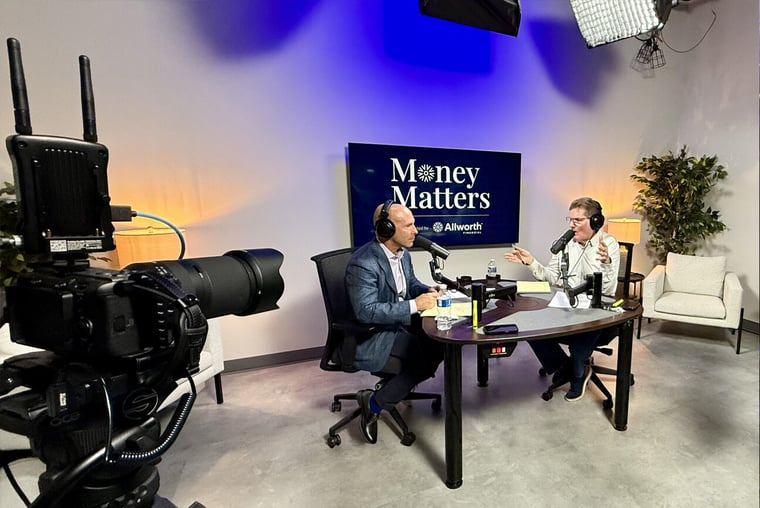
Beyond Index Funds: Advanced Tax Strategies, Direct Indexing & Smart Trust Planning
This episode of Money Matters explores advanced tax strategies that go beyond traditional investing to help high earners and retirees maximize efficiency, reduce taxes, and create smarter, more tax-efficient income streams.
With Pat out this week, Scott and Allworth advisor Mark Shone break down how strategies like direct indexing, long/short investing, and tax-loss harvesting can unlock new opportunities—especially for those with larger, more complex portfolios.
Plus, Scott and Allworth’s Head of Private Wealth Strategies, Simone Devenny, dive into trusts, from simple living trusts to more sophisticated estate planning tools.
What You’ll Learn:
- How direct indexing works—and when it can outperform traditional index funds
- Strategies to generate tax losses and offset future gains
- Smart ways to manage concentrated stock positions
- How options strategies can help increase portfolio income
- The key differences between revocable and irrevocable trusts (and when to use them)
Join Money Matters: Get your most pressing financial questions answered by Allworth's co-founders Scott Hanson and Pat McClain live on-air! Call 833-99-WORTH. Or ask a question by clicking here. You can also be on the air by emailing Scott and Pat at questions@moneymatters.com.
Scott: Welcome to Allworth's "Money Matters". Scott Hanson. Pat McClain is on his final week of vacation, so he'll be back next week. But again, we've got Mark Shone joining us. I got such good feedback after the first two episodes that Mark did with, and that I thought would have him on the third one here as council.
Mark: Let's do it again.
Scott: Yeah. And also, later in the program, I've got an interview with Simone Devenny talking about how to deal with complex trusts. So, if you have a trust, maybe even just a living trust, we're just going to go over some of the basics of trust and then some of the more complexities on when they might make sense. So, I think you'll find it really helpful. I enjoyed the conversations I had with Simone and you as well.
But with Mark, I want to talk with you, Mark, thanks again for joining us today, about moving beyond the index, and index funds is what I mean by that. So, if you think about... And you've been in the industry about as long as I have been, and so we're...
Mark: Thirty plus years, I'm still staying.
Scott: I'm 59. I've been in it since out of college. I've been in this industry a long time. And when I first got started in the industry, it was all these actively managed mutual funds, and your job is to pick the best mutual fund or whatever. But everything's moved to indexing. The vast majority of individual investors' assets are in index, just in index funds, I should say, not just an index, but in index funds. But for those with larger portfolios, maybe larger than a million or $2 million or $3 million or more, there are some strategies beyond the index that can be quite profitable and create a lot of opportunities, planning opportunities to help people with their overall finances.
Mark: Yeah. You have to be effective in implementation, but most of it is around tax. So, indexing became very popular. There was a whole active versus passive and tougher active managers. That kind of was the shove behind making index investing really popular and their tax efficiency.
Scott: Yeah. You're not getting these big capital gain distributions every December.
Mark: Correct. So, the evolution as you gain larger portfolios and have more complex tax situation is not just to be tax efficient, but really to be, what I call, tax effective. So, some of the things and the strategies that you can use, one is direct indexing. So, instead of owning the index, we'll use the S&P 500, instead of owning the S&P 500, you can actually own the underlying individual stocks that make up most of the S&P 500. And when the S&P 500 goes up 10%, not all of the 500 stocks go up 10%. Some of them go up 40% and some of them go down 10% and what have you. So, direct indexing just allows you to book losses within that index like performance. So...
Scott: And cherry pick which piece of the index you might want to sell or donate.
Mark: That's correct, yeah.
Scott: Or gift or give.
Mark: Donate, gift, book losses that carry forward forever, essentially, to do that. So, direct indexing is something that's come into play. The other one is dealing with concentrated stock, and you can use some strategies, long-short strategies. So, long-short being your long-sum part of the market and your short part of the market. And what that allows you to do is actually book capital losses that can then be used to pay for the reduction in concentration. So, if you have owned a bunch of Apple or Microsoft or NVIDIA or what have you, you can use those losses.
Scott: And you book loss because of your long-short.
Mark: Because your short positions are going to have losses.
Scott: Automatically, you're going to have... Any movement at all is going to trigger a gain and a loss.
Mark: That's correct. And you're using leverage there. So, let's just say, I'll just use some round numbers, you'll be 150% long, meaning take a dollar and you buy a $1.50 worth of stock, and then you're 50% short on the other side. So, your net exposure is the market, but it allows you to book losses, so it's a strategy that makes sense. That's in a separately managed account. And there's different levels of leverage depending on what kind of capital losses you want to take.
So, some people say, "Hey, I have to sell some assets to buy a house because my kid is going to college and I want to buy the house in that community. I have to create the capital to do it." And they're going to go to school in three years. So, you take some cash, you invest in a long-short strategy, and you accumulate $3 million of capital losses or a million dollars in capital losses. That allows you three years from now to sell the stock without any tax effect, creates the cash to buy the house. So, you're just creating cash flows in a very tax efficient manner. There are also strategies where you...
Scott: By the way, I was thinking, that'd be a nice college house for $3 million.
Mark: Yeah, the losses. I think they're doing a couple of things with that. Yeah. I wouldn't recommend a client...
Scott: I wouldn't recommend it.
Mark: ...to buy a $4 million house on the college camp. The one that would be very popular...
Scott: That'd be the fraternity one, the house, yeah.
Mark: They'll be super popular and they won't go to school, so that'd be good. Then the other one is just, there are strategies where you can not only book capital losses while making money, but you can also book ordinary income losses. So, just the tax treatment of certain options and swaps, not to dive in too deep, but there are ways you can create ordinary losses. So, how would you use this? You take a million dollars, historically, you've been able to take about 30% of that in ordinary losses in a year. So, now you have $300,000 in ordinary losses. What does it give you the freedom to do? Maybe a Roth conversion. So, now, you're going to do a Roth conversion of $300,000. It's going to be offset by the ordinary income loss you can take.
Scott: And then you have a capital gain on the other side, or what do you...?
Mark: Yeah, you have some unrealized gains that are on there. You're actually going to take capital losses. If it's cash, you're just going to have losses, you're just creating losses. If you have a concentrated stock position or a portfolio that has a lot of gains, you're going to push those unrealized gains out that you'll have to deal with in the future. There's ways to do that. One is direct indexing with another part of your portfolio. So, there's ways to kind of tax manage this through. But if you're investing in cash, you're just creating losses in the portfolio, allows you to do Roth conversions.
So, a lot of the investing, there's effective and efficient. Effective is you get the portfolio invested in the allocation that's most useful to you, that makes the most sense. Whether it's stocks, bonds, cash, alternatives, etc. Like, you've got to get there. That's really important. Then there's efficient. And there's just a lot more strategies now that you can create efficiencies in the portfolio so that you're doing it in a tax-smart way. Some of these things weren't available years ago. So, the investment world's expanded. Put your brain around that, and implementation can be very, very tax efficient.
Scott: Yeah. And some of these strategies, they might've been around for a long time, but it might've been for the families with $100 million or $200 million or more. And now, they can be for families of a couple million or $10 million or $20 million.
Mark: That's correct.
Scott: It's the same kind of strategies.
Mark: Yeah. A lot of those become available to the registered investment advisory community, brokerage community, what have you. They've come down market quite a bit. It used to be just institutional for some of these managers, but, yeah, they've become available, so...
Scott: Yeah. And some of these are in the form of just a separately managed account. So, a brokerage account that some manager has the control to manage the account. And some are through some...
Mark: Some are hedge funds, yeah.
Scott: ...hedge fund strategy. What's the term? Oh, a hedge fund. It's just a structure of an investment that tend to be not as liquid. And before we went on the show here, you were talking about a strategy to generate income off a stock portfolio, whether it's an index funds you own or individual stocks.
Mark: Yeah. So, you can take a diversified portfolio of stocks, and they have their dividend rate and you have a bunch of unrealized gains there that are kind of in stock.
Scott: Let's say I'm moving into retirement. I've got my IRAs and I've got a brokerage account with...let's say, I've got a million bucks in my brokerage account. It's of stocks that I've picked over the years, capital appreciation on them all. I'm now going into retirement. I want some income. The dividend yields on it is, let's call it, 1.5%.
Mark: Yep. In short, you can add an overlay of options strategies there that create income, and historically, added about 4% of yield to an existing portfolio. So, you know, we've talked about before in previous conversation, you know, there's no free lunch. It's like, so what are the dangers there? It's important that you're still bullish on stocks long-term because it does put more short-term volatility in the portfolio. But if you're a long-term holder, and more volatility doesn't bother you, you can clip another, on average, 4% over time on top of a portfolio in income, which is pretty meaningful. So, if you watch your account statement have a little bit wider movements, you know, the highs are higher and the lows are a little bit lower, you can create income using options strategies.
Scott: Yeah. So, we briefly talked about a number of strategies. And I think this is just an example of, it's just financial planning, in a lot of ways, has become more complex, not less complex, with the amount of tools that we have available today. And it's really getting clarity on what is it you're trying to accomplish, number one, right? And then from that, to your point, what's kind of asset allocation makes the most sense? And then do we use indexing? Do we use this kind of strategy, that kind of strategy? What's going to be the most tax effective, both current and long-term?
Mark: It's, you know, you have to have access to an institutional-type platform first, right? So, you have access to all these underlying products. They're just levers. They're levers that you can pull as an advisor in the financial planning process. It says, "Here's what we're trying to accomplish from cashflow. Here's our tax situation. Here's the kind of growth we need."
Scott: So, why does so many advisors don't offer these?
Mark: One, they're complex. There's a lot of complexity there. You have to have a very integrated tax team and tax knowledge because they're not simple products. Some firms are just too small, they're not going to have access to some of these institutional products. Some of the products, you know, like that income overlay product is something we do in-house, so someone else is not going to have... They'll be forms of it in other places, but it's...
Scott: And I think some of these smaller shops, the challenge today... I mean, you came from a smaller shop.
Mark: I did.
Scott: Right? So... Mark Shone is one of our partner advisors. You joined Allworth three years ago?
Mark: Oh, it's almost 5, 2021.
Scott: Five years.
Mark: Yeah. May 1st, 2021.
Scott: So, yeah, Mark joined us through our M&A process, right? So, Mark took some chips, just like he advise his clients, took some chips off the table, rolled some equity into Allworth, became a partner in Allworth, and as a result, gave you more access. When you were on your own, part of the challenge is you need subject matter experts in-house. Because the complexity of you can't be an expert in all these things.
Mark: There's things you can't do, you know, at that time, $365 million in assets, that you can do at $37 billion in assets. You have access to more. Your platform is more robust. So, you know, when I made the decision to partner with Allworth, I looked at it very much like clients look at it when they're hiring advisors, you know, who are the stakeholders, and is their situation improved? And one of those things was, you know, is this better for clients? And one of the reasons that I felt it was better for clients is the platform and availability to all the levers that meet the client's needs.
Now, do you need the hedge fund for someone who's working in, you know, has their 401(k), and they're doing that, and maybe have a little ES. You know, employee stock purchase plan and they're getting some RSU's and, you know, they're in accumulation stage? Probably not. But do you need them as the asset levels grow and the complexity grows and the tax situation?
Scott: And you're at a point in life where protecting your assets is more important than trying to grow it.
Mark: Correct.
Scott: More concerned about not going broke than you are about becoming wealthier.
Mark: Yeah. So, it's not about, you know, having a fancier conversation at the cocktail party with your friends. It's about being more effective. So, that's when these tools become more useful.
Scott: Yeah. I appreciate the conversation. Thank you, Mark. Thanks for taking some time to be with us.
Mark: Yeah. Great to be here.
Scott: Anyway, let's start off here. And if you want to join us on the program, love to take your call questions@moneymatters.com. That's the email that you can send the address to send us an email, questions@moneymatters.com. We're in California talking with Flo. Flo, you're with Allworth's "Money Matters".
Flo: So, my wife and I are both W2 salary employees. We have two kids, 5 and 9. And my high-level question is when it comes to RSU's and bonuses that come in throughout the year, how do I determine the most effective way to allocate those dollars? And so, you know, there's the three main things that I've been looking at, but I want to give you kind of my financial numbers there, but that's the high-level question. So, high-level I'm 41. My wife's 39. Our annual gross is five 32k. My wife and I each make about 170k a year. And then that remaining 192k is that is essentially RSUs that vest throughout the year that I just sell upon investing and bonuses. And then in joint brokerages, we have four 56k my wife's 401(k) 600k. I have...
Scott: I hold on. You're going a little fast. $450,000 in brokerage account. How much in your retirement accounts?
Flo: My wife has 600k I have 545k. And then in IRAs, we have about 248k, and that's a combination of traditional and rollover and Roths.
Scott: And did you say you have children?
Flo: We have two children, 5 and 9.
Scott: And so, what have you been doing in the past?
Flo: Yeah, so right now, what I do is we have about 120k in savings. And I feel like my emergency punch is probably where it should be. If not, maybe too much there. And so, what I've done is every month, I invest about $3,000 in DTI or a combination of that, so your Vanguard ETFs. We max out HSAs, 401(k)s, 529s. And then we save about a thousand dollars each month as well, just for savings. We don't have any debt aside from our home. Our mortgage is about 420k. The house is worth about $1.2. And then we have a 30 year, 2.75 interest rate. So, that's what we've been doing is just instead of...
Scott: And do you still have quite a bit in stock in your employer?
Flo: No, I still work for Amazon, and I just, essentially, when those RSUs vest, I just sell them immediately.
Scott: And have you done any direct indexing with your portfolio?
Flo: I have not. I've looked at it. I've looked at some of the pros and cons. It's felt a little intimidating, but I haven't. I know you've mentioned it, but I haven't looked at it too closely.
Scott: Because I think for you particularly, triggering some tax losses strategically could be beneficial to you because of particularly, I mean, the high income you've got. And neither you or your wife... Do you guys both work for Amazon?
Flo: No, no, she works for General Mills, so...
Scott: Okay. Very different kind of companies.
Flo: Yeah. And she's actually got a pension, which they closed it after 12 years. So, she'll get some, like between 3k or 4k is the projections, what she would...
Scott: Really? When did they close it? That's amazing.
Flo: Oh, yeah, they closed it probably, I want to say, at least five years ago.
Scott: I know, but usually, most of these companies closed them in the '90s.
Flo: Oh, yeah. Oh, no, no, we were very lucky in that sense, yeah. It's not that long ago, but there was enough where she got, at least, 10 years of work there before she was shut off. You can't accrue anywhere.
Scott: Your brokerage account, how is that allocated?
Flo: So, I think, I want to say, it's pretty aggressive. I'm at, I would say, like 90% large cap and then another 10% international. I don't have the numbers off top of my head. I'm getting my screen to load here, but it's fairly aggressive.
Scott: And all index funds?
Flo: Because I figured I have time. Yes, yeah, all index funds, yes.
Scott: And how much do you have in your 529 plans?
Flo: Right now we have 20k and 50k. So, 20k for the younger 5-year-old and then 50k for the 9-year-old.
Scott: Yeah, I'd recommend, rather than continue to add to your S&P 500 index fund... VTI is that total stock market, I forget the symbols and everything.
Flo: Yeah, yeah.
Scott: Total stock market, right? Rather than to continue, I would use a direct indexing strategy because they're... Right now... And it used to be, it's just a few years ago, there was transaction costs on buying individual securities. Made it almost impossible, particularly for smaller amounts. Today, there's no transaction costs. You can get technology that'll do this pretty inexpensively, and it's a way for you to help manage your overall tax burden.
Flo: And if I were to do that moving forward...
Scott: And by the way, you can dial in how aggressive or conservative you want to be on any sort of tax loss harvesting. Because as you do some tax loss harvesting, over time, your portfolio ends up with a lower and lower cost basis for the same portfolio. So, like, eventually, you're kicking the can down the road, but the same kind of concept, you're kicking the can down the road with your 401(k) as well. Like, the longer we can defer some of this stuff, the better.
Flo: Got it. Yeah, because right now, my challenge is just, for tax use or tax strategy, I really haven't been able to do much. And my concern with direct indexing is, or the part that I don't know enough about is that, like, do I direct index, like, a new set of dollars, or would you say it's direct indexing all my brokerage?
Scott: No, well, the problem is you trigger some tax gain, so it wouldn't make sense. Probably the majority of your current brokerage account, you're going to have to maintain where it is. I mean, if you've been investing on a monthly basis, you might be able to take some losses, even on some contributions you made in the last six months or whatnot.
Flo: Got it. So, the idea is I essentially opened up a new account with one of these new firms. I guess some of the folks are doing this now. How much debit at it? The new dollars going in, which is... So, like, for example, I have, you know, 40k that are investing in RSU's. I can dump those into a new account, and those 40k, moving forward, would be direct indexed, however I please. Is that the idea there?
Scott: Yeah. And there might be some minimums that could be higher than $40,000 that depending on the firm, so I'm not sure. But just about any major brokerage firm or investment house is going to have a direct indexing strategy. And there's a number of different technologies out there that essentially do the same thing. And whatever the cost is now has come down considerably from even a couple of years ago. And I think it'll keep going, getting lower. It's a commodity now, right? Like it's a...
Flo: Yeah. And just the final kind of thought here, I do have a mega backdoor option available to me, but I don't know if that would ever make sense for me at this point.
Scott: Why wouldn't it?
Flo: I'm just wondering, so it's available, they auto convert it. It's very...
Scott: Yeah. I would do that before I did the direct indexing.
Flo: Okay. Yeah, because that's the other thing that my... You know, Fidelity is our provider, and they're like, "Hey, by the way, it's here. You click this box and we all transfer it and you don't do anything." So, it's very painless.
Scott: Yeah. So, what ends up happening throughout the year, you're contributing on the before-tax basis to the maximum, and then you go above that on an after-tax basis. And then at the end of each year or whatever the different 401(k) providers, actually, it's the company plan that specifies this, it gives you an opportunity to take those after-tax dollars and convert them to a Roth.
Flo: Right. Exactly. So, that's available as well. I just hadn't been doing that because I just wasn't sure if that was helpful.
Scott: I'd rather you do that before you do the direct indexing, because the Roth, that's all tax free down the road. And you can always have access to your contribution. So, those after-tax dollars that you would contribute before you did the background, those dollars are always free to you without any penalties. It's only the earnings and growth that you got to wait to retirement. So, I would absolutely take it. I doubt, does General Mills have that? I doubt that. Probably just Amazon.
Flo: Correct. Okay, great. So, I think I'll look at both of these. I think the direct indexing I've been eyeing just because you've mentioned it a few times, but I'll start with the mega here and then go from there.
Scott: Yeah. Quick question for you, quick question because you work for Amazon. It's like, how quick are they trying to get deliveries? Because it's amazing how many products come that day.
Flo: You know, the idea is it's ready before you actually need it because we know you want it. I mean, that's the idea. I don't work in that division, but the idea is, like, there's history on what you've ordered. How can we have it ready in the location that you need it? So, now, it's a pharmacy, right, it's same day pharmacy. So, it's, it's pretty amazing.
Scott: It is amazing. It is really amazing.
Flo: Thank you so much.
Scott: Yeah, appreciate the call. Well, I'm here with Simone Devenny, our head of private wealth strategies here at Allworth, and I want to talk today about trusts. Many of our listeners have some sort of a living trust, a revocable living trust they've done in their estate planning. But sometimes, it's important to go beyond those kinds of basic trusts. And even with our basic, revocable living trust we have, there's oftentimes triggers in there that are going to create other trusts when we pass away.
Simone: Absolutely. Great topic. Thank you for joining me today to talk about this. I'm so excited.
Scott: Oh, boy.
Simone: This is one of my favorite topics.
Scott: Is it really?
Simone: Yeah.
Scott: Why?
Simone: Well, I was a trust and estates lawyer.
Scott: No, I understand that.
Simone: Well, because I think there's a lot to demystify. And I think there are very simple concepts that we can get out there so people can understand better. Because there's so much talk about trusts out there. You can open any newspaper if anybody opens a newspaper anymore, but it'll say, "Set up a revocable trust or a living trust, avoid probate." And then you hear about things like irrevocable trust. And then you hear about things like, what's an eyelid? And what's the difference between this? And they call it the alphabet soup of trust.
Scott: Yes. Correct, correct. Oh, yeah, yeah.
Simone: Yeah, you have it, right? All that. So, I think it's great to kind of go through and just explain a little bit, kind of a surface-level discussion.
Scott: Let's do a surface-level discussion.
Simone: All right, we're going to do trust 101.
Scott: Okay, good.
Simone: All right. So, let's start with, I think you mentioned it, revocable trust.
Scott: Why does anyone need a trust?
Simone: Okay. Well, why do you need a trust? And why do you need a trust?
Scott: What is a trust?
Simone: Right. A trust is a vehicle into which you put your assets, it has a set of instructions that control how those assets are distributed.
Scott: Good. Okay. Thank you.
Simone: At its core. There are two basic categories that trusts fall into. Revocable trusts, also known as living trusts, also known as, if you're in a state like Massachusetts or somewhere where they still speak in old fashioned ways, the inter vivos trust, that is a revocable living trust. Contrasted to an irrevocable trust, of which there are so many types. Now, let's just start with the basics. Who needs a trust? What's a revocable trust? Why do you use it?
Scott: Yeah, I think, go ahead.
Simone: Good? All right. Revocable trust is a will substitute. The only thing that a revocable trust is really intended to do is to avoid probate and to help in the event of incapacity. So, a trust, a revocable living trust, operates in a very similar fashion to a will, meaning it says, "These are my assets, and this is what happens to them when I die. And this is the person that I'm putting in charge to control that distribution when I die."
Scott: And the main benefit is avoids probate.
Simone: That's right.
Scott: So, it's really more powerful in the states that have a nasty probate process versus some states, it's so simple that...
Simone: That's right. And what is probate? Probate is the court supervised distribution of assets pursuant to a will or somebody who doesn't have a will, which would be called intestacy. But probate court is a place most of us don't want to go. It's often expensive. It is often very long and drawn out.
Scott: Public.
Simone: It is public. The assets of the estate become public.
Scott: Public.
Simone: Creditors come forward, all kinds of things about probate that if possible, we can avoid those by using a revocable or living or inter vivos trust and by funding that trust. So, meaning, when we set up a revocable trust, we also have to title our assets into that trust. That means deed to the house.
Scott: Brokerage account.
Simone: Brokerage accounts.
Scott: Any other assets you have.
Simone: Any other assets you have, except for assets with a beneficiary designation on them. And that's beyond the scope of what we're talking about today. But so, that's a living trust. Now, a living trust is just that, a living trust. It doesn't do anything for tax purposes. It doesn't do anything for asset protection.
Scott: Because it's revocable.
Simone: It's revocable and it just looks like anything else you would do. Now, sometimes, and I think you mentioned this, there are trusts that trigger within other trusts. So, sometimes, a living trust is set up where there are a couple of different ways. Think about a will. Used to be when I was in law school, my law school professor used to call it an "I love you" will. What's an "I love you" will? All to spouse. My will says, when I die, I leave everything to my spouse. Period. End of story. That's an I love you will. You can do the same thing with a living trust. Living trust can say, "When I pass away, everything goes to my spouse outright. No more trust. It's just theirs. It's outright." So, outright is the term that means in contrast to, in trust. So, you're either in trust or you're outright. So, the living trust can say everything to my spouse outright, excuse me, or it can say everything to my spouse in an irrevocable trust. And all of a sudden now, there's an irrevocable trust, which is different than a living trust.
Scott: And when might somebody want to use an irrevocable trust?
Simone: So, in its...
Scott: Because I think oftentimes in this planning, we're going to talk about this alphabet of trust.
Simone: Alphabet super trust.
Scott: But it's really like, what is it you're trying to accomplish? And then a good estate attorney who is going to say, "All right, well, if we're trying to accomplish this, let's use these tools."
Simone: Absolutely. So, in many cases, irrevocable trust can offer... And not all of them do, and there are lots of different ways. But in the case of, let's take a family trust, right, with family context, going to the spouse, and then going to the kids. The irrevocable trust can put terms that limit the beneficiary's access. So, for example, sometimes you'll use an irrevocable trust to a spouse to make sure that that spouse doesn't get remarried and give all of the family assets to their second spouse.
Scott: Yes. By accident sometimes.
Simone: By accident sometimes. Intentionally sometimes.
Scott: That's true.
Simone: Depending on who that spouse is and how persuasive they are. Now, the irrevocable trust can be very powerful in terms of giving a beneficiary access, but also, limiting the exposure, right? So, an irrevocable trust can be used to... You know, let's say that we are leaving irrevocable trust to our children, but we want assets to stay in our bloodline in the event that there's a divorce with our children. Those irrevocable trusts can protect against potential divorce. They can protect against creditors. Let's say there's an accident and somebody's holding a judgment from a lawsuit. Those assets can be protected from a creditor. So, I'm going to say, going back, remember the revocable trust, we said there's no asset protection. It's invisible. Irrevocable trust can be very powerful for asset protection, creditor protection. We say creditors and predators, right? Divorces and different types of situations like that.
Scott: And so, if you are, for example, say, a typical family that says, "I want to leave everything to my spouse. I want everything to go to the kids. And maybe there's something in the trust that says with my kids, I don't want it to be outright. I don't want them to get into their 35 or 45. That's fine if we use some for their education or they need to be employed to get any money," or whatever. You can structure. That would be with an irrevocable trust.
Simone: An irrevocable trust, exactly. And so, what we used to see, so very common back, I would say, even 20, 15, 20, 30 years ago, and we see a lot of trust like this, right? So, it's a revocable trust set up by the parents. The parents have now passed away. And this now splits into three irrevocable trusts, one for each kid. And those irrevocable trusts say, the assets stay in trust to be used for them until they're 25. And when they're 25, they can take half out outright. And when they're 35, they can take out another quarter outright.
Scott: And you're just making up numbers here.
Simone: Yeah. And then when they're 45, they can have the rest. I'm making them up, but actually these numbers were very, very common, this age, 25, 35, 45.
Scott: Oh, is that right? Okay, that's right.
Simone: And I always joke and I say, like, 25 is the new like 85, okay? Because kids are not maturing at the same age as they used to.
Scott: That's right. That is correct, yeah.
Simone: And so, those trusts actually really are not terribly effective from the asset protection perspective, particularly when we're thinking about divorce. Because we see, if you look at trends in divorce, a lot of divorces happen either early on or in midlife. And what happens, if you have a full distribution at age 45 of these trusts...
Scott: It's all commingled
Simone: ...there's no more protection. They've already been commingled, let's call it, with the spouse, and suddenly, have lost that protection. So, actually, if someone is looking to achieve the most optimal sort of asset and creditor and predator protection, you can leave those assets in the irrevocable trust for the beneficiary for their whole lifetime.
Scott: For perpetuity.
Simone: You can do things like, let the beneficiary be their own trustee at a certain age, lots of different things you can do. But we really see the use of trust as being a very powerful protection mechanism. And those outright distributions at ages are kind of impacting how effective they are.
Scott: And at what asset level does it make sense to...? Because there's, obviously, a cost to administer the trust each year, you got to file a tax return and that sort of thing, so...
Simone: Right. So, there's a tax return, and that's...
Scott: You're not going to want to do it for $5,000 that you're leaving to your fourth cousin.
Simone: That's right. And so, I think you'd really... This is always an individual decision and you have to decide in the context of your family and the wealth that you have and what's meaningful to you, right? So, if you have a million dollars and you're leaving $333,000 to each of your three children, is that enough to warrant keeping it in trust? Maybe that's a lot of money to you and maybe you worked really, really hard for that. And maybe it is worth the cost of just filing a tax return, especially if some of your beneficiaries may have other assets, and maybe this asset can continue to grow, be invested, be there for future generations. So, it really becomes a personal decision. But I would say under $50,000, under $100,000, even under $250, oftentimes, probably not necessary.
Scott: And let's talk about the irrevocable trust when it comes to estate planning. Let's assume someone has an estate larger than the exemptions, which is roughly $30 million for a married couple now. How can someone transfer some assets, but yet still have some control or some income from those things?
Simone: Yeah, this is a great question. So, we touched on only the most basic of irrevocable trust, which is, basically, they coming out of the will or coming out of the trust for the benefit of the kids. There are very, very, very powerful types of irrevocable trust that can be used to reduce or eliminate estate tax, even for very, very large estates. The primary reason for that is, irrevocable trusts are considered to be separate entities, entities separate from the person who creates them if they're properly structured. And there are a lot of mistakes that can be made here. So, the key is properly structured and properly, the terms of the trust respected.
But what does that mean? Let's say, for example, right now we have a $15 million estate tax exemption. That exemption might go away someday, or it might go down to a million or $675,000 like it used to be. And if that exemption goes away and somebody pass away, they have all those assets in their own name or in their revocable trust, those assets are all subject to the tax. And I'm going to use a very simple example, instead today, if somebody sets up an irrevocable trust and makes a $15 million gift into that trust, they've now used up their estate and gift exemption because it's $15 million, so you report that. You don't pay any tax. That irrevocable trust now is the owner of that $15 million.
That $15 million can continue to grow until the person who gave the gift passes away. Let's say it's now $50, $60, $70 million. That's not part of the owner's taxable estate. So, that can stay within that trust. You can create trust for generations. They're called dynasty trusts, depending on the jurisdiction. There are charitable trusts. There are trusts that split interest between an individual and a charity. So, many different types out there, but many of them very powerful for tax planning.
Scott: And I think, again, it comes down to what is it someone's trying to accomplish, and then having the right kind of tools in place.
Simone: Exactly. And so, many ways to do this. And also, I think the number one thing, and I think about this a lot, we always joke and say, we mentioned earlier, the alphabet soup of trusts. You have a Q-tip trust. You have a Q-dot trust that's for a foreign person. You have a CRT, charitable remainder trust. You have a CLT, charitable lead trust. You have something called a BDIT trust.
Scott: I don't know that one.
Scott: That's a B-D-I-T, beneficiary defective inheritor's trust. I think that's actually trademarked. So, many different types. Some of them are entirely or almost entirely driven by estate tax planning reasons. Some of them are almost entirely driven by asset protection reasons for somebody who's in a high risk profession. Some of them are entirely driven by wanting to control what our heirs do and make sure that they go to school. And you can't tell them who to marry. There are restrictions on what you can legally do, but you can put all kinds of things in there.
There are also trusts that protect for special needs beneficiaries, people who might receive government benefits due to a special need. There are trusts that you can do for them, which won't jeopardize their benefits, but still allow them to supplement what their needs are. So, a lot of different types of trusts out there. And I think the key is exactly as you said. It really depends on the individual situation and what the objective is.
But I think that what we really want people to understand is just because it's so confusing and there are so many, you don't need to do them all. And in fact, I've looked at estate plans before for very wealthy families where they'll come in and they'll say, "Oh, we went and we paid a few hundred thousand dollars and we had this estate plan done and we don't understand anything." And you look and there's a map and there's a trust here and a trust there and there are, like, 19 different trusts and nobody knows what's going on. And I would say, it's not...
Scott: The planning firm likes that.
Simone: They like that, right? They like that. I would say, the best trusts are the ones where you're using the simplest way to achieve your objectives. And maybe in this case, that family needed that because they were a little bit more complex. But there are simple ways to approach this. And really, when you work with advisors who can help you to understand, we always want clients to walk away understanding what they've done, what have we accomplished here with our attorney? What documents do we have? Who are the fiduciaries, what's the reason we did it? And how will this play out. And so, make sure that when you're working on your own estate that you understand what you've done, and that you didn't just get some really confusing road map of alphabet soup.
Scott: Yeah, well, that's good. Thank you for taking some time and talking about the topic you love talking about, trust.
Simone: I do love it. All right, thanks so much, Scott. Appreciate it.
Scott: Thanks, Simone. Well, hey, thanks for taking some time to be with us. Pat McClain will be back next week. But again, if this particular episode has been helpful because we talked about a lot of different strategies, you think it'd be helpful to someone in your life that you care about, share it with them. They're going to learn something. We all learned something today. So, I think you'll find that helpful. And if you're not already a subscriber to our YouTube page, go check us out there. And lots of good education content there. And you can be a subscriber and get the latest that we're talking about and what we're doing in education for you. So, we'll see you next week. This has been Scott Hanson, Allworth's "Money Matters".
Automated Voice: This program has been brought to you by Allworth Financial, a registered investment advisory firm. Any ideas presented during this program are not intended to provide specific financial advice. You should consult your own financial advisor, tax consultant, or a state-planning attorney to conduct your own due diligence.
Insights for Complex Wealth Decisions
Join our email list for exclusive commentary from our Chief Investment Officer, early access to expert-led webinars, and your complimentary Wealth Planning Checklist for Complex Portfolios.
We take your privacy seriously and respect your privacy choices. By submitting this information you agree to our Terms of Use Agreement, Privacy Policy, and to receive important notices and other communications electronically.