
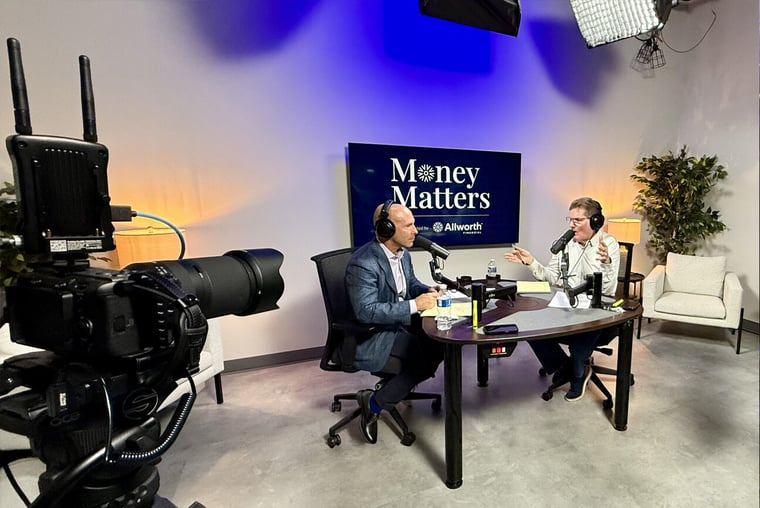
- Introduction to Money Matters 0:00
- Financial Confidence vs. Net Worth 0:51
- International Stocks vs. U.S. Markets 9:28
- Caller: Should We Sell Our Rental Property? 13:22
- Caller: Pension Lump Sum or Monthly Payments? 27:13
- Caller: Leaving Money to Spendthrift Heirs 36:11
- Caller: Asset Location for Tax Efficiency 44:59
Big Financial Decisions: Pensions, Tax Strategy and Leaving Money to Heirs
Taxes can quietly shape some of the biggest financial decisions you’ll ever make — from choosing how to take a pension to deciding how to leave money to your heirs. On this week’s Money Matters, Scott and Pat take calls from listeners working through those exact issues. One caller is weighing a pension lump sum against monthly payments, and the tax consequences of that decision become central to the conversation. The guys also discuss how asset location affects tax efficiency, why different accounts are taxed differently, and how thoughtful planning can help reduce unnecessary taxes over time. They even explore ways to structure inheritances that protect beneficiaries while keeping taxes in mind.
Join Money Matters: Get your most pressing financial questions answered by Allworth's co-founders Scott Hanson and Pat McClain live on-air! Call 833-99-WORTH. Or ask a question by clicking here. You can also be on the air by emailing Scott and Pat at questions@moneymatters.com.
Scott: Welcome to Allworth's "Money Matters". Scott Hanson.
Pat: Pat McClain. Thanks for joining us.
Scott: Yep, we'll talk about financial matters today and then a little bit about the markets, of course, take your calls. And our objective on this program, like every other, is to help you make wise choices with your finances. We believe that the more knowledge somebody has, the better choices they're gonna make, and the more confidence they'll have with their finances. Because study have shown that wealth and confidence in your finances are not necessarily correlated. So, you've certainly seen plenty of people that have a lot of money and are freaked out about the economic future, and you see other people that have more modest means and have complete confidence in their future.
Pat: I talked to an 89-year-old client earlier this week that was exactly as you described.
Scott: Which one? The first or second?
Pat: Well, I don't remember in what order they came, but he was doubting his portfolio for a little bit. And it's an interesting thing. I've worked...
Scott: And how long has the client been with you?
Pat: Thirty years, Scott, and we go through this every eighteen months.
Scott: Pat and I started in the industry in 1990. You still have a handful of clients.
Pat: I do, yeah.
Scott: I don't have any clients any longer. Still there for them if they need to reach out, but there's other certified financial planners I work with. But you still maintain a handful of them.
Pat: And I love the interaction, but it's every 18. And it normally...
Scott: And after 30 years, there's not a lot of planning to do, my guess.
Pat: Oh, and his grandkids won't spend this money. His great grandkids won't spend this money. But...
Scott: Oh, they might.
Pat: Okay. Now, that's fair.
Scott: Well, the grandkids will.
Pat: But it normally has to do around political events. And he has a tendency, when he gets wrapped up in this little thing, is to actually look at the negative of every side of the picture, which is the emotion coming out.
Scott: Those are all news stories.
Pat: Yes. It's all the news stories. Or there'll be a... He sent me an article about the debt in the U.S. and how it's gonna sink all the markets, stock markets, bond markets. And I said, "Well, the debt's real, but, unfortunately, the country has enough wealth that they can overcome the debt problem with legislation." That's real.
Scott: There's more assets than there is debt.
Pat: Yes, yes.
Scott: Frankly, there's more assets with the federal government, too.
Pat: Yes.
Scott: And the power they have. That right.
Pat: But that's why. But it's interesting, the confidence, every 18 months, we go through this little exercise. And I think back of all those times that he wanted to get out of the market and didn't. Because getting out of the market is obviously the easiest thing to do.
Scott: Right. It's getting back in.
Pat: Yes, when do you get back in?
Scott: And it's really hard. I mean, I think of times, Pat, when I've had clients... I think back to the great recession. And this is a client, he'd been a client, I don't know, five or six years prior, maybe longer than that when I think about it, before the financial crisis. The market started selling off a bit in '08. Actually, I think it's the latter part of the '07, '08, "Scott, I think we should get out of the market." Call, "Well, no. Here's why I don't think we should. We'll lay out the whole thing." Three months later, markets are lower. Call, "Scott, I think we should get out of the market."
And, mind you, he wasn't a 100% in stocks. Like, our approach is never a 100% in stocks. It's always making sure people have some liquidity available to them if they have some capital needs and income needs, that sort of thing. Few months later, now we're in the beginning 2009, I think January, talked to him again. Markets are lower. So, now, I'm looking like an idiot because he's thinking, "I should have not listened to Scott the first time." I talk him out of it. Then he calls the first part of March, chooses not to speak to me, finds somebody just kind of in our trading department and places his own orders to get...or did it online. I don't know how he did it, anyway, without talking with me about it and got out of the markets entirely. This was, like, four days before the bottom.
Pat: The bottom is a contra indicator.
Scott: And the and the reason I'm bringing this up, the challenge is, when the market started recovering, he'd say, "What do you think, Scott? Should we get back in?" And I honestly didn't know what to tell him. I said, "I don't know because I didn't tell you to get out, but you got out because it spooked you." So, the concern is we get back in, the markets have a little brief period of sell off, and you've just hit a double whammy. Now you're gonna incur more losses.
Pat: Did he get out of both his stock and bond positions? His whole thing went to cash?
Scott: I think he kept some of his fixed income positions. I don't recall.
Pat: But the reality is, Scott, I gotta tell you, I've been listening to a ton of podcast about AI, right? And...
Scott: Yeah, because it's easier to listen than to learn the tools. Well, I actually do use some of the tools.
Pat: I do use a few of them. But the thing I find, two interesting things is, the business models of the companies actually are changing greatly from a variable spends, the software companies, to a capital spends.
Scott: A tremendous amount of capital.
Pat: Right, tremendous amount. And the other is, the capital spend, although they come out with these big bold announcements, my guess is about 60% to 70% won't take place because of technology actually becoming more developed and not having to use as much energy and as large a space for the chips themselves.
Scott: Well, you listen to some, I mean, they say, maybe in five years, we don't need nearly the amount of energy that we need today.
Pat: That's right. And the other thing there is, that there'll be a fight between the AI companies and the businesses that use the tools over cost. Because the breakeven is if I'm using an AI agent, what's that AI agent cost relative to an employee?
Scott: Of course, as in every technology spend.
Pat: That's right.
Scott: Do I put in the self-checkout of the supermarket, or do I hire someone to check?
Pat: Yeah. And how many customers am I gonna lose that won't do the self-checkout, or what is my shrinkage by theft? Yeah, it's interesting to talk about it. It's interesting to watch. I think that profitability of firms over the next five years, quite frankly, will just amaze some of us. But I think it's a societal problem that needs to be dealt with.
Scott: It is the most interesting time with all this AI, right? Because, like, for myself, there's part of me that's really excited. This is really pretty cool. I'm, like, I'm alive watching this transformation. The other part is like, are we creating our own demise? And you think back to the Terminator, like, this doesn't seem that far off.
Pat: It doesn't. It doesn't. And even if... I'm finding myself using AI for things I used to plug into my calculator by hand. Net present value calculation.
Scott: I had a home that I had bought and sold, and rather than running, like, math, I just I just put in ChatGPT. And I think I dictated it all. I paid such and such, and I got this much rent. And I just wanted to kind of a ballpark with the REI was on it.
Pat: It's crazy. It's crazy.
Scott: Well, it's an interesting one.
Pat: But back to the confidence, you can view the world a lot of different ways, right? You can view it through a positive lens. You can do a negative lens. I think, especially hard now, is depending on what side of the aisle you are politically, you have a view of the economy that's actually shaped by that.
Scott: Well, you have to. If the other part aside's the enemy, which is kinda where we are today, there's, like, very little centrist. Like, it used to be you could vote for the person, not the party, but in congress, they don't vote the party line, they're done.
Pat: Yes, it's over.
Scott: Look at Trump, just comes after people like, "We're gonna primary you to death and put you out." Anyway, we don't wanna talk about politics. What I did wanna mention before we take calls, oh, and by the way, most of you who are listening to this right now, this isn't your first time listening to Allworth's "Money Matters" with Scott Hanson and Pat McClain. You've listened to this in the past. If you find this helpful, beneficial, think of two or three people in your lives that could benefit from this and forward it on to them. Just say, "This program's been helpful for me. I think it'll be helpful for you." We would appreciate if you did that for us.
All right. Before we take the calls here, Pat, I saw a chart the other day on global stocks. So, owning stocks outside of the U.S. We've been in this industry long enough to see these trends, right? So, for a while, it was, have a lot of global stocks because the global markets were a good place to be. Then it was, don't have them in global markets. And, frankly, the last decade, really, since the financial crisis, it's been challenging to own international stocks because compared to the U.S. markets, they have lagged.
Pat: Because there's two components to it, right?
Scott: One is their overall returns, and the economies, for the most part, haven't done as well as the U.S. Secondly, it's the change in currency.
Pat: Their currency to the dollar.
Scott: Yeah. When you have a strong dollar and you own foreign currency, it's not helpful for you. Well, this last year, foreign markets performed well by and large, and the dollar fell. So, it you've got kind of...
Pat: Double whammy.
Scott: Yeah. Got two kickers there. And a lot of the foreign markets up 30% or more. Well, when you look at flows, that's what's so funny...
Pat: And describe flows.
Scott: Where money into ETFs, exchange-traded funds. And so, these are not only... They could be individual investors. They could also be money that's directed by advisers side. I don't know. The article didn't break these down. This is just happens to be money flowing into foreign stocks. And you look in 2004, we had a couple quarters where we had negative flows. People are pulling money out of the U.S., international stocks, presumably to go back in into to U.S. So, they're moving...
Pat: 2004, so 22 years ago.
Scott: Yeah. I'm sorry, 2024.
Pat: Okay, thank you.
Scott: Thank you for correcting me.
Pat: Thank you.
Scott: I wonder why you quit. Yeah, so just a year and a half ago, they pull money out. So, last year, the market was on fire. And we look as the year went on, more and more money's flowing to the foreign markets. So, you look at December of last year, it was just off the charts. And I'm thinking, why is it that the investment markets are the only markets that I know of where people wanna buy more when they're expensive? When prices go up, people want more. When prices go down, people want less.
Pat: It's because people, I hear it all the time, it's doing well. It's not doing anything, it did well. The mere fact that we can measure it means it's over.
Scott: It's all history.
Pat: All of its history. All of it. But remember, we had the same thing between growth and value stocks for years, and the flows just...
Scott: I mean, look, I think of in my own portfolio, because I have an allocation to international stocks. And I remember over the years, it's been like, "Mm, wow, this is kind of hard to hard to own when the S&P is up 15% and those are up 8%, or whatever the numbers are. Well, it was quite a nice year last year.
Pat: It helps.
Scott: It helps a lot.
Pat: Yeah, but that's just part of well balanced portfolio, is to own international stocks in them.
Scott: Well, and to your point, if you're highly diversified, at any point in time, you're gonna have something that's not performing well.
Pat: Oh, you're gonna be unhappy. It's a bad portfolio if you're not unhappy with 20% of it. Twenty percent of your portfolio, at any one point in time, if you're well diversified, you should be looking at it. But the problem is, it's always a different 20%. You should always be looking at your portfolio and thinking, "A fifth of this thing isn't... I should get rid of it." But in a well-diversified portfolio...
Scott: Well, then there's another 20% slug that is crushing.
Pat: Yes, it doesn't work.
Scott: I mean, that's usually how it works. Like, "Wow. Look at these socks. These things are going gangbusters."
Pat: But don't be tempted to move that direction.
Scott: Yeah. All right. Let's take some calls. If you would like to join us and be a guest on our program, we love taking calls, having guests, send us an email at questions@moneymatters.com. We're in North Carolina talking with Chris. Chris, you're with Allworth's "Money Matters".
Chris: I appreciate you guys taking the call. Thank you. You guys are doing well.
Scott: Yes. Fantastic. Thank you.
Chris: So, over the last two-ish years, I've kind of been on this called DIY educational and personal finance, and then helping piece together my wife and I's kind of retirement journey to roadmap to follow. And I've got two questions on what I'm going to call our old life. We met roughly 10 years ago in the Bay Area. Fast forward to now, we're in North Carolina. I've been there for roughly seven years. And my first question, and can excuse more towards my wife, but the home that she was in when we met, we've been renting out for the last seven years. It's kind of this unicorn scenario with family where her family is helping kind of be the landlord, take care and lease, like, haven't missed a day of rent. But the cash flow on this thing sucks.
Pat: Are you renting it to a family member, or they're just helping facilitate it?
Chris: They're helping facilitate it.
Pat: Okay.
Chris: And so, the other one is the cash flow is not great. And we know it's not in the long-term plans. And I guess in the broader scheme of where we are with retirement savings, etc., there's, like, this level. Again, I heard you guys talk several times about, like, I think, and just kind of being done with rentals in the past. But it's like there's a level of, like, easy button, would love to just sell this thing, take the hit, not do a 1031 exchange, and throw it to a brokerage and let it rise for the next, you know, 20, 30 years and until we're ready to tap into it.
Scott: What's the value of the house?
Chris: Yeah. Rentals, roughly $900. We owe $475 on it. Got one of those primo COVID interest rates at 0.35%. So, you know...
Scott: What does she pay for the house?
Chris: Originally, it was, like, just over 5%, and that was back in 2016. There's a refinance in 2021.
Pat: And what and how much income does it generate net after expenses, everything? And that includes the new water heater, the gutters on the home.
Scott: And it actually should include some sort of sinking fund for capital expenditures, like when the roof needs to be replaced.
Chris: So, annually, we're at, like, a $3,500 net, which is basically one month's rent.
Pat: Okay, $3,500 net. Okay. Well, obviously, that is a terrible cash flow. But we're gonna talk about a Delaware Statutory Trust here in a second. Explain what an option is for this.
Chris: Yes. As far as, like... Because really where I'm at is, like, I want to make sure I'm seeing the forest for the trees because it's like there's this level of, like, easy button, let's just be done with this, throw it into a brokerage. Because I think, in the broader context of, like, where I'm at with 401(k) savings, I think we've kind of got the room to kind of just do this and be done with it and sets, at least, a portion of things on autopilot. But, yes, so cash flow $3,500 a month...or excuse me, that'd be nice, dollars $3,500 for the year. But, yeah, the idea would be...
Scott: And is this rented out to family members or friend?
Pat: It's not, no. But they're but the family members are involved in managing it somehow.
Chris: Correct, yes. So, that's been the easiest part.
Pat: Just to test the relationship.
Scott: Oh, of course.
Scott: Are they getting any economic benefit as a result?
Chris: None. It's a unicorn scenario. There's no fees or anything. It's just out of the goodwill of their heart.
Pat: So, Chris, before we go on, how old are you?
Chris: I'm 35.
Pat: Oh, okay. And how old is your spouse?
Chris: 37.
Pat: And do either of you have children from a previous relationship?
Chris: We do not.
Pat: Okay. All right.
Chris: We got a little 2-year-old. So...
Scott: Oh, congrats. And you own your home in North Carolina, I'm assuming?
Chris: Correct.
Scott: And what's the mortgage balance on that house?
Chris: We're $325.
Pat: What's it worth?
Chris: Also $900.
Scott: Okay. What's the...? Just out of curiosity, and I don't know where in North Carolina you are at, but set a picture of what the house is like in the Bay Area for $900. These are equal priced homes. What's the house like in the Bay Area, and what's the house like you're living in in North Carolina?
Chris: I see where you guys are going with this. North Carolina's purgatory for whoever's listening. It's so hot, homes are much smaller than the Bay Area.
Pat: Don't come. Don't come here.
Chris: Don't come. Keep that pipeline to Colorado and Texas alive. But, no, yeah, we're in the suburb of Charlotte, I mean, literally just right outside of Charlotte. And I think we're like 3,600, 3,700 square feet home. And I mean, so much of this is timing. We bought 2020 and it just rode the wave of equity up. So...
Scott: So, here are your options with the rental. One is you can just ignore it, I mean, keep it as it is and hope for the best long-term, right, which is what you've done the last several years. Secondly, is you can just sell it, bite the bullet, pay the capital gain taxes, of which you're going to incur 20% federal capital gains tax rate, plus state of California, because it's in California, you'll end up with 10 point something percent or so on capital gains for California. And then you're gonna bump up to also to the Obamacare tax, the 3.8%.
Pat: So, you mentioned a refinance. Did you take money out of this property?
Chris: Yeah. She or we did pay her parents back for helping buy. So, yeah.
Scott: Worked out good. And the third option...well, you have four options. The third option is to sell this and maybe buy two rentals in around where you are. You can do that. You can do 1031 exchange. You gotta essentially keep the same loan balance and the same kinda equity balance. So, if you either reduce your indebtedness or the value is less, it becomes a taxable event taxable boot, they call it. And then the fourth option is to do what's called a 1031 exchange, tax free exchange, into what's known as a Delaware statute statutory trust, DST, and they've been around for years. Think of them as partnerships that tend to be commercial type endeavors. So, maybe it's senior housing or it's apartment buildings or its commercial or whatever. It could be a variety of different things.
But you can exchange this into... You've got about a 50% debt rate, so you'd have to find other properties that had similar debt or more in order to be a completely tax-free event. But if you structure it properly, you could exchange it into that. And think if it's 721, there's another rule, that if it's structured properly, those can be converted into the securities of the real estate investment trust that manages these properties. So, you end up diversifying away from a single property, or you could do a couple properties in this situation, into the REIT itself, and then you can sell portions of it at a time and incur capital gains, spread the capital gains over a period of time.
Pat: And, Scott, because of the indebtedness on this and the amount and his age, is it worth the hassle?
Scott: I did one for myself. I took a residential rental and converted it into senior housing, senior living?
Pat: You didn't have debt on it, though.
Scott: No. But I ended up... I chose to have a property that had some debt on it to, basically, increase the risk exposure. Myself, personally, that's what I wanna do at the time, to your point. And the challenge with doing that, it's not like the universe of investments are open to you. There's a handful of companies that are sponsors in these Delaware Statutory Trusts, and your limits are what properties, what syndications are open currently.
Pat: And not only what syndications, which ones are worth investing in. Because there's lots of real estate syndications that are garbage.
Scott: That's correct. And so, you could end up exchanging something that has a poor rate of return the next... But then I also look at... I mean, the stock markets that is... What would you do? Pat is saying that...
Pat: I'm just thinking I would just...
Scott: What are your options?
Pat: Those are the options. I wouldn't mess with the Delaware Statutory Trust. He's 37. His wife's 35. He's got a 2-year-old at home. I assume you're employed.
Chris: Yep. I'm employed. Yeah. It's sort of like there's a level of... I haven't heard of the Delaware Statutory Trust, but I'm going to look it up. But, yes, like there's a level of easy button and I was like, you know, nobody enjoys paying taxes, but it's like there's a level of, why don't we just eat the taxes now? I was assuming maybe $300 we would take to the bank, and otherwise, put in a brokerage and let it ride.
Pat: That sounds about right, right?
Scott: That is about right.
Pat: That sounds about right, three and a quarter. Yeah, that sounds about right.
Chris: And so, that's where I was like... And I think in the context of our broader puzzle, it's like, I think we're okay with that, but it's like I wanted to make sure we're...
Scott: Yeah. And it could be not just a brokerage, but maybe you look at, "All right, maybe we figure out what the 529 should be funded at for the 2-year-old," right? Those sort of things.
Chris: Yeah. I feel like with each year, my Grinch heart grows a little bit. But we...
Scott: Your Grinch?
Chris: Yeah, my Grinch heart is growing each year with
Scott: Grinch, what does that mean?
Chris: I think my wife and I grew up very differently. And I had to pay for school. And you can go down the list, and there's very much a yin to the yang. And so, right now, where we are with 529 is like, when baby number one right now has got $30,000, and the goal would be, it's in a total market fund and just grow that. And then once baby number two pops out, that will put another $30,000 in and let it go.
Pat: What's the overall net worth investable assets, not including the home.
Chris: Not including the home.
Pat: Or the rental.
Chris: My 401(k)s Roth, brokerage. I mean, just pure retirement, we're at $500, and got about $50, $55 in a brokerage right now.
Pat: And what is the family income?
Chris: So, it's just me right now, but I'm anywhere between $150 and $175.
Pat: I would hit the easy button then see...
Scott: I think you're doing well.
Pat: Oh, yeah, he's doing very well.
Scott: Given the income level and what you've got saved in your assets. I think you're doing great.
Pat: I wouldn't mess with the Delaware Statutory Trust on this.
Scott: I think you're right. Yeah, you're so limited, and it'd be such a big chunk of your net worth. And if it didn't work... Yeah, yeah, I agree with Pat. I don't think I would bother either.
Pat: I would just take the tax.
Chris: Actually, it's like, as I've been piecing stuff together, I was like, "Oh, I actually..." I feel like we were blindly doing 'right things to do' and, you know, started trying to piece some stuff together and it's like, "Okay, yeah, I think we're actually ahead and there's a level of, what can we do to just make it easier now?" So...
Pat: Oh, that is an... Look, the easier it is, first of all, to manage the assets, the easier it is on the relationship between you and your spouse, number one.
Chris: Oh, yes.
Pat: Right? I know. I'm married to an accountant. I actually had to say to my wife the other day, "Let's not let this financial thing get in the way of our relationship," because we were discussing a financial situation.
Scott: And Pat and I have done some investments over the years together. And the reality is some investments are home runs. Those are ones that your friends talk about at the cocktail bars actually. And some don't work out so well.
Pat: But that's the nature of it.
Scott: I could think of the one or two that Pat and I have done over the years that maybe didn't crush it.
Pat: And I could think of a half dozen that did great.
Scott: And sometimes, some of these things, they're almost impossible to ever get out of.
Pat: That's what scares me about a Delaware Statutory Trust.
Scott: I mean, sometimes it's there's liquidity, and they just continue on for years and years. Then you get these K-1s that go for years and years.
Pat: Now, I'd sell the house and go there. And any other questions for us?
Chris: Yeah, I got one more. So, this one, I think I know what you guys are going to recommend. But so, the second part of our "old life", she was a teacher in California, had vested in the...I forgot what it's called. But otherwise she's five years in that.
Pat: STRS, State Teachers Retirement System.
Chris: And so, the math on that works out to, like, $7,000 a year, but that's 25 years from now. And I feel like I got bored. And cost of living adjusted it, and it's like 2,500 bucks of today's money.
Scott: And what's the net present value? What's the...?
Pat: That's a big assumption that there's gonna continue to have a COLA on.
Pat: What's the lump sum today?
Chris: $31.
Pat: Well, the numbers let's just go by the numbers.
Scott: Because I think the maximum cost of living adjustment on a CalSTRS is 2% a year. I could be wrong, but I think that my recollection is correct.
Pat: Yeah. But it's $7,000, and the $7,000 gets paid out at age 55 or 60.
Chris: Correct.
Scott: Or 65.
Pat: What's the number?
Chris: That there. What is it? Two percent versus your last three salaries times the years of service. That number is $7,000.
Scott: Yeah. But is that at age 65?
Chris: I'm gonna need to double check, but I'm assuming.
Scott: You gotta run the numbers.
Pat: Yeah. But I would not leave my money in a... She's 37. We're looking at a 23-year time.
Scott: Well, if you still lived in California, it'd be different. Because then we might say at age 55, she should go back for three more years pension spike.
Pat: And bump it, yeah.
Chris: Yeah. That's why I was like, yeah, if we were gonna come back, I think it would be a very different conversation. But, at least, as of now, there's no plans to do it. But it was like we were looking at, yeah, just taking it out, and I feel like the account, when we were bumping and doing the numbers, it was... Where did it go in here? It was it was gonna grow to, otherwise, a couple $100,000. And it was just like, you know, it would, you know... It was ultimately their options, but it was like, yeah, it didn't really feel like we... I don't know if we need to do anything, but, yeah.
Pat: Well, you can defer the decision, but you have to go through the numbers. And what you're trying to figure out is what the rate of return will be in order to provide that.
Scott: Well, it's probably the same hurdle rate that they use internally, which is either eight and a quarter or seven three quarters, somewhere in there. You can go on their website. Like, you can just Google and figure out what's their assumption on their pension.
Pat: Yes. And but then the second risk is, what is the likelihood that that actually is gonna come true?
Scott: What comes true?
Pat: That they'll be able to pay that pension. I mean, we're talking 23 years in the future.
Scott: Out of California.
Pat: In the state of California.
Scott: Not exactly flesh with...
Pat: Which not the STRS pension, but the PERS pension. The estimates is that it could be...
Scott: A trillion dollar.
Pat: A trillion dollars underfunded.
Scott: And STRS is grossly underfunded as well.
Pat: Every bit as much, or at least, last time I looked, it was.
Scott: They just keep kicking the can down the road.
Pat: What would you do?
Scott: Oh, I'd take the money out.
Pat: I'd take the money
Scott: And put it into an IRA and invest it first for a 30-year portfolio.
Pat: Yeah. And the return might not be as much, but you don't have any liquidity risk on it at that point in time. You can always, at least under the current rules, you can buy back your pension if you move back to the state of California. Actually, did I tell the story about how I had that lady come back to work for one day in order to spike her pension?
Scott: Yeah. Let's have that story. Hey, Chris, good talking to you. Wish you well. And sounds like you are well on your way to financial security.
Pat: Yeah. Impressive, actually. Quite impressive. Yeah. So, I remember the story. I've told the story. Oh, I had a clients that came in and...
Scott: But look, here's the deal, we work on behalf of our clients, right?
Pat: Naturally.
Scott: We have a fiduciary interest to act in our clients' best interest, which means we give advice to our clients that are in their best interest. Sometimes these are not in society's best interest or the broad taxpayer's best. But look at...
Pat: But the taxpayer doesn't pay me.
Scott: The politicians, they create the tax structure, they create the pension schemes, all that stuff. They create the rules. Just like when you sit down and play a game, what are the rules of the game? "Okay, these are the rules. You can't, you have to," right? You understand the rules of the game, and you play within the rules. That's what this is. So...
Pat: And when you look at pensions, if people separate from service, especially in government or even in large corporations, they will actually vest your pension so you could leave in an unvested pension. But if you come back, depending upon your age and your length of service, you can vest your pension.
Scott: Yeah. So, typically, to vest a pension, it's a combination of years of service and age, and it benefits the older. So, some might be, "Hey, if you're 60 or older and have 10 years, you're vested for a pension." Let me rephrase it. But it might be that you have to you have to be there until at least age 55 or age 60 to have any sort of vesting. So, you might have 30 years, but you might not be vested because of the age.
Pat: But I've done it with people that worked in government and utilities.
Scott: Yeah. Private sector as well with pension plans.
Pat: Yes, yes.
Scott: Yeah, so give us the story. I know the story.
Pat: So, she came back and...
Scott: I know who you're talking to.
Pat: She came back. So, I was just meeting with them and I said...
Scott: So, she had worked for the government.
Pat: And then she left when she had children.
Scott: When she had... Yep.
Pat: And then at this point in time, she was 55. And I was meeting with them and I said, you know, "If you went and worked one day, you would turn your unvested pension into a vested pension and get health insurance for life."
Scott: And this is how it was structured that day. It was only a day. You didn't have to work three months or a year, whatever, five years.
Pat: Yeah, just one day. And I said, so...
Scott: Lifetime medical.
Pat: Lifetime medical. Just unbelievable. And then all of a sudden your pension goes from, you know, a lump sum of $80,000 to $1,500 a month. And I said, "Just go back and work one day." And so, she went back and got a job at the state. I said, "Doesn't really even matter what it is. The higher the pay, the better, but it's based upon your pension."
Scott: Did she literally work for one day?
Pat: She ended there nine months.
Scott: Oh, really, nine months? Had a big, tearful retirement party.
Pat: It was sad. They were all sad to see her leave. But if you've left, it's real, especially in utilities and government.
Scott: And if you calculated what her pay was during that nine months, massive. Because before, she probably had a small deferred vested pension, probably something similar to this. At age 65, would pay a few grand a year. She turned that into a monthly pension, whatever the dollar amount was, and lifetime medical.
Pat: And even if you take a deferred vested pension into an IRA and roll it out, you oftentimes can buy back that pension in this situation. Even though you took the money from the organization that you left, you can buy back the pension.
Scott: And every pension plan is unique, and it's all...
Pat: Yes. It's essentially... Which is actually why these defined benefit pensions have pretty much gone by the wayside.
Scott: Except for government.
Pat: And some utilities, yes. Because well, the risk stays on the company.
Scott: Yes, and people game the system, right? Become fire chief for your last year so you can get a good pension, and then you tap your buddy on the shoulder, they're fire chief, then you tap your next buddy on the shoulder, they're fire chief. I'm not picking up firefighters, by the way.
Pat: Gotta grow a mustache.
Scott: Or fire chief.
Pat: So, the fire chiefs don't have mustaches, do they?
Scott: I don't know. Just the fireman.
Scott: I don't know. Is that a requirement? If you become chief, you shave it?
Pat: I think so. But if you're a fireman...
Scott: We sound like we're mocking firefighters. We don't mean to mock firemen. Look, I don't blame anybody. Again, these...
Pat: This is the rule.
Scott: Look, a lot of us...
Pat: So, how many times have you helped people do this?
Scott: We try to plan our taxes so that we pay as little as taxes. We try to avoid the IRMAA tax if we're over 65 and on Medicare. Like, we do lots of things to try to maximize our own economic benefit, and at some time to the cost of the government not receiving as much. It's the same. I think these are the rules. They created the rules and agreed to the rules.
Pat: I think this is historical. What's good for the individual is not necessarily good for the whole, and the inverse is true as well.
Scott: Yeah. Anyway, if you find yourself in any situation like that, talk to a good adviser who's dealt with those.
Pat: Oh, absolutely.
Scott: And maybe spend some time with their retirement department. I remember had a friend that was a... Is he still doing this? Maybe he's still doing it, so I shouldn't say. I'm not gonna mention it.
Pat: Okay.
Scott: I can't mention it. It's not good, though for tax payers.
Pat: Let's go into the next call since it's not.
Scott: Just some of the government waste stuff. All right, let's talk to Glenn in Ohio. Glenn, you're with Allworth's "Money Matters".
Glenn: Hi, guys. Thanks for taking my call.
Scott: Yeah. Glad you joined us.
Glenn: Yeah. First of all, I just wanna tell you, I really appreciate your guys' podcast. I've probably been listening three years now and get a lot out of it.
Scott: Well, thank you.
Pat: Cool.
Glenn: Yeah, you're welcome. Especially, like, your banter between the two of you, so keep that up. But, all right, so...
Pat: Well, they don't enjoy it at home nearly as much. As my wife said to a friend the other day, "Don't encourage the behavior."
Scott: Your behavior?
Pat: Yes.
Scott: Yeah, well.
Pat: Was making...
Glenn: I get the same thing, so you're not alone on that one.
Pat: Okay, thank you.
Glenn: You're welcome. But anyhow, I actually, hopefully, you're gonna let me ask two questions, and they're both follow ups to what you guys have given out as advice in the past. So, just let me start off with one. I think it'll be a quick answer. And, both my... First of all, I'm widowed and then married again. And both my wife and I have children. I guess the term is spendthrift, but people, and it's really their spouse, that we really don't want to give them the money in a full lump sum.
Scott: Yep.
Pat: Yep.
Glenn: So, again, and I just listened... I actually was on listening to your talk show a couple of f weeks ago, and you guys were talking to somebody, and you recommend a trust. But my problem is, and then this is a different talk show I heard, that somebody said that trust are taxed at a much higher rate. So, if your trust is set up to hold that money for the 20 years that you want to distribute it, is it not true that that money that when you first die and it taxed, you know, whatever you call that, when you first put it in there, it gets taxed at a much higher tax rate than what our kids would be taxed. Is that true or not?
Pat: Kind of.
Scott: Sort of.
Pat: Kind of.
Scott: Any money...
Pat: Do you want to explain the difference between the revocable?
Scott: Yeah. So, first of all, what you're... Like, a lot of us have living trust set up, right? They're called Irrevocable Living Trust. We set them up for probate purposes.
Pat: Revocable.
Scott: We can revoke them at any time. You know, "I change my mind. I change..."
Pat: Wait, Scott, excuse me, you said, "We have irrevocable trust."
Scott: I'm sorry.
Pat: It's revocable.
Scott: It's twice I've misspoken today. Revocable Living Trust. Many of us have Revocable Living Trust. We can change the beneficiaries anytime we want. We can take something out of that. We can dissolve the trust. It's revocable. We have power over it. If we...
Pat: It stays in our estate. That's key.
Scott: And it stays in our estate.
Pat: It stays in our estate.
Scott: Irrevocable trust is where we transfer some of our assets into a trust which we, typically, no longer have control over. And it's designed for two purposes. One, to get it out of our trust...I mean, out of our estate. And secondly... And it depends on someone's estate. If someone's got a more modest estate, they may wanna maintain some control, but the fact is it's still irrevocable. In an irrevocable trust, on any income that the trust earns, interest, dividends, capital gains, etc., the graduated tax rates occur really quickly, right? So, for most of us, you know, we don't get to the top tax brackets until, what, $600,000, $700,000 or whatnot. With trust, it's something like $10 grand or $20 grand. It's very... I mean, you're pretty much taxed at the top tax rate from day one.
Pat: It's $16,000.
Scott: $16,000. That's for money that remains in the trust. If the trust pays out distributions to the beneficiaries, then there's no income that's left within the trust to be taxed at these punitive rates, and the income that was distributed to the beneficiaries is taxed based upon the beneficiaries' tax structure.
Pat: So, the answer to the question that you said is, yes and no. It depends on how the income is distributed out of the trust. So, let's
Glenn: That's okay.
Pat: So, describe your situation, and we'll give you what we think is the best way to deal with this. So, if you have a spendthrift child or their spouse, you give them a lump sum...
Scott: They'd buy a Lamborghini.
Pat: Right? And I've seen it. Not a Lamborghini, but a house on the beach. What are you trying to achieve? You want this money to...
Glenn: What we're hoping to do for both of them is actually somehow create a 20-year payout of, again, assuming that it's gonna be over $500,000, could be a million by the time we die. But any case, each one, we would just somehow pay that over 20 years. And my understanding is, again, just like you said, if the trust holds it, then it is taxed. That money that went in there and whatever it's holding on to the next year, they're taxed at. So, somebody suggested, if we put them, again, the trust and the trust directions or directives or whatever you call that are to create a 20-year annuity. Is that actually considered giving them the money?
Scott: No. Not until it's... You can set up a trust... So, my assumption is this is what you want created upon your death. Is that correct?
Glenn: Yes, that's correct.
Scott: Yeah. You could you could structure and say, "Upon my death, I want $500,000," whatever the dollar amount is, "to buy a twenty year commercial annuity to have these dollars paid out on a monthly basis, annual basis, over the next 20 years." That's clearly something you could do. And if you say, "Well, I don't wanna have it a 100% in fixed income," you could actually buy what's called a variable immediate annuity. It's quite complicated. But when you have something like that, it invests in equities, and then the payout fluctuates each year based upon how the equities perform.
Pat: So, they take a number of units. They purchase the units. Let's say, they purchase 240 units. In that particular trust, they pay out one unit every month for the next 20 years.
Scott: And the units can be different in fluctuation.
Pat: And the units will fluctuate up and down based upon the underlying portfolio. If you were in my office, I would say, you have that choice, or you could actually put restrictions in the trust. We can hire a third party administrator who acts as a fiduciary. There's both a fiduciary and then an administrator of the trust. I would say, for $500,000, I would just buy a commercial annuity, variable annuity, and I'd lay out a portfolio that was 60/40.
Scott: Because of the administrative costs.
Pat: Will eat up a lot of the returns.
Scott: And look, the reality is, when you're no longer around to negotiate fees, right, and it's an irrevocable trust, just my experience, like, the fees aren't cheap, typically. So, to administer that, to your point, Pat, you have to have an administrator. You've gotta file a tax return.
Pat: It's a lot of work. That's why if you buy an immediate annuity...
Scott: If you had $5 million, you'd say, "We'll set up the trust."
Pat: But by buying an immediate annuity, there's no tax returns because you've contractually turned that lump sum into a stream of payments, and the income would be paid by the beneficiaries.
Glenn: Okay. That's what I was hoping. Okay. That makes sense to me.
Pat: Is that right, Scott?
Scott: I don't know what you meant by the income's paid to the...
Pat: Well, the principal, there's no tax on that.
Scott: Tax. Correct.
Pat: But any of the income that...
Scott: Any gain on that?
Pat: ...it would be paid by the beneficiary, the tax.
Scott: That's correct. Yeah, yeah, yeah, a 100%. Because it'd be the annuitant on it.
Pat: Yeah. And you could write that into the trust.
Glenn: Okay. Perfect. Thanks. That's one. Hopefully, this one is something straightforward.
Scott: And how old how old are you?
Glenn: How old am I?
Scott: Yeah.
Glenn: I am 64.
Scott: So, odds are you're gonna revise this trust before you die.
Glenn: Most likely, yes.
Scott: And so, the reason I'm stating that, don't let perfection get in the way of progress here. Because what often happens, people do an estate planning, it starts getting complicated, and then... Because there's pros and cons to whatever decision you make, right? And then I've seen, oftentimes, they don't do the estate plan because it just ends up getting complicated, or maybe it causes some conflict in a marriage, and then people put it up. You're 64. Odds are you're gonna revisit this two or three more times in your lifetime, if not more. So, don't let perfection get in the way of the progress here.
Glenn: And we do both have wheels right now, which passes out on a lump sum, and we're just thinking some again because both of us have that concern. Is there some better way to do that? And so, I was just trying to determine that. And I think you...
Scott: Well, and it's important. Look, it's super important you've got something set up because you have kids from previous marriages. So, without this, you die, everything gets transferred to your to your wife. She dies, it goes to her kids.
Pat: With the exception of IRAs, which go to the named beneficiary.
Scott: Correct.
Pat: Or life insurance or annuities.
Scott: And people get people get disinherited.
Pat: So, what's your second question for us?
Glenn: Okay. Second question is, it's also a follow-up, well, you guys have said a few times that asset location is more important than asset allocation. And if there's...
Pat: I don't know if...
Scott: As important.
Pat: As important.
Scott: As important.
Glenn: As important. So, I don't know if you can generically describe that or if you need to hear where everything is or how I have it invested. But I just don't understand my tax implications, I guess, of what I'm doing. This we start off, my Roth IRA is set up to be all equities.
Scott: Perfect.
Glenn: And the reason I did that was because of the growth, and I don't plan on spending that, unless my new wife decides to travel around the world three times instead of just once. But I do have, again, bonds in my IRAs, and I don't know if that's the standard IRAs and so forth. So, that's, I guess, my question.
Scott: From a high level, anything that is withdrawn from an IRA, distributed from an IRA or 401(k), not a Roth, but traditional, is taxed as ordinary income.
Pat: Either while you're living or at your death.
Scott: Yeah, taxed as ordinary income. So...
Pat: The recipient of that.
Scott: So, let's say you owned a S&P 500 index fund. Any sort of dividends that they spin off, essentially, because it's in the IRA, it's gonna be taxed as ordinary income. And if you own some fixed income, you own treasuries, some other bonds, the interest on those are going to be taxed as ordinary income. Now, if things are held outside of an IRA, let's say, in a brokerage account or just held in a direct treasury or something, those qualified dividends from your S&P 500 fund are gonna be taxed at a favorable rate because they're called qualified dividends. They get a special tax. It's typically 15%. It could be a little higher income with Obamacare tax.
Pat: And why are they qualified, Scott?
Scott: Because that's the way they made rules.
Pat: There's corporation paid taxes on them once already.
Scott: Okay. Well, that was the argument at the time when they put that into... That's the rules that congress created for us that we live by.
Pat: That's correct.
Scott: So, qualified dividends are favorably taxed when they're outside the IRA. And then something like treasuries are not state tax. So, if you live in a high tax state, they're exempt from state income taxes. And maybe if you own municipal bonds, for example, you can own municipal bonds, they're completely tax free. So, everything being equal, which is not the case, but all things equal, you would wanna have your fixed income inside of a retirement account and your growth equities outside of retirement account. That's if everything... But everything's not equal. We have our own income needs. We've got a lot of other issues that we deal with.
Pat: The second thing is, if you've got things that have capital appreciation inside of an IRA, you're gonna pay taxes on them at some point in time. But because of the current tax law, the step up in basis, you pay no tax on that.
Scott: So, if you buy a stock for $10 and it's worth 50 bucks, when you die, if it's inside a retirement account, that 50 bucks is all taxable. Your heirs can spread it out over 10 years, but it's all taxable. But if it's held outside, guess what? All that gain is tax free, step up basis.
Pat: So, sometimes you'll actually see people come in, well, which will have the stock in their IRA, and municipal bonds in a brokerage account, which they're accepting a lower rate of return for tax benefit in it, and it depends on how they're spending the income. If they're not taking any income out of the brokerage, it's completely backwards. You would put your regular bonds inside of an IRA and put all your capital appreciation in the brokerage account.
Scott: Because the argument be, is you're opting for a lower rate of return on these tax and municipal bonds when it's not necessary because you've got this ticking time bomb of tax from your retirement account.
Pat: Yes. And then the second step behind that is you take a look at, who's gonna receive the money at your death? And so, maybe if all things...
Scott: Often, if there's required minimum distributions and, and, and.
Pat: Yes. But if the beneficiary is in a much lower tax bracket, then I could make an argument why it should stay in the IRA. But I had a client, and I'm like, "Okay, tell me about your four children that are gonna receive this." Three of them made the same amount of money as dad and mom. So, I said, "How about the fourth one?" "He doesn't make as much." So, I said, "This will be good for three out of your four children." So, that's how asset location works. But it sounds like you're on top of it.
Scott: At least you're paying attention to it here. So...
Pat: Your fixed income is in your, is in your IRAs, correct?
Glenn: Correct. My bond fund is just in my regular IRA. Yes, thank you. I don't know if I locked into this. I just knew what I wanted was Roth to be total equity, so I figured I just...
Scott: I agree.
Glenn: ...put the bond. And I do have a small brokerage account, but that's minuscule compared to my IRA and Roth IRA, but I do have something in there. And so, like, again, I'm not very good at tax loss harvesting, but I do have some individual stocks in there that I've been looking at that, too. So...
Pat: Well, you should. Absolutely.
Scott: Yeah. Well, glad you called, Glenn, and it sounds like you're doing well, and wish you well.
Pat: Appreciate the call.
Scott: And, again, don't let the perfection of the estate plan get in the way of just getting something drafted.
Pat: Perfection get in the way of progress.
Scott: Yeah. So, really, reminds me, Pat, I had a client. This was a long time ago. Second marriage. Both had kids from previous marriages. Both had their own assets. He had retired and had a pension lump sum that was a significant size IRA. And he had a... I don't remember the exact way things were structured. But essentially, he wanted his kid's education to be covered or his grandkid. I don't remember what it was. Some education costs. And then after that, there was some income off the trust for his wife, his current wife, but then he wanted all the assets, eventually, to go to his kids. And it wasn't drafted very well. And she essentially spent down his assets over a 15-year period while allowing her estate to grow and grow. And ended up, essentially, disinheriting. And he had an estate plan in place. And I watched...
Pat: And she was in the provision for health maintenance and support, right?
Scott: Whatever. I remember watching this thing.
Pat: And you can't do anything about it, you can't.
Scott: There's nothing I can do about it. No, nothing I could do.
Pat: Yeah. But that wasn't his intent.
Scott: It wasn't his intent. But it gave me... It was one of those things that you watched happen, and you're like, "You need to make sure you've got..."
Pat: So, he inadvertently disinherited his children.
Scott: They got some, but not nearly what he... I mean, I think she's still alive, so it's like they haven't got anything, yet. But, anyway, it's been fun talking about these financial matters. And if this has been help to you, again, forward it on to somebody, and we would appreciate that. And also, I wanna let everybody know...
Pat: Wait. Can give us a positive ranking? Are we allowed to ask for a positive ranking? Like, when they give you, like, stars, "Do you like this podcast?"
Scott: I don't think so. I think...
Pat: We're not allowed to ask.
Scott: We have all kinds of regulatory issues as most industries do, right? But testimonials are... If something about testimonials, we have to do those a month something else. So...
Pat: Okay, just give us a ranking.
Scott: Give us a rating. If you hate the show, then don't give us a rating of that. If you think you have the ability to give us a decent rating.
Pat: Thank you. Because the algorithm looks at this, and we'll recommend the show to other people.
Scott: Yeah. And follow our podcast.
Pat: And our marketing people tell us we're close to the tipping point.
Scott: Oh, it's gonna be here soon.
Pat: Soon.
Scott: Yeah. Anyway, it's been nice being with you. It's been Scott Hanson and Pat McClain of Allworth's "Money Matters".
Automated Voice: This program has been brought to you by Allworth Financial, a registered investment advisory firm. Any ideas presented during this program are not intended to provide specific financial advice. You should consult your own financial advisor, tax consultant, or a state-planning attorney to conduct your own due diligence.
Insights for Complex Wealth Decisions
Join our email list for exclusive commentary from our Chief Investment Officer, early access to expert-led webinars, and your complimentary Wealth Planning Checklist for Complex Portfolios.
We take your privacy seriously and respect your privacy choices. By submitting this information you agree to our Terms of Use Agreement, Privacy Policy, and to receive important notices and other communications electronically.