
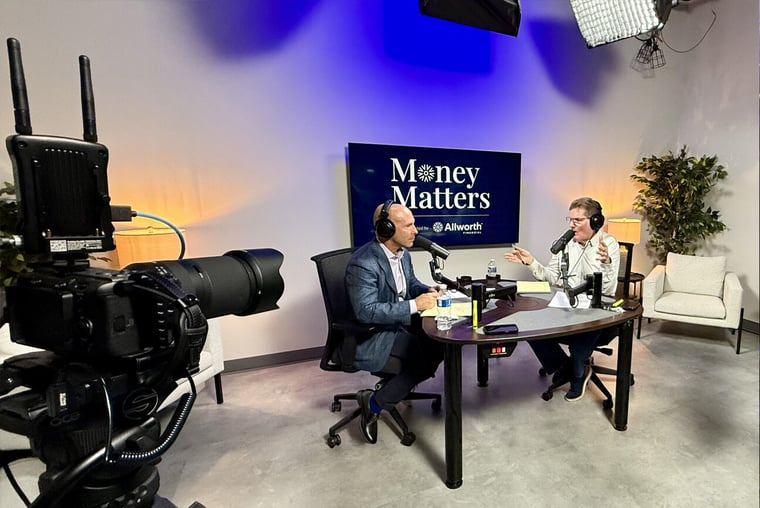
Managing AI Risk, Roth Strategies, and the Annuity Trap
Is the current AI boom a repeat of 1999? In this episode of Money Matters, Scott and Pat dive into the "irrational exuberance" surrounding tech IPOs and the hidden dangers of concentration risk in a high-net-worth portfolio. Plus, they break down real-world case studies on tax efficiency and retirement income.
What You’ll Learn:
The AI "Froth" Factor: Why 97x revenue valuations for new IPOs are a warning sign for diversified investors and how to manage concentration risk in big tech.
The Roth Conversion Reality Check: A $1.1M case study on why "pre-paying" taxes through a Roth conversion isn't always the right move for your legacy.
The Annuity Trap: How to spot high-commission products that are often sold as "safety" but may actually hinder your retirement flexibility.
Self-Insuring Long-Term Care: Strategic planning for healthcare costs when you have the assets to skip traditional insurance.
Whether you are navigating market volatility or fine-tuning your estate plan, Scott and Pat provide the fiduciary perspective you need to protect your wealth.
Join Money Matters: Get your most pressing financial questions answered by Allworth's co-founders Scott Hanson and Pat McClain live on-air! Call 833-99-WORTH. Or ask a question by clicking here. You can also be on the air by emailing Scott and Pat at questions@moneymatters.com.
Scott: Welcome to Allworth's "Money Matters". Scott Hanson.
Pat: Pat McClain. Glad to be here with you.
Scott: Yeah, talking about what's happened in the world of finance.
Pat: Well, so we haven't done a show since the big Elon Musk IPO, Scott.
Scott: That's correct. We'll talk a bit about that. Take some calls.
Pat: I am really, really... I had this conversation with my brother who's in the tech industry. Was the CEO of a tech company. Was in it his whole entire life. And we talked about... Can we talk about it now? Obviously, yeah.
Scott: Yeah, let's talk about it now. Let's start right into it. It's almost old news by the time. It's been a week.
Pat: Understand, but what you don't see, we keep seeing the headline numbers, right? We keep seeing the headline numbers, but the multiple of revenue...
Scott: Oh, my gosh.
Pat: ...they predict 92 to 97 times revenue, revenue. And the only part of the company that actually has net profits so far is the...
Scott: Twitter platform.
Pat: No, not even the Twitter platform, not the phones.
Scott: That's not profitable. You mean the Starlink.
Pat: The Starlink, yes. Yeah. It's crazy. You're just, is it, is this the dot-com all over again?
Scott: Well, I mean, Elon Musk is probably the most creative individual of this generation.
Pat: Maybe not only creative, he's creative. He's super driven. He knows how to drive teams. He apparently takes care of the people that he likes really well, so they follow them around, and he's a phenomenal risk taker.
Scott: Well, he creates more than anybody.
Pat: Thank you.
Scott: So, that's what I think I mean by being creative. Yes, he knows how to get stuff done. And he'll work 20 hours a day if he has to. He's like a...
Pat: Yes. Like he's a machine, yeah.
Scott: Very interesting.
Pat: Andy, he has houses all over the place with different women that have his children. It's just a strange, strange thing.
Scott: But he's a really good dad, apparently. Sorry. But I think, Pat, it's, well, even if you look at Tesla, how overpriced that is relatively there. I mean, the only reason you would pay what you pay for Tesla today is if, well, you're believing that the Tesla robot taxis are going to take over the planet.
Pat: But it's been that way since Tesla actually came out.
Scott: I understand.
Pat: It's never...
Scott: And it's the same kind of... Obviously, it's incredible what he's done with SpaceX and Starlink, but I think a lot of people are like, "Well, what's next for him? Are we truly going to colonize Mars?" That's his ultimate objective, right? And I think it's all about either you're betting with Musk or you're betting against Musk.
Pat: That's exactly it. Did you see? There was a graph, it was either in "The New York Times" or "The Wall Street Journal" about all the predictions that Elon Musk has said about his company.
Scott: That haven't come true.
Pat: Well, that have, have not come true, have partially come true, and have come true. And it was well greater than 50% of the things that he had promised didn't happen. But it's just the environment. He's a master at marketing.
Scott: It's funny, this morning, I was out early morning bike riding, and for whatever reason, I think a lot about financial markets or so.
Pat: Thank you for that, by the way. As your business partner, we appreciate that.
Scott: What would happen to that stock price if he suddenly was killed, died, car accident, whatever, something happened to him, right?
Pat: Yeah. He actually got in an accident driving the Tesla, talking on his Starlink phone.
Scott: No, I mean, just however. What would it...? It would completely crater. It's all about Elon. How else do you justify those evaluations? And he controls 85% of the voting share.
Pat: Which is...
Scott: There's no outside directors, and the directors that are there, he can fire at will.
Pat: He's a 100% in charge.
Scott: Correct.
Pat: I mean, the governance that he has set up around this is mindboggling.
Scott: And, look, I have no problem that he's worth a trillion dollars.
Pat: Who cares. Good for him.
Scott: You want to get people to give you all kinds of money to prop you up, great.
Pat: The people didn't decide, he decided. People, obviously, found value in what he was doing. And he's the master at getting money from the government, Mr. Doge himself.
Scott: That's right. All the tax incentives with Tesla and solar city.
Pat: And part of it was is that, especially with SpaceX, made so much money.
Scott: But look what he delivers.
Pat: Oh, I understand. That's what I mean. That's what I mean.
Scott: Isn't that incredible?
Pat: Yeah, it's incredible. So, '90... But then, does this not feel a little bit like the dot-com?
Scott: Yeah. And I wonder if some investors are looking at this thinking, you look at Jeff Bezos in their early days, right? So, he started this little online bookstore.
Pat: Oh, I remember.
Scott: That's really what it was. It was an online bookstore.
Pat: I used it as soon as it came out.
Scott: And then they came up with a Kindle and use that. And they were, then they went to the library of Congress and, like, every book they've scanned in, right? And that's kind of what it was, but the price of the stock, it was always way above anything that you would think would be normal.
Pat: Yeah, the earnings, for the earnings.
Scott: Yeah. Well, no earnings, for a long time, but just smaller.
Pat: Yeah, for 20 years.
Scott: But then he continued to add on different products and services to the point where it's at today. And I think employees more than any other company, right? I believe Amazon does.
Pat: Yeah. But a large part of his net comes from the Amazon web service.
Scott: Which he created.
Pat: Correct, to service himself and had excess capacity in this old other company.
Scott: He's super creative as well. I mean, incredible what he's been delivering.
Pat: He's saved my marriage more than once.
Scott: How is that?
Pat: Like, we'd be arguing over a toaster or something at home. And then, like, the heat regulation in our bedroom seems to be a point of contention between my wife and I.
Scott: Have you heard about those beds that have cooling things and different signs?
Pat: I have one of those.
Scott: Oh, then that's supposed to solve that problem.
Pat: But, like five, six years ago before I had that, the fan was too loud in the room, and I'm like, "I got a terrible night's sleep," and then we'd argue about it. And she's like, "Oh, I'm not going to sleep in there." And then you go online and he saved my marriage. And I thank him for that.
Scott: I thought you said a toaster.
Pat: That too.
Scott: Whatever. Okay. But to your... What's different this time than 1999? A lot of companies are doing very well earnings wise.
Pat: Oh, correct.
Scott: Like, you look at the S&P 500, their earnings are doing great. The froth is in, primarily, AI. And these models are built on them charging X for a token. And maybe the price of a token is 0.1X, or 0.005X. So, the revenue predictions could be dramatically lower than what's out there today.
Pat: Or lots of companies are actually going to multiple models, and then they build agents that determine where that information is going to be processed based upon the price of the token.
Scott: Yeah, but it's a commodity.
Pat: So, yeah, it becomes a commodity for parts of the business, and other parts of the business you have to pay for. And so, the model is based on the prediction of the income...excuse me, the revenue that will be generated.
Scott: There's clearly a lot of valuations based upon the belief of what is to come, but that really is the case with any sort of priced security of any sort.
Pat: That's correct. That's correct.
Scott: It's based upon what we believe the future to be. If you buy a government bond, you believe that the government's going to be able to continue to be able to make those interest payments and you're going to get your, your premium back at the end of the term, right?
Pat: At some point in time, yes.
Scott: Yeah, that's based upon your belief of the future. The belief of the future. The question that I have is, have we priced in such a rosy future that the underlying risks there are so great compared to the...
Pat: To the price you're paying today.
Scott: ...incremental increase.
Pat: It doesn't scale the same way as software does. AI doesn't scale the same way as software does. Because software, you make one copy, you sell it to multiple people. AI needs inputs every time someone runs on it. It needs a capacity, right, chip capacity, and it needs electricity, energy capacity. So, it doesn't scale the same way as software.
Scott: And if you just look at how the microchip over the years, Gordon's law every 18 months, it cuts the price, cuts in half and the speed doubles?
Pat: Moore's law.
Scott: What'd I say?
Pat: Gordon.
Scott: Gordon Moore.
Pat: His name is Gordon Moore.
Scott: Okay, yeah. One of the Intel founders, yeah. Essentially, every 18 months, it's going to... Was it double in speed?
Pat: Correct.
Scott: And the prices just dropped like a rock. I mean, it's almost free compared to what it used to cost for the same processors.
Pat: Yes. So, that is the question, which is... But in saying that, the difference between this and the dot-com is that there are lots of companies. As an example, this morning, I interacted with my pharmacy, and it was with an AI agent, the whole process.
Scott: It is probably better than calling and talking to someone.
Pat: Perfect. After that was done I thought, "I prefer this. I prefer this."
Scott: Yeah, because it's accurate information as opposed to someone taking their best guess and looking up online and giving you an answer as they're looking it up online, which is a...
Pat: It'll be interesting to watch. But we have lots of companies coming out here.
Scott: I know.
Pat: As long as the market stays up, they'll come out.
Scott: Who knows what the tomorrow brings with the markets. It's just been remarkable, the much we've had. This current bull market is... But, you know, I mean, I think back to 1996 and for those who have been around for a while, Alan Greenspan, it was in 1996. He said the market, it was irrational exuberance. That was the term for that era, irrational exuberance.
Pat: '96.
Scott: Yeah. The market, like, doubled between that and the top of the market before there was any sort of, you know, downturn. So, I think from an investor standpoint, particularly the closer you are to retirement age, the more you're concerned about maintaining financial independence, the less you're going to want to bet on any of these areas.
Pat: They will be part of your portfolio.
Scott: Of course.
Pat: Just by the very nature of investing if you have a broad basket of stocks and bonds,
Scott: I think technology telecommunications make up almost 50% of the S&P 500 index right now. Something like that.
Pat: It's massive because it's a weighted index.
Scott: Yeah. And that's where... But I think, if you want to have some of these positions, fine.
Pat: Just don't bet the farm.
Scott: Don't bet the farm because we don't know who the winners are going to be five years out or 10 years out.
Pat: It's interesting to watch.
Scott: Whatever happened to Netscape or Yahoo.
Pat: Yahoo is still around. I am the last person that uses a Yahoo web address.
Scott: AOL.
Pat: My email is still at Yahoo.
Scott: Actually think about this. So, the early days of the internet, AOL was huge, Netscape, Yahoo, right?
Pat: Yes. Where are they?
Scott: They're not the market leaders today. And you just wonder who the market leaders of this current phase are.
Pat: Well, then we could go back to the original Dow Jones industrial average at 11 stocks and that 9 were railroads. How many railroads are in the Dow Jones industrial average today?
Scott: I mean, none are there.
Pat: Well, we're still shopping at Montgomery Wards and Sears.
Scott: You get the counter service?
Pat: I've got a gift certificate at Sears.
Scott: Sears. Do they still exist?
Pat: Montgomery Wards.
Scott: I think they still exist.
Pat: They have, I think, one or two stores.
Scott: They merged with Kmart or something. I forget. Anyway...
Pat: It's hard to... Anyway.
Scott: We don't care about those guys. Sorry. Anyway.
Pat: But we do care because history has a tendency to not exactly repeat itself, but the themes are the same.
Scott: Well, the reality is companies become great at something under some great leadership. Everyone's excited about a new product and service and is pretty rare for companies to navigate the changing in the marketplace to be able to pivot quickly enough to still be a market leader and whatever comes next.
Pat: That's reality. That's capitalism.
Scott: Yeah. That's just how it works. And it's worked out pretty well for all of us. I think it's a pretty good place.
Pat: Yeah. Well, we are in a K-shaped recovery, so...
Scott: Very much so.
Pat: But before we get to these calls, do you think that there's so much excess capital in the markets right now that it's absorbing these IPOs without any problem. Because that money comes from somewhere. And you would normally, you would think that you would see a sell off...
Scott: There's a lot of cash.
Pat: ...in another, right, if people were reallocating. It's because of this excess capital, I don't know if there's such a word as excess cap, higher than average amount of capital in the market.
Scott: If you look at money market balances, I think they're on all times highs. I haven't really been on it.
Pat: As our credit card balances, which actually tells you that there's a K-shaped recovery, right?
Scott: The K-shape, yeah.
Pat: The guy that's...
Scott: The person with a couple million dollars in their money market account is probably not having a large credit card balance that rolls over.
Pat: But the person that's working on your car down at the shop probably does.
Scott: Yeah. All right, let's take some calls. If you want to be a part of our program, love to take your calls and questions. You can send us an email questions@moneymatters.com, questions@moneymatters.com. We are talking with Jim. Jim, you're with Allworth's "Money Matters".
Jim: So, I'm retired. Not married. I've been in retirement four years and have no debt. My house has paid off. And I have my own E*TRADE account, which I have investments 100% in stocks. But then also have my retirement accounts, and I have about a million there in retirement.
Scott: And how much do you have in the stocks at E*TRADE?
Jim: About $1.4 mil. Well, if I sold it, I mean, right now, it's all paper, right?
Scott: It's not paper. You know, essentially, I read that. It had a paper gain. I'm like, "Isn't money paper?" Last time I looked at a $100 bill, it was paper. The value today is real. So, when people talk about a paper loss or paper gain, I don't understand that. I read that in the financial press, like, what does that mean? At that moment, that is the value. So, yes, $1.4.
Pat: It's a psychological game people play with themselves.
Jim: That is the value if I sold it, yeah. So, my question is...
Scott: Or leveraged it or bargained with it or bartered, yes, that's the value.
Pat: So, you've got $1.4 million in the E*TRADE, all in stocks, and you have a million dollars in your IRAs.
Jim: That's all in bonds and... Well, 60% to 70% in bonds because I want it in your safety for my retirement. I mean, the strategy is that if I lose everything in my non retirement, I'm not hurt because I still have my retirement. So, my question is, and I don't understand Roth, is that something I can still do? Something that I should do is open a Roth? Or I'm retired, I can't do it or... I don't know.
Pat: You can convert.
Scott: You can convert.
Pat: How old are you, Jim?
Jim: 67.
Pat: And do you have any children?
Jim: No, never married.
Pat: And who's named as a beneficiary on the IRAs?
Jim: Currently, I have a family member, sibling... Not a sibling, sibling's kids.
Scott: Got it.
Pat: And what's the value of your home today?
Jim: Well, it's not high for this area, but it's about a million.
Pat: Okay. And who does this, all your assets go to according to your trust and/or will when you pass away?
Jim: Yeah, I do have a trust. I actually designated two of my family members, actually my sister's kids. So...
Pat: It's the beneficiary.
Jim: Yeah.
Scott: Okay. And where's your income coming from now for your retirement?
Jim: Social Security. I actually have a pension coming from my former company, which I spent quite a few years with.
Scott: And how much is that pension, the gross amount?
Jim: Well, I don't know how to value that because it's like an annuity. They give us a pension, yeah.
Pat: What's the monthly income? What's the monthly income?
Jim: I think it's about $4,000.
Pat: Okay. And your Social Security is how much?
Jim: Do you know, I wrote it down. I wrote it down another piece of paper. I think it's like what, was it...? I don't know, 2,500.
Pat: All right, well, let's go with that.
Jim: A time it was that.
Pat: So, the question is, should you convert to a Roth? I wouldn't.
Scott: Are you planning on staying in California forever?
Jim: Yeah, it looks that way.
Scott: And have you taken any money from your IRAs?
Jim: Like I said, I'm taking a monthly distribution out of that 403(b).
Scott: How much you taking out?
Jim: About $1,500 a month that plus Social Security and pension, you know, I have more than enough to pay for my expenses, living expenses.
Pat: So, you worked for a hospital?
Jim: Yes.
Pat: Okay. I wouldn't convert to a Roth.
Scott: I wouldn't convert either.
Pat: Yeah. And let's walk around
Scott: And the situation's different, right?
Pat: Yeah. Let's walk through the thinking around it.
Scott: You don't have a spouse. These are going to go to your nieces, right? And they're going to be in a lower tax bracket than you.
Pat: Maybe, maybe not.
Jim: No. Actually, they're grown up adults. When I first did this, they were, you know, kids, but now they're growing up and they're pretty successful in their own lives.
Scott: Well, let me ask you a question, do you want to send the government more money today so that your kids can inherit more, or would you rather not?
Pat: I'd rather not.
Pat: Then that's, that's it. So, all you're doing on a Roth conversion is actually pre-paying a tax. The number is the same. People are always like, "Well, you're better off paying the taxes later. You're better off paying the taxes now." The number is the same.
Scott: Assuming the tax rates stay the same.
Pat: Assuming the tax rates stay the same. That's good.
Scott: No idea what time. Odds are, they're going to go up.
Pat: Well, what if they go to a consumption tax?
Scott: That's right, value added.
Pat: Then it would have actually been a value added tax. Then the conversion actually...
Scott: Would have been harmful for you.
Pat: Right? But we don't know that. So, what you look at is you look at the beneficiaries income tax rates, your income tax rates. All you're doing is pre paying a tax on a Roth conversion. And then the number works out to be the same.
Scott: Your net worth goes down when you do that. Because you just sent the government taxes that you didn't have to pay them today.
Pat: But your income over the long-term stays the same assuming the tax rate stays the same. Is there any money going to charity at your death?
Jim: At my death?
Pat: Yeah.
Jim: I hadn't thought about it, but I probably should.
Pat: Well, that's what you would name as the beneficiary of the retirement plan.
Scott: Or at least some of it, yeah.
Pat: Is that.
Scott: The least tax efficient to leave to somebody.
Jim: Okay, that makes sense.
Pat: And the most tax efficient to leave to a charity because they're in a zero tax rate.
Scott: The E*TRADE account, the current law, you have full step up and basis meaning all that capital gain would be eliminated. So, your beneficiaries can just sell and pay no taxes. The same thing with your home. The retirement account is the one thing that could be taxable. And if you think that, you know, you're worth $3.5 million today, let's go out another 10 years. Now, even if you're taking distributions where maybe $6 or $7 million, you may or may not choose to leave a 100% of that to your nieces. And you might choose to leave something to some other nonprofit. And if that's the case, then you definitely don't want to do any Roth conversion.
Pat: Well, the other thing, the other component is long-term healthcare. I mean, long-term care, rather, not healthcare, but long-term care. Like, you know, if I get into my 80s and I need to health care. And I'm single, so I go to a home, right? So, I'd be funding that.
Scott: You have plenty of money.
Pat: You have enough money.
Scott: Plenty of money to pay for that.
Pat: I mean, do recommend long-term care insurance. I think somebody had suggested.
Pat: Yeah, you can. I can. I mean, you're...
Scott: Last night I bought a ticket. My wife and I are going... I bought a ticket on United Airlines. And they asked me, "You want to protect this trip", right? You've probably seen that when you go to... "You want to protect this trip," and you pay the 80 bucks or whatever it is to protect this trip. And I think I'm like, "I think I can self-insure this one," whatever that several hundred ticket was, right? I think I could self-insure this one. I'm going to skip the insurance because I understand how insurance works. They pay out 50 cents for every dollar they take in. I think I could self-insure this one. You're the same thing here. You can self-insure.
Pat: You can self-insure or you could buy the insurance if you want.
Scott: If you do it, I'd buy like one of those wife insurance policies that have an long-term care rider.
Pat: That's what I would buy.
Scott: If that's what you really want.
Pat: Yeah, you buy $200,000 and $300,000.
Jim: All right. Thank you.
Scott: All right, Jim. All right, appreciate the call. Yeah, wish you well.
Jim: Thanks. Bye-bye.
Pat: All right, Scott, before we go to the next call, I almost called you on this. I wanted your thoughts on this because a little crazy thought, maybe. I thought to myself, "This might be a crazy thought." Part of the tax code is designed to regulate behavior.
Scott: Social engineering, yes.
Pat: Regulate behavior. So, we live in Northern California, and where we live, Scott and I live in a suburb of Sacramento, and it is filled with anywhere between 25 year olds and 50 year olds who have grown up in the Bay area and they moved to Sacramento.
Scott: Lots of them.
Pat: But their parents continue to live in the San Francisco Bay area.
Scott: Lots of them.
Pat: And if you talk to them, they don't move here, although they'd like to because of the capital gains that they have in their homes, because they're only exempt...
Scott: $500,000.
Pat: ...up to $500,000.
Scott: You mean the parents don't move?
Pat: The parents don't, but they'd like to.
Scott: The kids because they haven't had that much gain.
Pat: They don't have any of the gain.
Scott: But you spent $200,000 for home in San Jose. That's now worth $2 million.
Pat: And this exists all over the United States and suburbs of Chicago and Boston and New York and Connecticut. It exists everywhere. And what drives this is this step up in basis at death of the home. So...
Scott: And the fact that the capital gains exclusions have nothing to do with where you live and how expensive homes may be.
Pat: That's right. So, think about this...
Scott: You're going on a very logical argument when it comes to tax planning, which is irrelevant.
Pat: No, it's not. Well, because they have changed these things in the past. Should there not be an exemption for someone over the age of 70, that they could sell their house and avoid the step up in basis.
Scott: Avoid the step up?
Pat: Oh, no, I'm sorry.
Scott: Avoid the capital gains today.
Pat: Yeah, correct. Yeah, avoid that so that it frees up...
Scott: So, that opens up homes in the areas where people need the jobs.
Pat: Thank you.
Scott: And we have some go to areas where the homes are less valuable and that's where the housing can be built, where it's cheap to build
Pat: And would probably be better off for many people socially because they're closer to their families, their children. I almost called you on this and I've thought... You know, I was thinking about calling.
Scott: Wait, wait, wait. It's a great tax idea, but how you... I mean, it's gonna...
Pat: You call a couple of congressmen.
Scott: Pat, I think you found your purpose in life. In this season, this is it. You saw Tom Steyer spend his fortune trying to get elected to president and the governor of California.
Pat: I was lost.
Scott: I was only going to write a letter. I was going to make a phone call. This could be your new thing. You can have commercials.
Pat: I'm spending any money on it. But think about it, what it would do, it would create tons of inventory where homes are very, very expensive. Release an inventory, which therefore would moderate some of the price increases.
Scott: Much of our social issues are politically engineered today.
Pat: That's right. Much, much, much.
Scott: I mean, you're talking about California housing. What it cost to...
Pat: For the homeless.
Scott: I've got a good friend of mine. He's a plumber. Started out digging ditches, but now he's got a large commercial plumbing. He does an apartment complex. I talked to him the other day, I said, "How many projects do you have going on?" "Twelve or fifteen." And I said, "How many people are employed today, plumbers?" "A hundred, something like that." He didn't quite know. But anyway, one of his project, he was just telling me what a scam... It's all housing scam money. He just shakes his head, how expensive at all. It's all prevailing wage.
Pat: But he's the...
Scott: Oh, yeah.
Pat: It's what I was gonna say.
Scott: I know. What's he supposed to do, he's providing the plumbing to him, but all right. Anyway,
Pat: Anyway.
Scott: Why are we on this company?
Pat: Well, because I was going to call you last week and then thought, you know, "I'm going to see him next week. And he's probably tired of talking to me."
Scott: A little bit. All right, let's continue. we're talking with Tracy. Tracy, you're with Allworth's "Money Matters".
Tracy: Oh, hi. Thank you.
Scott: Yeah. Hi, Tracy.
Tracy: My question is, I have been shopping around and interviewing various certified financial planners. One of them that I...
Scott: Good for you.
Tracy: Yeah, thank you. One of them that I recently met with had suggested as part of, I guess, one of the retirement tools was a fixed index annuity with income writer. And I've done a little bit of research on my own and I'm just not feeling comfortable with that suggestion. So, I was curious as to what your take or point of view on that recommendation is.
Scott: What was the name of the product again?
Pat: Fixed equity index annuity.
Tracy: Yeah, it's called the fixed index annuity with income writer.
Pat: And what are we trying to achieve?
Tracy: I think they're trying to achieve, like, steady income in the long run. I think what they've sort of determined is that I have longevity in my family and that's anticipated that I'll live a long time. So, I think in terms of me not running out of, you know, income during my retirement. So, I think that...
Pat: How old are you today?
Tracy: I'm 64. I just retired and I'll be turning 65 in just a couple weeks.
Pat: All right. So, we're going to call you 65. And tell us about your financial situation.
Tracy: I'm sorry, what was that?
Pat: Tell us about your financial situation.
Tracy: Well, I'm retired, divorced four and a half years ago. So, that definitely, you know, changed my finance finances a bit. But I've always maxed out. Coming from the healthcare side of where I've worked for many years. And so, for a number of years, I was not working, worked part time with raising children. But I've always maxed out when I can all of my 401(k)s.
Pat: So, how much money do you have in like 401(k)s, IRAs, 457s, 400s?
Tracy: Everything added up, right now, I'm sitting at $1.1 million.
Pat: In IRAs.
Tracy: Yeah, in...
Scott: And do you have a pension?
Tracy: Yeah, that will be a small pension, yeah.
Scott: How much will your pension be?
Tracy: Oh, shoot. I didn't know you were going to ask me all these questions. Let me see. I have it here.
Scott: No hurries.
Tracy: I know I wrote it down. Okay, if I take it at 65, it's like $1,962. If I take it at 66, it's $2,167. And if I go to 67, $2400.
Pat: All right. So, at 65, it's $2,000. What's your Social Security going to be?
Tracy: My Social, if I take it now is around, $27 or $26. If take it at 66, looks $29.
Pat: We'll work off today. We'll work off 2,700. So, now we're talking about $4,700 a month.
Scott: And what was your salary before you retired, your total pay?
Tracy: I went out at $160,000 or roughly around there.
Pat: And do you own a home?
Tracy: Yes, I do.
Pat: And what's the value of the home?
Tracy: Valued around $750,000, $800,000, I would say.
Pat: Do you owe anything on it?
Tracy: Yeah. I owe like $358.
Pat: Okay. And what's the interest rate?
Tracy: 2.87%.
Pat: Okay. And do you have any money in the bank?
Tracy: Yeah.
Pat: How much?
Tracy: I have... In terms of?
Pat: Savings, brokerage accounts, that sort of thing.
Scott: Any other assets outside of the IRAs?
Tracy: Oh, well, when my total was all of my Fidelity, all of my stuff that's in my brokerage and retirement. So, that was all combined, $1.1. And then $20,000 in savings, and right now, $15,000 in checking.
Pat: And do you receive any spousal support?
Tracy: No.
Pat: Do you have to pay any spousal support?
Tracy: No.
Pat: Would you like to? I'm joking.
Tracy: No.
Pat: I'm joking. I'm joking. And what was the idea behind this fixed index annuity?
Tracy: I think, from my conversation with them, they seem to be very conservative. So, I think that was one of the retirement tools that they were possibly thinking they... I mean, it was just the first meeting, but I just thought that was interesting because everything I've heard is that, no, don't do annuities. And...
Scott: I used an annuity years ago with a woman who she says, "I have one of my family lives over 100." And so, I remember just...
Pat: How much did they want you to put in this annuity?
Tracy: I don't know that, yet. I haven't gone back. I didn't go back for the second appointment.
Pat: It seemed early in the process to be recommending product.
Scott: Product, yeah. Anytime that...
Tracy: Yeah, that's...
Pat: I mean, I go to see a doctor and he looks right at me and goes...
Scott: Amoxicillin.
Pat: ..."A hundred percent, you need something a little stronger than Amoxicillin there, Pat." You know, it would scare the daylights out of me.
Tracy: I think they suggested it because I shared with them that I do have longevity in my family.
Pat: Yeah. I actually don't... Well, depends on how much, right? And then if you're going to buy a fixed index annuity, the question is, why didn't you just buy a longevity annuity that kicks in after age...?
Scott: That's what I would say, age 85.
Pat: Yeah. Which is, if that's what we're trying to ensure again...
Scott: You just take some cash and...
Pat: You take $100 grand or whatever and you buy a longevity...
Scott: $50 grand or whatever the number was.
Pat: Yes. The thing...
Scott: In a perfect world, the assets continue to grow. So, there is never a spend down that's provides total financial security. So, if we lived to 100 years old or longer. Who knows? With current medicine, with the way things are going. I don't know.
Pat: So, how much income are you going to take from this, your assets, ma'am?
Tracy: Well, that's what I'm going to figure out, I mean, with, you know, the certified financial planner, which I actually have decided to go with Allworth Financials. So, yeah.
Pat: Thank you. And by the way, we would have possibly recommended this before you retired that the whole planning process, not after. And my guess is that you'll be okay. If you take a distributions out of the IRA, let's say, of the investable assets, you got $1.2 million. If you take a 4% distribution out of there, right, you'll get about $3,500, $4,000, $3,700 a month. Between that and your pension you should be okay, you should be okay. And you're thinking, "Well, I made all this money," but you paid Social Security on that money that you were earning and you were putting money into your either 403(b) or 401(k). If I was worried about longevity, I wouldn't buy a fixed index annuity. And by the way, the thing I worry about more than the fixed index annuity product structure itself is the longevity in the insurance company that's actually insuring it.
Scott: That's right. That's right.
Tracy: That's a good... I kind of thought about that myself, too.
Pat: I don't care how the rated. I do not care how they're rated. These insurance companies can go downhill, sometimes unbeknownst to anyone in the organization because of the contracts they have been underwriting. So, if all of a sudden they're issuing products that seem to be too good to be true, oftentimes, they are. But I wouldn't buy a fixed... If you're worried about that, ask your advisor about a longevity. I've never used one. Have you used one, Scott?
Scott: No. Look, you're 60, 65 years old, or 64 years old. We want your assets to continue to grow. We want them to be worth more when you're 74 and more when you're 84.
Pat: And the reality is, if you're still spending money in your mid to late 80s like you are in your early 60s you are an animal. Most people don't, they just don't. I have some clients that still travel in their 80s, but...
Scott: Really rare.
Pat: ...it's very, very rare.
Scott: And are you planning on staying fully retired?
Tracy: Well, no, I'm looking... No, I'm doing like some type of part-time gig just to have some, you know, extra income coming in.
Pat: And something to do.
Scott: I think that would be good for your finances much better than an equity index annuity or whatever they...
Tracy: Yeah, because you're a very active social person, so...
Scott: You're a little tight on the...
Pat: A little tight.
Scott: ...finances for retirement. So, a part-time job would be helpful for you. It's doable.
Tracy: Yeah. That's what I was thinking, too.
Pat: If you worked part-time, you take some pressure off the portfolio and delay distributions. And what did you do for a living? You were a nurse?
Tracy: I was a dietician.
Pat: Okay. Well, you could work at my house full time. You just stand in the kitchen and say, "Don't eat that. Don't eat that. That shouldn't even be in the house. Can you name those chemicals in that food?"
Scott: No kidding.
Pat: Yeah, you're fine. You're fine. I would absolutely stay away from the index annuity.
Tracy: Okay, that's what I...
Pat: I didn't understand. Sometimes you could make a justification as to why someone's recommending a product, but I don't understand that. Do you, Scott?
Scott: And I've stated this before, the world would be better if annuities were never invented. And the reason I say that, there are places for them. We've used them in the past for our farm. Matter of fact, we probably still do, periodically. There's fee-based insurance products that don't pay commissions. The problem with the problem with these products, they're very complex. And the biggest issue is the commission structure. So, an agent gets paid a commission when they sell the product.
Pat: Not the outcome.
Scott: Has nothing to do with the outcome. As opposed to most, most of the relationships in the wealth management and financial planning these days have gone to more of a fee-based relationship where if the client does well, the advisor does well. If the client does poorly, the advisor does poorly. These products don't work that way unless they're fee-based product, which most are still sold by commission. So, there's that conflict, that person who sells them, who makes commissions, they cannot be neutral.
Tracy: I agree. That's right. So uncomfortable.
Scott: They can do their best to try, but they can't be. Yeah, so anyway, congrats on the retirement. Appreciate the call.
Tracy: All right. Thank you. Okay. Take care. Bye.
Scott: All right. Wish you well. Well, hey, if you don't subscribe to our YouTube page, we highly recommend you subscribe. You can get our full length shows. There's also some shorts. And some of these challenges that we solve and talk about, we'll have them like kind of in shorts there and that sort of thing. And also, wherever you get your podcast, if you subscribe to us, that's helpful for you and us.
Pat: So, the YouTube, they have little segments where you can actually see facial expression, where we show either disgust or excitement.
Scott: Not always good.
Pat: Sometimes, because they're callers, we'll look at each other like, "Oh, my gosh, this person's crazy." Or, "What were they thinking?" Or better yet, when they're talking about some of the advice they've been getting, you're like, "Holy smokes."
Scott: Yeah, don't get it.
Pat: But that's what you get to see if you go to our YouTube page.
Scott: Yeah. So, anyway, thanks for being part of Allworth's "Money matters". We'll see you next week.
Automated Voice: This program has been brought to you by Allworth Financial, a registered investment advisory firm. Any ideas presented during this program are not intended to provide specific financial advice. You should consult your own financial advisor, tax consultant, or a state-planning attorney to conduct your own due diligence.
Insights for Complex Wealth Decisions
Join our email list for exclusive commentary from our Chief Investment Officer, early access to expert-led webinars, and your complimentary Wealth Planning Checklist for Complex Portfolios.
We take your privacy seriously and respect your privacy choices. By submitting this information you agree to our Terms of Use Agreement, Privacy Policy, and to receive important notices and other communications electronically.