
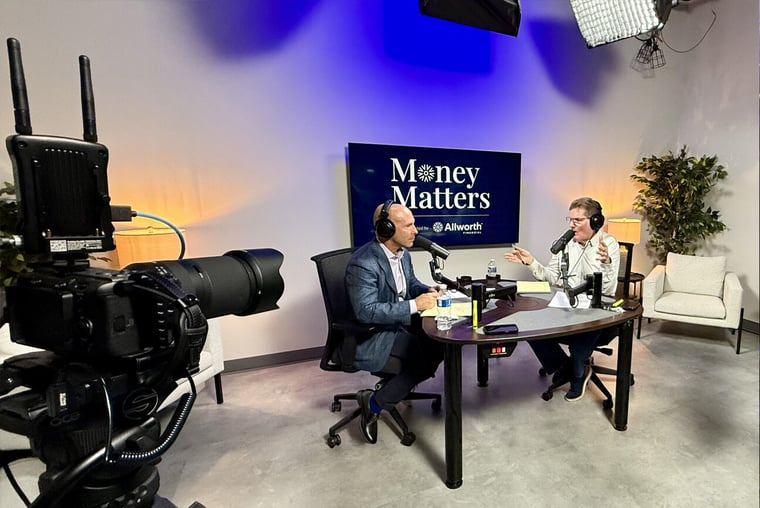
Selling Smart, Building Wealth: Business Exit Strategy, Tax Moves & Real-Life Financial Wins
In this packed episode of Money Matters, Scott and Pat talk with Simone Devenny, Allworth’s Head of Private Wealth Strategies, about smart planning before selling a business—covering tax-saving strategies, timing, emotional readiness, and more. Then, a caller shares how he sold his startup for $1.2 million, while another longtime educator seeks guidance on managing a $317,000 lump sum. Whether you're prepping for a sale or figuring out your next big financial step, this episode is full of practical advice to help you sharpen your business exit strategy, minimize taxes, and take control of your financial future.
Join Money Matters: Get your most pressing financial questions answered by Allworth's co-founders Scott Hanson and Pat McClain live on-air! Call 833-99-WORTH. Or ask a question by clicking here. You can also be on the air by emailing Scott and Pat at questions@moneymatters.com.
Announcer: Would you like an opinion on a financial matter you're dealing with? Whether it's about retirement, investments, taxes, or 401(k)s, Scott Hanson and Pat McClain would like to help you by answering your call. To join Allworth's Money Matters, call now at 833-99-WORTH. That's 833-99-W-O-R-T-H.
Scott: Welcome to Allworth's "Money Matters." Scott Hanson.
Pat: Pat McClain. Thanks for joining us.
Scott: That's right, as we talk about financial matters, both myself, my co-host, both financial advisors.
Pat: Yes.
Scott: Helping people with their finances...
Pat: For many, many years.
Scott: ...and financial planning and all that stuff [crosstalk 00:01:05] program. So, yeah. We got some great calls lined up. But before we go to the calls, we're talking with Allworth's head of private wealth strategies, Simone Devenny. And Simone's been on the program, I don't know, two or three times, I guess. So, Simone, thanks for taking some time to join us.
Simone: Thrilled to be here. How you doing, guys?
Scott: Good. I'm glad you're thrilled.
Simone: I'm always thrilled. Oh, no. Always thrilled when I'm talking to you [crosstalk 00:01:29]
Scott: Thrilled. Okay, good. So, you are, by formal training, you're an attorney, but you spend most of your career helping higher net worth folks minimize taxes, do the right kind of planning, and some advanced strategies with their, oftentimes, the family business, etc. Right?
Simone: That's right.
Scott: All right.
Pat: How many nut jobs have you had to work with in the last 20 years, Simone?
Simone: I mean, you know, I [crosstalk 00:02:03]
Pat: Like, crazy rich people. Like, crazy rich people.
Simone: Crazy rich, like crazy rich together, meaning, like, insanely rich, or crazy and rich?
Pat: Crazy and rich.
Simone: All of them.
Scott: All of them. Oh, come one.
Simone: I'm just kidding. I'm just kidding. No, I've gotten to work with all kinds of people. And as we know, the world is filled with all types of different people, and crazy is how we perceive it. But I would actually say, most business owners are the right kind of crazy. They tend to be risk takers. They tend to be builders. They tend to have a vision that a lot of the rest of us might not. Well, I know you have that vision, the two of you. But yeah, the best kind of crazy. I've seen a lot of them. I've worked with all kinds of different people, and seen many, many, many types out there.
Pat: You know, and the reason I ask that question, I loved, myself, I love working with business owners as well, because I find them just a little bit out there, just a little bit, like... They don't view the world the way the rest of us do, normally.
Scott: Well, they're normally not rule-followers, in the sense that they typically weren't the best students in, growing up in high school...
Pat: Check.
Scott: ...that went to the top schools.
Pat: Check.
Scott: Right? Those go into leadership management, and oftentimes, business owners, they do things a little bit differently. And oftentimes they weren't that excited about formal education, and didn't go to the top school. Sometimes they did, but oftentimes not, and...as I'm sure you can attest to that, Simone.
Simone: Yeah, I think a lot of times we're talking about people, you know, it reminds me of the, I think it was Mother Teresa or someone who said, "Be the change you wish to see in the world," and I think a lot of times, we're talking about people who are creative, and they wanna see something that isn't out there yet, and they'll go out there and do it. And a lot of times, that means there's not a playbook necessarily. They're building it as they go.
Scott: Yeah.
Simone: So, definitely a different, a little bit of a different mindset than your kind of more typical employee of a company.
Scott: Yeah. So, what kind of plan, what are some planning techniques that some of these business owners should be considering as they're contemplating their business sales? So, maybe they're not sure if they're gonna be selling their business yet or not, but they're getting up in age. They know that they have to do some sort of succession planning, otherwise someone else is gonna do the planning for them. So, what are some things they should [crosstalk 00:04:36]
Simone: I think that's a great question, Scott. And I think, you know, gosh, I find myself throwing around a lot of expressions that I can't attribute to anyone in particular, but another one that I heard recently is "start before you're ready." And I think that when we think about a business owner selling his or her business, I think maybe the best advice we can give is start preparing before you're ready. You know, a lot of times, you think about businesses transition ownership for a number of reasons. It can be by decision, right? But it can also be by death, by divorce, by disability. There are factors that we can control, factors we can't control, but I think the best advice for any business owner is, whether or not you already have a sense of precisely how you would ideally like to exit this business and sell it, start preparing now.
And I think what that means is, you know, there are a number of things to do. Obviously, we think about it, all kinds of considerations. Number one, obviously you know, on the wealth management side of things, we wanna be prudent about structuring things from a tax perspective. And often that involves pretty significant pre-planning. So, we also wanna think about how do we maximize what we're actually going to receive when we sell the company. So, even pre-tax, right? How do we maximize that number? How do we think about, you know, if we wanna transition the business maybe to our employees, things like an ESOP. But I think that no matter what a business owner hopes to achieve, you know, it's really important to start being intentional in thinking through all of the possibilities very early on.
Part of the reason for that is there are opportunities to structure businesses, pre-sale, and often significantly pre-sale, that can dramatically reduce the tax implications of that sale. Sometimes...you know, a lot of times you'll hear the guidance out there that, start preparing to sell your business one to two years before. I would actually say start thinking about it more than five years before. There's some special rules out there under the tax code, with certain types of businesses that can, you know, save you tens of millions of dollars in tax if you structure more than five years pre-sale. So, I'll pause there and see if there's anything [crosstalk 00:07:03] expand on.
Scott: Yeah. So, give us some examples of someone you've worked with in the last, I don't know, few years or whatever, on some advanced planning that you did prior to sale, and what the implications were for their, you know, the eventual proceeds.
Simone: Yeah. I'll give you a good one. I'll give you a good one. So, and actually, I think this kind of dovetails nicely. I think I can tell you a story of a family business. And this was, I think it was paint. I think they manufactured paint. But this particular family had been thinking for a long time, many, many years, about and when to sell the business, and how to properly structure that. And what this family did is actually, in a very recessionary period, when, you know, home-building was down and the economy was depressed, what they did is they set up some trusts for the benefit of the next generation. They transferred the ownership of the company into those trusts, while the company was not doing well. And then many years later, when they sold the company, all of the proceeds of that sale, and we're talking about a very high-figure sale, are now excluded from the owner's taxable estate. So, there's not going to be an estate tax implication if you do this right. This is an invisible transaction for income tax purposes. So, that would be one example.
Pat: So, they used up their unified credit, right?
Simone: Right.
Scott: Part of it, yeah.
Pat: Or part of it.
Scott: That's just the amount that we can transfer at our death, or while we're alive, without any estate or gift tax.
Pat: But they did it in a place in the economy which was super favorable to them.
Simone: That's right.
Pat: Super favorable.
Scott: Yeah.
Simone: That's right.
Scott: And you might have a business right now, something similar. The hard thing, though, Simone, is to actually do it in a time like that, because we don't know what the future's gonna be, and you're thinking...
Simone: Well, this is where the pre-planning comes in, Scott. So, you know when we said not 1 to 2 years, but let's start thinking 5, 10 years before. And the reason why is we know that the economy is cyclical. And so, if we have, just like with investing, if we have a long enough horizon, our opportunities are going to be better. So, you know, I think some advice to business owners, you know, all business owners who are contemplating an exit, at any time, is, number one, you know, get a valuation done of your business. This is one of the first things we tell business owners to do. Go out there, find an accounting firm, a CPA firm, a business valuations firm, and obtain a valuation, so that you know what that business is actually worth at this present time. Again, a valuation during a down market is really great for transferring assets out of your taxable estate.
Pat: It's incredible.
Simone: Right? So, there are a lot of reasons, but we always say, no matter what you're doing, prior to a business sale, you wanna have a valuation, because that allows you to undertake whatever type of estate and trust and tax planning you need to do. But that's sort of, you need to have that in hand. Another thing that we would tell business owners is, you know, look, a business owner is generally focused on one thing, and that is their business, right? I mean, this is, we see a lot of dedication. We see a lot of, you know, sleepless nights, and people pouring their lives into these businesses. But sometimes, you know, you're so head-down in the business that you're not thinking about, you know, you're thinking about now, you're thinking about the future state of the business. You're not, most business owners actually aren't thinking about their own personal enrichment. They're thinking about the business. But what we wanna say is, okay, you know, make sure you surround yourself with advisors. Oftentimes, you can have a board with outside advisors, you know, who can really help you take a step back, and have a look at, you know, how are we going to best position this business to be as strong as possible prior to a sale? I mean, there are things like, not just the valuation, but, you know, looking at obtaining what's called a quality of earnings report, right? You know, really arm yourself, as the business owner, with the best information that you can about your business, so that you're well-positioned to negotiate, you know, when you're ready to engage in the sale process.
Pat: And Simone, this is my general view of this. I have a number of friends that own businesses, some quite, quite successful. And when I talk to them about, you know, planning, they always tell me, "well, I never plan on selling the business." I'm like, "well, how's that work?" "Oh, I just never plan on selling it." I'm like, "So you're gonna die with this thing."
Simone: I was gonna say, it's like my former estate planning life, people who think, well, that's, you know, "I'm never gonna become disabled or pass away," and it's like, well, you know, odds aren't so good there.
Scott: Yeah.
Pat: So, do people not engage in, do they not engage in this kind of practice because they're afraid that it's gonna push them into a sale?
Simone: Yeah. I think, look, there's a lot of psychology behind this, right? There's a lot of psychology behind this. I think, by nature, and I always hate to make generalizations, okay, but by nature, business owners, entrepreneurs like to be in control. Right? They like to be in control, and in fact, in many ways, I mean, I could get super philosophical about this, but in many ways, when we're building something, it's the opposite of thinking about, you know, decay or death or anything. We wanna build. We wanna move forward. We're in growth mode, right? And it's keeping us very much alive. So, the idea, a lot of times, for people, you know, selling or parting with their business in any way, almost represents, like, a figurative, you know, checking out of life, or a death, right? And people don't like to think about that. It's, you know, but I think what we really need to be mindful of is, look, I think I mentioned it earlier, there are, whether we like it or not, there are circumstances in this life that are beyond our control. Disability, death, divorce, you know, these types of things. And I don't have percentages or numbers, and in fact, after this call, I may go do some research, but I'm very curious to know how many business owners actually transition or sell their business in the way that they choose, rather than having something that's happened to them.
Pat: Oh. Good point.
Simone: I think that'd be an interesting stat to come armed with next time.
Pat: You know, so, having, Scott and I have sold, when we sold the reverse mortgage [crosstalk 00:13:40]
Scott: Couple businesses.
Pat: Yeah, we sold a couple businesses, a couple times. And the way I described it was the same, I have four children, is the same, I felt almost the same way when my first child went to college as I did when I sold...
Scott: Elation?
Pat: No, kind of like, you knew it was gonna happen. You're a little bit sad. It's the end of an era. But at the same time, it's just all part of life. And when we took private equity for the first time, for Allworth, the emotion was almost the same as when I dropped my first child off to college, which was, yeah, I was a little sad, but at the same time, it was a little exciting.
Scott: Yeah, but little different than selling your business and walking away, taking on equity, and selling a chunk [crosstalk 00:14:28]
Pat: That's probably true. That's true.
Scott: So, real quick...
Simone: I mean, you've both been through it, right? You've both been through it. I think, look, there's a big component of this, which is very much an emotional component, that people don't think about. And I think you just said it right. You know, this is, someone's devoted their life to creating something, or, you know, it's like raising children or building a business. You know, there are a number of things. And stepping away is a challenge. And actually, there are those types of factors that we often encourage clients to think about prior to selling the business, and not just about the money. It's about who are you going to be if you are not the person running this business anymore, the owner of the business anymore. But we also think, by the way, with great planning, and a healthy financial outcome, what we often see is, you know, entrepreneurs, business owners, channeling the energy that they brought to their business, and they now have really carte blanche to go in a new direction and reinvent themselves, and typically [crosstalk 00:15:32]
Pat: They have carte blanche to drive their families crazy, by spending all that time at home.
Simone: No, no. This is how we help people think through. You know, my mother-in-law, by the way, when I got married, she said, "I have one piece of advice for you." You know, they'd been married probably 60, 70 years. She said, "For better or for worse, but never for lunch."
Pat: That's right. That's right.
Simone: And so, I think, oftentimes, you know, post-sale, especially if it's gonna be the type of situation where the business owner steps away, a lot of times, people will channel that into a new endeavor. It might be a philanthropic endeavor. It might be building something, you know, to solve a problem that they've seen. You know, most of the time, people who built successful businesses aren't just gonna go out and just spend every day playing golf. [crosstalk 00:16:21] some days, but not every day.
Pat: That's right. That is correct, so...
Scott: All right. Simone, thanks for taking some time.
Pat: Simone, as always, thanks for being part of the team at Allworth, and thank you for the advanced planning that you work with our hundreds of advisors across the U.S. [crosstalk 00:16:32]
Scott: Yeah. And often... Yeah, I appreciate your time, Simone.
Simone: Thank you very much to both of you, and again, I really was thrilled to be here, guys.
Scott: Oh, good. Thank you.
Simone: [crosstalk 00:16:40] take care.
Scott: And I've been in some client meetings with Simone, and she's got... There's a bunch of different kind of advanced strategies that... Every situation's so unique.
Pat: Yes. And then, her job is to take all the tools that are available, and apply it appropriately.
Scott: And every tool, there's a positive and a negative, right? There's consequence. Oh, you do this? Here's the good. Here's the downside.
Pat: Yes.
Scott: And it's trying to figure out which, kind of putting a puzzle together, what's gonna make the most sense for you personally, so... All right. We're gonna take some calls. We're talking with Trevor. Trevor, you're with Allworth's "Money Matters."
Trevor: Hey, guys. Hey, thanks for having me on. And I just wanted to say how much I appreciate you guys.
Scott: Thank you.
Trevor: I grew up in a family that really struggled financially, so, for a long time, I had kind of a negative relationship with money, but I think this podcast is really one of the catalysts that totally changed my perspective...
Scott: Wow.
Trevor: ...and it's really been the highlight of my week for past probably 10 years, so thank you, guys.
Pat: Holy smokes.
Scott: Wow. That's the nicest compliment I've ever received.
Pat: Trevor, how old are you?
Trevor: I am 39.
Pat: Oh, wow. And thank you for the compliment. Yeah, look, you know, we all have a relationship with money, that... Right? And I know I grew up in a family, I don't know what yours was like, Trevor, but there wasn't a lot sloshing around that place. And I know Mr. Hanson...
Scott: I had a tree-trimming business. I mean, I did that too, but, a paper route, not because I enjoyed delivering papers. I needed the money. There was no extra money for anything, right?
Pat: Yeah, yeah. Yeah, I get it. So, how can we help, Trevor?
Trevor: Yeah. So, I called to you guys for advice a few years back. I was leaving a government job to start a small technology company. And fortunately, I'm on the opposite end of that now. So, we were just... Our company was just acquired by a larger company about a week ago, so...
Scott: Wow.
Trevor: ...I've come into a little bit of money. I mean, it's not tens of millions, but to me, it's a lot. So, I was kinda just looking, wanting to get your opinion on what I should do with it.
Pat: Tell us about the rest of your life.
Trevor: Yeah. So, quick rundown. I'm 39. My wife's 38. She has a great, stable career. We have no kids. Our financial situation, between retirement savings, between IRAs, 401(k), brokerage, we've got about $900,000 in equities. And this is all prior to the sale. And then about $50,000 cash. Other than that, we have no debt. We also don't own a house. I don't think I mentioned, we don't have kids.
Pat: Yep.
Trevor: So, our life is pretty simple in that regard.
Pat: What's your wife's income?
Trevor: About $130,000.
Scott: And what's your plan after this? Are you continuing on with the company? Are you gonna do something different, or you don't know?
Trevor: Yeah. So, I'm continuing on for a while, for as long as they want me. There is a little bit of an earn-out, which, hopefully will get. Maybe, maybe not. We'll see. So, my plan is to stick around for a while, but I also kinda have the entrepreneurial bug a little bit now, some kind of itching to explore some other ideas as well, [crosstalk 00:19:49]
Pat: What is your income from the job today? Not the lump sum, but the income?
Trevor: It'll be about $150,000.
Pat: And how much money are you walking with pre earn-out?
Trevor: So, pre earn-out, the gross is about $1.2 million. And the majority of that is taxable capital gains.
Pat: Got it.
Scott: And will that be this year? 2025?
Trevor: Yeah. Unfortunately, an installment sale type of arrangement wasn't gonna work, so it's all gonna be just for this year.
Pat: Which is, actually, I would, I actually [crosstalk 00:20:23] like that. I like that. The fact that [inaudible 00:20:26] What's the earn-out look like if you hit all the numbers? And I assume it's a 24, 36-month earn-out?
Trevor: Yeah, it's 24, but it's kind of prorated, or, and phased. So, it's potentially up to another million dollars over the next year.
Pat: Wow, that's a big earn-out.
Trevor: Yeah, it was...it's a long story, but it was the best deal for us at the time. So, whether we get any of the earn-out or not, it was still a good deal for us, so, that was kind of why we [crosstalk 00:20:52]
Pat: Yeah, yeah. You sold it at eight times your income, which isn't bad for a company that's relatively new.
Scott: Yeah, congrats. Good for you. Pretty exciting.
Pat: Yeah. And, and by the way, there's probably some big hurdles in that million-dollar earn-out, so swing at it, and if it doesn't happen, it doesn't happen.
Scott: No, kudos to you.
Pat: Yeah.
Scott: [crosstalk 00:21:08] how fun is this, though?
Pat: Oh, it's so much fun. How many, Scott and I have, we've started a number of companies together. We've started, I think, five, three of which we talk about. [crosstalk 00:21:23]
Scott: [inaudible 00:21:23]
Pat: It doesn't always work. It doesn't always work. So, are you gonna buy a house anytime soon?
Trevor: That's a great question. So, we've owned in the past, and we're kind of between houses right now. We have a tendency to not stay in one place for too long, so I think that's been the main reason. And with having this start-up the last couple years, I just haven't had the stability, so I'm kind of on the fence. I'm not itching to buy anytime soon. So...
Pat: And do you believe that you'll...
Scott: You think you'll start another company?
Pat: Do you believe that you'll procreate in the future?
Trevor: We're not planning on it.
Pat: Okay.
Trevor: It seems unlikely. I mean, you never know, but it doesn't seem like it.
Pat: Okay. All right. And then, Scott, your question?
Scott: Yeah. Do you think you'll start another company?
Trevor: I would like to. I've got another kind of project in the works, that hopefully will go somewhere. So, yeah. That's my eventual goal. I think that's my longer-term plan.
Pat: This last company that you were in the ground floor, were you part of the formation of it, or did you grow it after it was, did you join after it was formed?
Trevor: Yeah. I was one of the two co-founders.
Scott: Cool.
Pat: Okay. And how did you finance this one?
Trevor: It was bootstrapped.
Pat: Okay. All right. I love it. And what a great story.
Scott: Yeah. What's your question?
Pat: Yeah. What's the question?
Trevor: Yeah. So, with that, you know, just the lump sum that I got, I'm trying to figure out what to do with it. And I'm not, you know, I've got it basically sitting in a money market right now. I'm just trying to get some...trying to get your opinion on it, what I should do with it.
Scott: If it were me, if I were 39 again and it were me, I'd put it in treasury bills right now.
Pat: I'd do half of it.
Scott: Half in treasuries and what else?
Pat: I'd invest the other half for the long term, in a direct index.
Scott: I wouldn't because... who knows what you're gonna need for your next company?
Pat: I know that. That's what my thought is, though.
Scott: Okay.
Pat: Right?
Trevor: Yeah. It's interesting. I wasn't actually expecting you guys to go the treasury bill route. Yeah. My first instinct was kind of just, you know, trying to figure out maybe what I need for, to seed this other company, and then throw the rest kinda just into [crosstalk 00:23:40]
Scott: When did you start this company?
Trevor: End of 2020.
Scott: Okay. So, five years, you created, in addition to making some salary, you created 1.2 million bucks for yourself.
Trevor: Yes.
Scott: You've got another idea. Can this other... Do you think this other idea is better than the previous idea?
Trevor: You know, I think it is, but I guess time will tell.
Pat: So that's, and so...
Scott: I mean, the way for true wealth is not investing in index funds or anything. It's in your own career, in your own business.
Pat: Understand. But he's got a track record now, and he can raise capital much easier this time than he would have been last time. And so, Scott, where I'm saying is, I'd sweep half. I'd sweep half, and call it long-term savings, and it's not touchable. That's for my retirement. The other half, I'd leave in the game, and then anything from the earnouts, I'd actually leave in the game.
Trevor: Okay. Yeah. [inaudible 00:24:36] and that's why I wanted to talk to you guys, because I was [crosstalk 00:24:40]
Scott: No, I mean, I'm with you on that, because you're saying, instead of putting all the...because things don't always work out, right?
Pat: Well, and the problem he has is that he started a company, and it's really, really difficult to go back and go to work for someone else after you've lived in that adrenaline-filled cage for a year or two or three.
Scott: Yeah, so [crosstalk 00:25:01]
Trevor: Yeah, I just got out of a corporate meeting, and I was struggling a little bit.
Pat: You're kidding.
Trevor: Try to get back in to that [crosstalk 00:25:07]
Pat: I have never done that before. Oh, my. We sold a company to Genworth, which was a spin-off of GE. Oh, my. I gotta tell you, Trevor, it was pure pain to sit in a meeting with these guys from corporate. Oh, it was awful. I actually...
Scott: We didn't last very long.
Pat: We were there...we actually pushed our earn-out forward, and got out in less than a year. We were supposed to have a two-year earn-out, Scott and I...
Scott: I think four months. Three, four months.
Pat: Oh, it was so bad. Yeah, so I feel what you're going through.
Scott: And we didn't get a dime of the earn-out, by the way.
Pat: We didn't get any of the earn-out, but they were jerking us around all the way through.
Scott: Well, be careful. I think there were some NDAs or something. I know that was a long time ago, but...
Pat: Come after me.
Scott: You think any of those people are still around?
Pat: No. No. They all... Remember they'd talk about their MBAs all day?
Scott: Yeah, yeah.
Pat: Oh. Anyway. Yeah, I like the idea, and I'd use it [crosstalk 00:26:04]
Scott: So, the idea behind this is allocate some... And I agree with Pat. Allocate some portion. What of this do you wanna have for your long-term, your, to increase...
Pat: You and your wife.
Scott: Yeah. Your base there. And then what do you wanna put at risk for the next business? And whatever you're gonna put at risk, I would just have in treasuries, or money market account, or something along [crosstalk 00:26:28] CDs or something.
Pat: Yeah.
Scott: Not CDs. [crosstalk 00:26:31] liquid.
Pat: But I would take that $600,000 and call it retirement. And I would put it either... You could fund Roth IRAs. Do whatever you need to do on that side to make it more efficient. But the rest of it, I use direct indexing.
Scott: But if you think it's gonna take more cash than that to get this thing going, or if you had the cash, you can hire some people quicker, and run quicker and faster than... I would start with that number first.
Pat: That's right. And I'd use 100% of the earn-out to push towards the treasuries in order to do that. But remember, it's so much easier to raise capital on your second time at bat, rather than the first time.
Trevor: Absolutely. Yeah, and I appreciate that. I really hadn't even thought of that, so... I do have a quick question on direct indexing if you have time.
Pat: Sure.
Scott: Yes.
Trevor: So, I've heard you guys talk about that quite a bit. And I don't have an advisor. I've just been managing stuff through Vanguard as the institution, and I went to Vanguard and was looking at direct indexing, and it seemed like it was all through... All the information was for advisors. Is that something that people can directly access [crosstalk 00:27:36] advisor?
Pat: Yes.
Scott: Yes, you can.
Pat: Yep.
Scott: Maybe...I don't know if that particular company has it for...
Pat: Yeah, but any big, the large custodians, you actually can. And they charge.
Scott: Yeah. They do. I think Schwab advertises it.
Pat: Oh, [crosstalk 00:27:49] Yeah. And Fidelity.
Trevor: Okay.
Pat: Yeah.
Trevor: That's fantastic. Well, I really appreciate the advice.
Scott: All right.
Pat: Hey, listen. Congrats.
Scott: Yeah, congrats.
Pat: I mean, how did it feel when you took the offer from the corporate overlords?
Trevor: Yeah, the due diligence took so long that I think by the time it was over, it was more of a release, but I did splurge and buy new brake pads for my [crosstalk 00:28:16] truck [crosstalk 00:28:16]
Pat: We're gonna tell you a story, though. So, Scott and I sold this company to, like I said, it was a spinoff of GE. It was called Genworth, and it was a company that Scott and I had started and sold within, like, four [crosstalk 00:28:34]
Scott: Three and a half years.
Pat: Okay. Within four years. And it was a reverse mortgage company. Didn't have anything to do with our investment advisory firm. We just did it on the side. And it grew quite quickly. We had 200-plus employees when we sold. So, we're in the room, and they're transferring money over to the accounts. And we're just state school kids, right? I mean, we're just like, "yeah, we don't know what the...we're doing," right? The whole thing. And so, these guys are sitting around this big conference room table, and they're like, they move the money over, and they're like, "What are you gonna do with that money?" And what did you say to him, Scott?
Scott: I'm buying a new bicycle. That's all I wanted. [crosstalk 00:29:13] I wanted a new road bike.
Pat: Yeah.
Scott: A nice road bike.
Pat: A nice bike.
Scott: I want a new road bike.
Pat: And they're like, they're staring at Scott, and then they're, like, they come to me, and they're [inaudible 00:29:21] "What are you gonna do with the money, Pat?" and I said, "I'm gonna get HBO and Showtime." And they just [inaudible 00:29:29] which may have been one of the reasons we didn't last long with that corporation.
Scott: Maybe the smart-aleck responses given on the first, seconds after closing.
Pat: Don't do that.
Scott: At least mine was somewhat sincere.
Pat: Mine wasn't.
Scott: Do you listen to the podcast, that "Built to Sell?"
Trevor: Yeah, actually I [crosstalk 00:29:54] about that from you guys. Yeah. So, I [crosstalk 00:29:55]
Pat: "How I Built That."
Scott: "Built to Sell."
Pat: "Built to Sell."
Scott: "Built to Sell."
Scott: You listen to both?
Trevor: Both of those I heard about from you guys.
Scott: Oh, yeah. They're great.
Trevor: [inaudible 00:30:03] fantastic.
Scott: They just did some really interesting... You ever listen to "Built to Sell?"
Pat: [crosstalk 00:30:06] I've never even heard of it.
Scott: Oh, it's awesome. You hear about this one... I appreciate the call, Trevor. Wish you well.
Pat: Call us anytime.
Scott: No, they, [crosstalk 00:30:12] listen to one of this guy's life...
Pat: Hey, call me when you start your next company. I'm interested.
Scott: This guy's life became miserable after he sold his business for millions of dollars. And he just...they, the whole... They've got all kinds of different...they're mostly smaller businesses, about the kind of size of Trevor here, a lot of them. And they just talk about their process of, they built, started the business, they sold it, how the process went. What's life for them working, like, for now?
Pat: Are most of them happy, or...?
Scott: Yeah.
Pat: Except for this one guy?
Scott: Oh, super interesting.
Pat: Which is why you focused on him, the unhappy person?
Scott: I listened to it several times.
Pat: "Built to Sell." All right.
Scott: Yeah.
Pat: Got it.
Scott: John Warrillow. I actually interviewed him, the host. I'm doing a book on selling your business to private equity or private equity-backed firms, and he was a good person to talk with.
Pat: Yeah. And you're still working on it?
Scott: Yeah. With Forbes Books.
Pat: Oh. How's it going?
Scott: It's going.
Pat: All right. Let me know when you...
Scott: Yeah. When I interview you?
Pat: No, don't interview me. Don't interview me.
Scott: All right. Talking now with John in California. John, you're with Allworth's "Money Matters."
John: Well, hello.
Pat: Hey, John.
Scott: Hi, John.
John: First, I wanna say thank you. I called two years ago, and I told you a story about my 50-year-old wife who, on her birthday, decided she wanted to have a baby. And then you told me about getting Social Security when she turned 62. Well, she just turned 62, and we've been collecting Social Security on behalf of our kid, so I really appreciate that advice you gave me.
Pat: Go...
John: Hey, money in my pocket.
Pat: Yeah. Listen, they set up the rules.
Scott: They set up the rules.
Pat: They set up the rules. Well, good. And so, you have a... How old's the...?
John: I have an 11-year-old. My wife's 62, I'm 60, and our kid is 11.
Pat: Oh, very nice. Very nice.
John: And so we have lots of adventures.
Pat: All right. Well, it's good to catch up. Do you have any questions for us?
John: My question is I'm getting ready to retire from CalSTRS. And I've been with them for 25 years, as an elementary school teacher.
Scott: Oh, wow.
John: But I also taught a college in the evenings. And all of the college contributions were covered under CalSTRS as well, but they didn't count to my service credit. They were put into a, what they call a supplement savings account.
Pat: Okay.
John: The supplement savings account is worth $317,000.
Pat: Holy smokes. You taught a lot.
John: Well, I love college. College is awesome. I teach music. I'm a lucky duck.
Scott: Oh.
John: So, the decision-making, when you're sitting at the STRS desk, they kinda just throw a bunch of numbers at you, and ask you what you wanna do. I need to decide how to take that $317,000. I can take it as a lump sum payment. I can roll it over into some vehicle, because it's pre-tax money. They will offer me payouts over a 3, 5, or 10-year period, a monthly payout. Or they'll offer me a lifetime annuity.
Pat: Okay. Let's just go with the 10-year. So, what is the...because that's a easy one to calculate. What we're looking for is an internal rate of return on that $317,000, to determine...
John: Sure, [crosstalk 00:33:26]
Pat: ...whether you should take a pension or a lump sum. So, if they paid it out beginning, what, next year? Today?
John: Yes. So, if they start paying, [inaudible 00:33:35] yeah, if I retired today, they would pay me $3,651 a month.
Pat: For 10 years.
John: For 10 years.
Pat: Scott?
Scott: I'm working on it.
Pat: Thanks. [crosstalk 00:33:46] So, what this is is, what we're trying to do is we're calculating...
Scott: How much was the monthly again?
Pat: It's $3,651 for 10 years, beginning now. So, what that means is we're doing a calculation that if I took $317,000, and I put it [inaudible 00:34:05], and I paid out $3,651 a month for 10 years, what rate of interest do I need to earn on that money so that at the end of 10 years, it is zero? Because what you're doing is you're exchanging $317,000 for a stream of payments for 10 years. And we know it's not a zero interest rate. My guess is it's probably 6.5%, but Scott's actually doing the math. And what determines whether you take the pension or lump sum is that, well, not only that, but that interest rate that's internal. So if it's a low one and you think you can do better, then you actually take the lump sum. What other assets do you have outside of this?
John: I have about half a million dollars in a 403(b) account, about $135,000 in a Roth IRA, and about $85,000 in a brokerage account.
Pat: All right. Is your house paid for?
John: I have a...my house is worth $1.2 million, and we owe $400,000, and we're on a 15-year, 2% mortgage.
Pat: Okay. All right. Makes sense.
John: And then we have a vacation home that's paid off.
Pat: And do you...is the vacation home a rental, or just a vacation home?
John: No, it's just a vacation home.
Pat: All right. And does the wife work outside of the home?
John: She's recently retired from STRS.
Pat: Okay. So she's got a pension as well. So, you've done that math.
John: [crosstalk 00:35:37] Her pension is about $94,000 a year.
Pat: And how much will your pension be?
John: My pension will be about $72,000 a year.
Pat: And did both of you take a full joint and survivor? Which means...
John: Oh, like a...
Pat: ....on her pension, if she dies, you get the same amount that she's getting?
John: No. Actually, we're both half.
Pat: Okay. So you took half.
John: We took half.
Pat: Got it.
John: Hey, I figured out what you're asking.
Pat: Okay. Do you have life insurance on yourself at all?
John: I have $450,000 of life insurance.
Pat: And your wife?
John: $300,000.
Pat: Perfect. All right. You guys are in good shape. What's the number, Scott?
Scott: It looks like it's about 6.8%.
Pat: I said 6.5% was my guess. So, what this means is, if you took this as a lump sum and invested it, you would roll it into an IRA. You said you're 60 now?
John: That's correct.
Pat: And you received more than 6.8% over the long term, then you're better off taking this. And I know exactly what I would do. Scott, you looked at me like this is a no-brainer.
Scott: No, I was running the numbers, and didn't hear the rest of his financial situation, so I don't know what I would advise.
Pat: Oh. He's got $500,000 in a 403(b), $155,000 in Roth, $85,000 in a brokerage, owns a home at $1.2 million, $400,000 of debt, vacation home. The kid is young, but between the two of them, they have approximately $160,000 in pension?
John: That's correct.
Pat: And they took both joint and survivors at 50%. I'd roll this thing into an IRA, and not touch it.
Scott: I would too.
Pat: I wouldn't touch it till I was 75. I might use it to pay for the kid's education.
John: Well, yeah. [crosstalk 00:37:31]
Pat: But, but, but you don't need the income now, right? You're gonna be able to live quite comfortably on those pensions, correct?
John: That's correct, sir.
Pat: And so, the idea of actually then adding it to my taxable income, rather than deferring it... And the rate of return that you need to receive is greater than 6.8%, which, look, if it's properly invested...
Scott: Over a long period of time.
Pat: ...over a long period of time, it's properly... And I wouldn't expect that you're gonna, other than maybe use some of it for college education, I wouldn't... But you're a music teacher. He's probably gonna go to school on a music scholarship. Yeah, I would absolutely roll this into an IRA, and invest it.
John: Right on.
Pat: And I'd put that 403(b) in, that $500,000 in a 403(b), and this $317,000 in a, same IRA, and if you're not comfortable managing it, hire a firm to do so. Don't buy any exotic index annuities or any of that other crap. You're just gonna be... You're gonna invest it the same way that CalSTRS has it invested.
John: Got it.
Pat: Right?
Scott: Similar.
John: Well, awesome. [crosstalk 00:38:36]
Pat: Not identical. Similar, but not identical.
Scott: Yeah.
John: All righty.
Pat: All righty?
John: Well, thank you very much.
Scott: All right, John. Appreciate it.
Pat: Congrats. Congrats on the retirement. And what grade do you teach in elementary school?
John: I teach kindergarten.
Scott: Oh, my goodness.
Pat: And then you go into college...
John: I'm a [crosstalk 00:38:51] kindergarten teacher. But I go to college...
Pat: You're not a music teacher. You're not a music teacher in kindergarten...
John: No, I teach kindergarten. Kindergarten. But I do a lot of music in my class. But then in the nighttime, I go teach college, and the clientele is kind of the same, because, you know, the little kids and the grownups are excited to be there, you know? They're excited about being in school, so it's a lot of fun.
Pat: How long have you been a kindergarten teacher?
John: Twenty-two years.
Scott: Wow.
Pat: Thank you for your service.
John: [crosstalk 00:39:22] Thank you.
Scott: Yeah, wish you well, John. We appreciate the call. Wanna let everyone know about a webinar that we've got coming up. Yes, another educational opportunity for you. This is a case study in multimillion-dollar portfolio optimization, so, we're getting kind of a case study that we're gonna be looking at. And Benjamin Abraham, he's one of our Allworth partner advisors, he's the one doing the webinar. I think you'll like hearing from Benjamin, very smart individual. But in this, what you're gonna learn is you're gonna get some behind-the-scenes, really a breakdown of how our in-house experts, and some of the latest industry-leading tools, technology, have helped a high-net-worth couple do several things. First of all, eliminate some costly capital gains, with some tax-smart restructuring. Building, just, frankly, building some confidence, through retirement income modeling, so they had more confidence about their future, and refining their portfolio to unlock some long-term flexibility. So, just giving some flexibility on that. So, this is really designed for those that have saved or accumulated more than $2 million of investible assets. The webinar, to take part in it, to view it, Wednesday, December 10th, at 10 a.m. Pacific, Thursday, December 11th at noon Pacific, and Saturday, December 13th, at 9 a.m. Pacific. So, you're gonna wanna register to take part of this. Simply go to allworthfinancial.com/workshops. You can enter your information there, and also, if you're like, "Eh, I don't know if this is gonna be for me," you can learn a little bit more about it there as well. So, appreciate you being part of Allworth's "Money Matters." This is Scott Hanson and Pat McClain. See you later.
Announcer: This program has been brought to you by Allworth Financial, a registered investment advisory firm. Any ideas presented during this program are not intended to provide specific financial advice. You should consult your own financial advisor, tax consultant, or estate planning attorney to conduct your own due diligence.
Insights for Complex Wealth Decisions
Join our email list for exclusive commentary from our Chief Investment Officer, early access to expert-led webinars, and your complimentary Wealth Planning Checklist for Complex Portfolios.
We take your privacy seriously and respect your privacy choices. By submitting this information you agree to our Terms of Use Agreement, Privacy Policy, and to receive important notices and other communications electronically.