
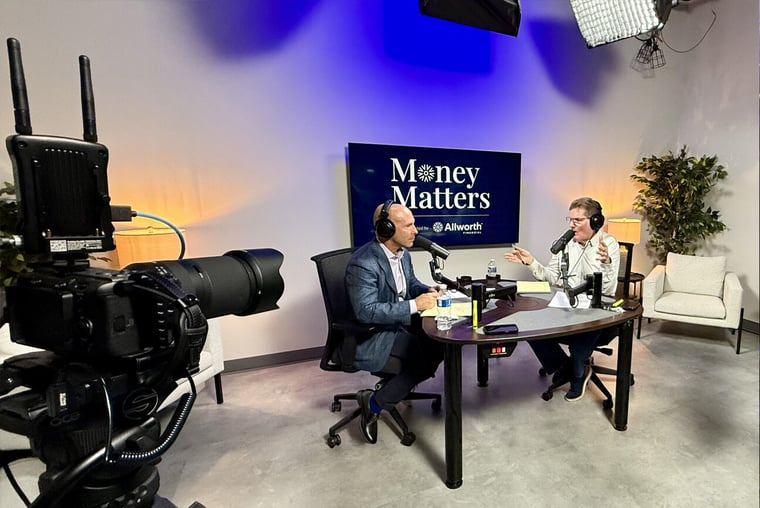
Portfolio Case Studies: Roth Conversions, Life Insurance, and RMDs
Should you use permanent life insurance to cover long-term care? Does converting a $1M pre-tax account before you stop working make mathematical sense? In this episode of Allworth’s Money Matters, Scott and Pat walk through real-world portfolio case studies, dissect common tax myths, and break down where aggressive financial pitches fall short.
Topics covered in this episode:
The Rise of Prediction Markets: Why momentum traders are shifting from crypto to event betting, and how speculative traps disguise themselves as investing.
Commercial Real Estate Realities: A look at how major leveraged properties can collapse, and the timeless importance of broad diversification.
Caller Case Study (Jonathan): Evaluating a seminar pitch on life insurance with long-term care riders, understanding pure insurance costs, and deciding when self-insuring makes sense with a $2.5M portfolio.
Caller Case Study (Jeff): Debunking the “zero taxes” pitch. Scott and Pat explore the math behind Roth conversions, the difference between marginal brackets, and why high earners shouldn't rush conversion timing before RMD age.
Join Money Matters: Get your most pressing financial questions answered by Allworth's co-founders Scott Hanson and Pat McClain live on-air! Call 833-99-WORTH. Or ask a question by clicking here. You can also be on the air by emailing Scott and Pat at questions@moneymatters.com.
Scott: Welcome to Allworth's "Money Matters." Scott Hanson.
Pat: Pat McClain. Thanks for joining us.
Scott: Yeah, talking about financial stuff, taking some calls.
Pat: We've been doing this for how many years, 30? How old's your daughter?
Scott: She's 30. She'll be 31 in December.
Pat: So we've been doing it for 31 years.
Scott: Thirty-one years. Good times, most of them. Hopefully it's we have 31 years of experience, not 1 year 31 times over.
Pat: Yeah, actually it's probably 2 years of experience, 15 and a half.
Scott: Yeah, that's probably fair.
Pat: So Scott, I wanted to bring up...I read this article this last week and I really had to smile because...it was in "The Wall Street Journal" and the article was called, for many individual traders, "Prediction markets are hot and crypto is not." And I thought, okay, I gotta read...
Scott: Are these young people primarily?
Pat: They're momentum investors.
Scott: Speculators.
Pat: The hot new thing, yes, speculators, right?
Scott: They've moved from GameStop to...
Pat: Well, they're crypto, GameStop, back to crypto.
Scott: And now it's prediction markets.
Pat: And then it's prediction markets. And then the hot AI trades, if they could get involved in them. But, "AI trades stole Bitcoin's thunder. The cryptosphere is losing some of its most loyal traders to bet on soccer matches and congressional elections." So the crypto is still...
Scott: And you know what's strange about these prediction markets is like some of the big brokerage firms are getting involved in them.
Pat: When the ducks quack, feed them. They're not interested in what the clients do. They know there's a trade to be made and they don't care whether they're trading, in "Trading Places," hog bellies or orange juice futures.
Scott: The movie.
Pat: The movie. They're just, "Tell him the good news, Mortimer."
Scott: At the end of the day, whether a client makes money or loses money, we still get paid. That was the answer.
Pat: That was the answer in...That's not our answer, but that's "Trading Places" answer. So the world's biggest digital currency recently traded. This is at Bitcoin, if you haven't guessed, $79,000 per Bitcoin, down from a record of $126,000 in October of 2025, down 37% below its record. The thing I always thought about Bitcoin is because it was almost an anonymous buy and sell, you could own multiple market, you could own multiple wallets, and then those wallets could be attributable to one people or a group of people. It seemed like the price could be manipulated. And it's the same thing they kind of did with a meme, but they were using crowdsourcing social media to manipulate markets. These trades are not dissimilar because many of them are actually...there's insider trading taking place where people are actually...
Scott: Prediction markets?
Pat: Yeah.
Scott: Stuff I've seen, a lot of it's a scam.
Pat: It seems to be. It seems to be.
Scott: Well, they have these fake ads.
Pat: Well, that's true. Yes, right? I listened to a series of podcasts about the fake ads...
Scott: Fake ads.
Pat: ...where they actually...
Scott: They filmed them after the event took place?
Pat: Or they had a website that looks like Kalshi, but actually rather than an L, it's an I. And on the ad, when you look at it, you can't see it really clear, but it's just a complete fake website. So there is a place in crypto. The banks are moving into crypto. They're moving into a crypto that trades on a free market or a dollar denominated fixed stable coin is another question altogether, which makes complete sense to me to have stable coins.
Scott: A stable coin for commerce.
Pat: For commerce, yeah. Especially international trade.
Scott: For commerce.
Pat: And for illegal [crosstalk 00:04:37.237] Right? I just thought it was interesting that this group of people have moved on.
Scott: It's mostly younger men. I don't know. Yeah, they're that typical person betting. They're losing money over the long term.
Pat: Well, according to Kathy Mellibronk, a 36-year-old trader and fashion stylist in New York, this is a young lady, or at least she uses a young lady's name, "I just felt like I had better luck at the roulette table with prediction markets versus crypto." So when you said speculators, she actually compared both the prediction markets and crypto to a roulette table.
Scott: Okay, well, there we go. She even thinks that way.
Pat: Yeah, so she's not even trying to confuse herself that this is investing. Strange world. What will be next? What will be the hot fad next?
Scott: I don't know, but I read an article a week or so ago. It's not a hot fad at all, just how things can change. And it was about in San Francisco...San Francisco had a massive mall, shopping mall.
Pat: 1.4 million square feet.
Scott: Yeah, huge. Couple major anchors. This is in downtown San Francisco.
Pat: Westfield was part of it. I remember going into that mall more times...one time would be more times than I wanted to, but I have been in that mall probably a dozen times.
Scott: That's more than I...only a couple times I've had.
Pat: It was...
Scott: Painful, yes.
Pat: It was okay, it was enjoyable.
Scott: But that had a valuation of $1.4 billion, $1.5 billion, something like that, prior to COVID, eight years ago. And now it's worth, maybe it's going to go on the auction, maybe $120 million, maybe. A 90% decrease. And there was some debt on it, so the equity holders completely wiped out.
Pat: And then the bond holders.
Scott: So you think about this, Pat, you do a real estate play. Let's say someone's, hey, we're going to put you in this REIT, it's got 50% leverage, so you've got plenty of downside room, 50% leverage. I mean, no way is it going to fall by 50%. And here we have something like this...in San Francisco.
Pat: Oh, Scott, that's exactly what I thought when read the article.
Scott: What?
Pat: What you just described, which is you go into these things thinking, look, how could there be any downside? We're at 50% debt to equity.
Scott: And we have all these tenants. And even if one goes bankrupt, another one's going to pop in.
Pat: And then eight years later, it's all boarded up now. Yeah, and they actually don't know what they're going to do with it because of the regulatory environment and who actually owns the ground.
Scott: But as I'm reading it, I just thought about from an...We've been financial advisors for 30-some years, right? So a lot of it is making sure that people have wise choices with their finances. Most people are more concerned about not going poor than they are about becoming wealthier, particularly as they get older.
Pat: They get confused at times.
Scott: Of course. But it's really about protecting wealth oftentimes as we get further down in life. And a certain type of investment that almost seemed like, you could think, well, maybe the returns going forward wouldn't be all that great, but you would certainly not think this is an asset I'm going to lose 100% of my principal.
Pat: You certainly would not think that.
Scott: Right? Any real estate deal with 50% leverage, you wouldn't think you're going to lose. But this is just one example of many. I mean, the office complexes, there's still many of them.
Pat: Oh, way underwater. Yeah. It just reminds me of, I knew this gentleman and he was building a hotel and he was looking, raising capital, and he showed me the financials before he actually broke ground. And he said, "What could go wrong? Tell me, Pat, look at this deal. What could go wrong?"
Scott: Let me tell you, let's list them out.
Pat: I said to him, "How much time do you have?" Because the thing that will go wrong is not even one that we would list on a piece of paper.
Scott: Well, you look at San Francisco...
Pat: Part of it was COVID.
Scott: And part of it was the whole George Floyd backlash and suddenly defund the police and let the mentally ill and drug addicts have free reign.
Pat: And then part of it was the regulatory environment of actually turning them all around or repurposing it.
Scott: That's correct.
Pat: Right? So that took value away. And then someone's like, well, you know, maybe I should buy this thing and I could repurpose it into an indoor sports center. And then they think, you know, I've been looking at 12 other deals. Although that's probably a good idea, these 12 other deals that I'm looking at actually have less headache and maybe a...
Scott: This is in San Francisco. The city is on fire, most of the real estate market, except for this big hole in the middle of it.
Pat: That's right.
Scott: And probably some other outliers, but...
Pat: Yeah. But again...
Scott: Because of AI.
Pat: ...diversified portfolios is where it comes down to.
Scott: A hundred percent.
Pat: And, look, if you've been an investor for a long time, or any amount of time, you're going to have some losers.
Scott: Of course.
Pat: I don't care how good you are. I do not care how good you are. If you ask Warren Buffett, you know, what are you most proud of? He will oftentimes point to things that he lost money on because...
Scott: What lessons you could learn. Well, and it also...It's funny. I was having this conversation over the weekend with...last weekend with a long-term friend of mine. He's been in tech his whole life. And I said, "What...?" He's worked for a lot of different startups. I said, "What percentage of business success is actual good execution and the other is just luck?" He says, "The older I get, the more I think it's just luck. Luck of you're in the right place, the right time, the right introduction, the right technology. A lot of it's just learning."
Pat: The right age, right? You got the right colored shirt on so they hire you. Whatever. Yeah.
Scott: Anyway, as you often say though, luck counts too.
Pat: Luck does count. You have to actually be in the game to get lucky.
Scott: Yeah, that's right. All right. Let's take some calls. By the way, if you want to join us, we'd love to take your call. The best way to schedule a time...and we record every couple of weeks. We'll sit in the studio, take calls so that we can schedule a time that's convenient for all of us. Just send us an email, questions@moneymatters.com. Again, questions@moneymatters.com. We're starting with Jonathan. Jonathan, you're with Allworth's "Money Matters."
Jonathan: Hey guys, how's it going?
Scott: Fantastic.
Jonathan: First of all, I'd like to thank the two of you for helping me develop my mantra. I retired in 2020 and after going through the four phases of retirement, I went back to work in 2022. People would ask me, "Why are you coming back to work?" And I said, "Work is an option, not an obligation."
Scott: Yes. Good for you.
Jonathan: Thank you so much. And I want to thank you guys for that.
Scott: Well, it does change your mindset though, doesn't it?
Jonathan: Absolutely. Absolutely. I went to a seminar, my wife and I, here recently. It was called The Changing World of Retirement Planning. And of course, first they were waiting for the pitch. But the presenter talked about old paradigms and new paradigms. And the old paradigm was that Social Security pension in retirement, your savings, you're going to be okay. And the new paradigm shift was higher tax rates. Well, he went into this whole program talking about [crosstalk 00:12:40.740].
Scott: Sell life insurance.
Jonathan: Yeah. That's what I'm calling it.
Scott: Is that what it was?
Jonathan: I want to know...Yes, that's what it is. He said, if you're looking at long-term care, they have a new program called long-term care insurance, or long-term care insurance with long-term features. Life insurance with long-term features.
Scott: Yes.
Jonathan: So right away, I'm waiting for the pitch. And the pitch never came the first day. So it was a two-day event. And he talked about history and taxes. And in 1943, the top marginal rate was 94%. It blew the class away. And in the '70s, it was 70%. And he said, right now in 2020, at 37%, you're in the best tax rate you could be in. So the next night...
Scott: But no one actually paid those rates.
Pat: Yeah, there was the time because of the deductions that would go up against that. So anyway, but the headline is appealing.
Jonathan: Right. Right. So the pitch was life insurance with long-term care. This is how we can protect you against loss and pay for long-term care expenses. So I was telling my wife, we can self-pay. And she said, "We don't have enough. We don't have enough." And I said, "Well, let me call Pat and Scott [crosstalk 00:13:57.033]."
Scott: Okay. Let's back up for a minute. I want to briefly talk about the tax benefits of life insurance, because this is how it's usually pitched, and then how you might get those same tax benefits in other types of investments.
Pat: But Scott, and then I'd like to talk on the pros and cons of a long-term care policy in a life insurance policy, which by the way, it might surprise people, I'm not opposed to...
Scott: I'm not either.
Pat: ...if it's used appropriately. So let's spend a minute about how they sell the life insurance because of what's called LIFO and FIFO.
Scott: Yeah. So life insurance, different than a lot of other types of investments. You invest money, we're talking about a cash savings type of...so whole life, universal life...
Pat: Variable universal life.
Scott: Something that has a savings element to it, equity index, universal life or whatever. That excess money is invested and it grows tax deferred. All right. So let's say you put in some money in a life insurance policy, whether it's an annual basis or a lump sum, it all grows tax deferred.
Pat: Okay. So can I step back for a second?
Scott: Yes.
Pat: So let's just say you have a premium of $36,000 a year and they say, we want you to put $3,000 a month into this policy, or we want you to put $200,000 into it. What happens is a portion of that money goes to pay for the pure insurance, the mortality risk at your death. And that is a component inside the insurance. It's called pure insurance or mortality risk. So a portion of that just goes to pay for that. And then some goes to administration, some goes to commissions, and then there's an excess. And this is either invested in a bond fund or what they call their home office fund, whatever it is, right, it's some sort of investment. In a variable universal life, you choose the investment. So you're depositing more than the cost of the insurance. Continue, Scott.
Scott: Yes. And as long as you don't violate the MEC guidelines or whatever...
Pat: Modified endowment contracts.
Scott: ...it'll grow tax deferred. And then later in life, you can withdraw all of your deposits without any taxes.
Pat: Which sounds great.
Scott: So let's say you end up putting 100 grand into something. And let's say the cash value is worth 200 grand down the road. Just throwing some numbers out. You can say, hey, I need 50 grand for a car. I want money for this or whatever. You can pull out all of your deposits first before you have to pull out the earnings. Then once you go to your earnings, you can tell the insurance company, hey, you know what? Instead of withdrawing it, why don't you loan me my own money? And so you can borrow against the policy, and therefore, you never pay taxes because you technically didn't withdraw it. And then if you own it to your death, whatever death benefit's left is given to your heirs tax free and whatever loans you had are forgiven at that time.
Pat: Jonathan, does this sound familiar?
Jonathan: It sounds very familiar.
Scott: Okay, here's another way to do it.
Pat: Wait, wait, wait. Stop. But here's the problem with that, right? Is that if the policy collapses, I mean, there's not enough money in there, and the cost of pure insurance goes up as you get older. The closer I am to death, the more the mortality cost actually kicks in. So if I have drawn out all of this money, then the policy has a great risk of collapsing. And in a collapse, what it means is the policy lapsed prior to death. And if it lapsed prior to death, then I owe all those taxes on the money that I borrowed from the policy.
Scott: That's right.
Pat: So while they talk about all the good things in it, what they fail to mention is the administration...
Scott: And I've seen that.
Pat: ...cost. I've seen it too. The administration costs continue to go up and they charge you interest to borrow your own money.
Scott: But here's another way to accomplish this. First of all, you should be maximizing any Roth opportunities you have before you buy a permanent life insurance policy.
Pat: Every day.
Scott: Average family. Every once in a while it makes sense for state planning or whatever, I'm setting that aside. But let's assume instead of doing that, you say, how about instead I'm going to have term insurance for the years that I need insurance, because I probably won't need it my whole life anyway, just for the years I need it, and I'm going to invest...I'm going to pick an S&P 500 fund. Right? Whether it's an ETF or mutual fund, I don't really care. You invest in that.
Pat: Outside of an IRA.
Scott: Let's say that you put in 100 grand, it's worth 200 grand down the road. There's no reason you can't borrow against that as well. It's called a margin loan. Any brokerage firm will be happy to securitize that and give you a loan against that. So you can borrow against it. And at your death, your heirs receive...
Pat: A full step up in basis.
Scott: ...a full step up in basis. So it's a very similar tax [inaudible 00:18:55.684] without all that added insurance [inaudible 00:18:58.100]
Pat: So when they sell these life insurance policies, it very rarely comes to fruition that people use them the way they explain it. Now, having said all that, if you're buying a policy for long-term care and they say, okay, how much money...Let's say you bought a $300,000 policy and you put $100,000 in cash into this, Jonathan.
Scott: The death benefit is usually much lower and they usually end up being modified endowment contracts because they're overfunded the seven-year test or whatever it goes.
Pat: So what you're allowed to do is once you use up all your deposits for long-term care, they will actually then continue coverage for a period of time.
Scott: And here's why they work. Think about the same way we have a deductible on our automobiles. You could probably get a deductible for a hundred bucks. I have a $5,000 deductible on my car because I'm not going to make a claim unless there's something pretty significant. And as a result, my insurance premiums are much less. Right?
Pat: You took that risk on.
Scott: I take that risk. You could do the same thing with long-term care. So the real risk in long term is not a year or two in a nursing home. It's a 10-year stay with someone that's got dementia, Alzheimer's, where it lasts a decade or so.
Pat: That's the risk to the insurance company.
Scott: But that's the risk to most families.
Pat: As well.
Scott: Most families...like the average stay, most families can deal with. It's those super long ones. So if you think about buying a long-term care policy, I mean, let's make an extreme example. Let's say you had a long-term care policy that had a two-year waiting period. It's like a deductible. So you end up needing long-term care. That doesn't kick in for two years. Well, odds are you're going to be dead by then. But if you're not, if you're one of those outliers, that's where the insurance kicks in. What these life insurance policies do is, in a sense, provides a very long elimination period, waiting period.
Pat: You go through all your money first. The money that you put in. And once that is all used up...
Scott: Then the insurance kicks in.
Pat: Right? And if you die, right, and you haven't used that up, then your family gets that back. But what you'll see is the cash value policies, and most of these don't grow at all. And the reason they don't grow is that's what they're using to actually fund...
Scott: Pay for the insurance.
Pat: ...the insurance. I like them. I like them if they're used...
Scott: For the right circumstance.
Pat: ...for that.
Scott: Yes.
Pat: I hate the idea of you're using it for retirement planning. But if you came in to me, Jonathan, and you said...How much money in non-IRAs do you have right now?
Jonathan: $750,000.
Pat: Okay, and have they told you how much they want you to fund the life insurance policy for?
Scott: $750,000.
Jonathan: No, that was the hook. We had to give them all our information, which I wasn't going to do because I listened to you guys last week where somebody did this. They went to Arby's or a Denny's and gave all their information. So, you know, I'm 68 years old. My wife is 61. We have no children. Our home is about $600,000. We owe $250,000 on it. In retirement investment, we have about $1.7 million. In a brokerage account, $750,000. In a high-yield savings, $100,000. We have a rental that clears about $500 a month. And I went back to work. I have a pension. I stopped my Social Security. I went back to work. I have a pension with the Department of Juvenile Justice. And I'm working part time now making $55,000 a year, and the money's coming in. And my wife is thinking about retiring. She's 61, and she said she's going to take her Social Security at 62. But I'm going to hold off until 70. So we're not hurting for anything. But I feel like we don't have enough still.
Pat: Of course you feel that way. That's why you have it. How much is your pension?
Jonathan: My pension is about $36,000 a year.
Pat: When you were working full-time, how much were you earning?
Jonathan: No more than $75,000.
Pat: Between your pension and your Social Security, it about makes up your earnings. This is one of those things where you just say, do I want to do it or don't?
Scott: Does your wife have any pension or any other income?
Jonathan: She's working. She works, and she makes about $60,000 a year. She has no pension, but my survivor benefits, she has 100% of that.
Scott: And she has 100% of that. Let's go 15...sometime in the future. That's what you're looking with the long term, sometime in the future. Between Social Security and your pension, there's 70 grand a year. And then you've got 2.5 million bucks in savings, investments.
Pat: You can self-insure.
Scott: Correct.
Pat: But if you don't want to, you can buy a policy. And you don't actually have to buy it through these guys. You can go online. You could buy a no fee/low fee life insurance policy that does exactly the same thing as the commissioned one does. But if you were sitting in my office, I'd say, dude, what makes you feel good?
Scott: Yeah. I mean, your wife's young. If your wife's concerned about this long-term care for you, then maybe you say, we'll take 100 grand and put it in this life insurance policy. It's going to provide these benefits and gives her the peace of mind.
Pat: And you don't insure completely.
Scott: And if you don't use it, that 100 grand will be there the day you pass away and it'll go to your wife.
Pat: You can buy them on two people too, or at least you used to be able to.
Scott: Correct.
Pat: So that it covers both you and your wife.
Jonathan: Would I be able to go to Allianz as an individual...
Pat: Oh, yeah.
Jonathan: ...or does it only take...? Okay.
Pat: Yeah, but...
Jonathan: Because that's who they were saying...
Pat: Okay, well, that's kind of a...look, they throw out Allianz. You could go to a no-cost/low-cost brokerage and buy an insurance policy. There's fee-based insurance policies. Our firm has an insurance division, right?
Scott: Yeah.
Pat: And if we make a commission, we'll tell you we make a commission, but if...
Scott: By the way, our advisors get no commission.
Pat: Our advisors don't get...
Scott: It's mostly...we try to do fee-based. There's a lot of insurance fee-based now.
Pat: Yeah. And the reason we do that is just because someone like you, if you came in my office, I'm like, man, yeah, if it makes you feel good, if it makes your wife feel good, you're fine either way. But if you want it, here's...Yeah.
Scott: It's worth looking into.
Pat: Yeah.
Jonathan: All right. Well, thank you guys.
Pat: And what did they serve? Two days.
Jonathan: They served water and peanuts.
Pat: Two days. How many hours a day?
Jonathan: It was about 90 minutes.
Scott: Oh, each day?
Jonathan: About 90...Yeah. Yes.
Pat: All right. We did one, we served dinner and wine, and I hated it.
Scott: We've done hundreds, maybe more than hundreds, maybe even to a thousand.
Pat: Yeah, did a lot of them.
Scott: Workshops.
Pat: Mostly company-based.
Scott: Specific, yeah.
Pat: Yeah, to that. Anyway.
Scott: Anyway.
Pat: Those are the good old days, weren't they, Scott?
Scott: I had a Toyota Camry, which it was a great car. By the way, still a phenomenal car. Very reliable. Good car. But my...
Pat: Do you still own it?
Scott: No, I don't. But I had a screen, because if you...Like at a hotel, if you use their stuff, they charge you quite a bit. So I had a screen that I'd carry in the back of my car and a projector thing in the trunk.
Pat: This is old school.
Scott: Correct.
Pat: An overhead projector.
Scott: Overhead projector, because otherwise you had to rent the screen from the hotel and the overhead projector. But it wouldn't quite fit in the back. I'd had to kind of lean it against the side door. And it was in my car so much it cut into the upholstery thing on the car a permanent mark from my screen.
Pat: It just killed the resale value of that Toyota.
Scott: Let's talk now with Jeff in Ohio. Jeff, you're with Allworth's "Money Matters."
Jeff: Hey, thanks for taking my call.
Pat: Hi, Jeff.
Jeff: Hey, guys. I got a question about Roth conversions. So my wife and I recently met with an attorney and put together a trust. And from that we got an hour of free time with one of their tax attorneys.
Pat: Tax attorney or tax attorney?
Jeff: Tax...Yeah, state planning tax attorney, really looking at our estate from a tax perspective.
Pat: Was it helpful?
Jeff: That was his specialty. Yes, mostly. But he went down one path that I didn't agree with. So I felt like I needed a second opinion. And it was all related to Roth conversions. So a little background. I am almost 63. Probably will retire sometime between 67 and 70. Have about a million in a traditional 401(k). And maybe $250,000 in Roth IRAs. Maybe another $50,000 in traditional IRA. So this tax planning attorney's primary goal, he said, and he writes on a whiteboard, is zero taxes in retirement. I'm like, wow, that's a strong statement.
Pat: Wait, what scared me most is he did it on a whiteboard. So he was standing up in front of you writing on a whiteboard? Okay, keep going.
Jeff: Correct. And it became obviously more elaborate after that.
Pat: Okay. That's a little off-putting.
Jeff: It can be. Yeah, he's standing and I'm sitting. So in general, I felt like the conversations about getting more in Roth, not having taxes, etc. all made sense. And a lot of this is predicated on our taxes being higher in the future in general, right? So I felt like, you know, hey, if I could afford to do a Roth conversion and I can pay for the tax impact out of cash or something I'm making very little money on, then it probably makes sense, even though I'm only four to seven years from retirement. But...
Pat: But you're working now.
Jeff: I am still working.
Pat: So let me...Can I ask a...?
Scott: A little higher level here. So if you were at this point, instead of having a million bucks in a traditional 401(k), the million bucks in a Roth, you would have more after-tax money in retirement, right? And to this person's point, you could have a lot of tax, not paying any taxes during retirement. The question is, would you have the million dollars in Roth? Because the only reason you would have that is if you paid those taxes along the way. And the tax money is going to come from somewhere. It would either mean a lower standard of living for yourself and your family, right? Because you couldn't have the money to spend or you wouldn't have the dollar saved.
Pat: Yeah, that's correct.
Scott: So let's actually...
Pat: So let's boil this down.
Scott: A Roth is no...think of it no different than a prepaid tax [crosstalk 00:30:40.758]. That's all it is, right?
Pat: And so what's your income right now? Are you married?
Jeff: I am. I am married.
Pat: Okay. And what's your income?
Jeff: Bonuses and everything, about $180,000 gross.
Pat: And does your spouse work outside of the home?
Jeff: No.
Scott: Okay. And how much do you have in brokerage accounts in cash?
Jeff: You mean non-IRA assets?
Scott: Yes, please.
Jeff: Not a lot, $40,000 or $50,000.
Scott: By the way, this is a very typical retirement profile here, right, where you've got your largest nest egg is your 401(k) because...But the fact that you've got the 20% in Roth, I think is a good position.
Pat: So let's just forget what he said. Let's just forget.
Scott: And do you have any pension?
Jeff: No.
Pat: Okay, let's just forget you ever met this guy and asked the question, right? Does it make sense to convert money into...
Scott: I'll tell you off the surface, it's just crazy.
Pat: I certainly wouldn't do it.
Scott: It's nuts. It makes no sense whatsoever.
Pat: Unless you think we're going to a flat tax and his tax rate's going to be higher.
Scott: Or even if tax rates went higher, you've got...Look, you said you're going to retire in four years. So he wants you to convert a million dollars over four years. Right now you're making $180,000.
Jeff: No, no, no. Hang on. He wants me to convert it between 67 and 70 in thirds so it takes me just up to whatever the next tax bracket is. So in those years, so my concern though is I don't have the cash to pay the taxes.
Pat: That's okay. You can use the rollover to actually do that. But I got to tell you, I wouldn't even have had the conversation with you about what we were going to do in four years. I mean, why waste our breath? I would say we should consider, the day you retire, right, the following year, whenever you retire, that we should be doing some Roth conversions. Right? And I would have left it at that. Would have left it at that. Wouldn't have said another word.
Jeff: But isn't there some...specifically though, if I take that money out and I pull, what, 20% out, or 22%, or whatever to pay the tax, when I convert it, then it's growing. I've put less money in a Roth.
Pat: It's the same. ..
Jeff: It's growing. So isn't there a break-even point, I guess is my question?
Pat: No, it's the same number. Right? So let's say you have $100 and you're in a 20% marginal tax rate. Right? And I convert this $100 into a Roth and it doubles in 7 years. How much money do I have? I have $160. Right? So I took this $100, I converted it to a Roth. So I used the Roth to pay the 20% tax. So now I have $80. It grows by 10% per year for 7 years. Now I have $160. Right? Simple math.
Jeff: Correct.
Pat: Let's say that I have $100 and I don't convert it and it grows by 10% for 7 years. Now I have $200 and I have 20% tax on it. I take the money out. I pay the tax. What do I have? I have $160.
Scott: So if the tax rates are the same, it doesn't make any difference.
Pat: It's a push. It's a push. Where there is opportunity and where I would agree with this individual you're speaking with, it's because our tax rates are not flat. They are progressive. But I don't know why he said 67 to 70. Why wouldn't he say 67 to 75? Because that's when your required minimum distribution kicks in. So in all this saying, if I was sitting in a room with you, I would have brushed over this as lightly as I possibly could.
Jeff: Well, maybe I just focused on it because I wasn't able to do the math in my head and it just didn't add up. I felt like I was getting less in the end, but your simple analysis of $100 makes sense.
Scott: And it's four years out, like...
Jeff: Correct. [crosstalk 00:34:42.109]
Pat: And not only is it four years, you have seven years to actually convert it before the required minimum distribution. And then it depends on what you're living on, whether it makes sense to do that or not. So I wouldn't worry. I wouldn't spend another minute thinking about it.
Jeff: No, that's fine. I mean, you know, I'm now doing Roth contributions because apparently my employer supports that. I didn't realize it. So, sure, why not? And some things like...so I'm trying to reduce my tax liability.
Scott: Actually, if I were in your situation, I would take a pretax.
Pat: I would too.
Scott: Because your taxable income is $180,000 today. When you go into...or not your tax, but your gross income. When you go into retirement, you're not going to have $180,000 flowing through your tax return.
Pat: Yeah. I wouldn't do the Roth contribution. What's the state income tax at the state you're living in?
Jeff: I'm in Ohio. I'm not sure. I'm not sure.
Pat: I have no idea. I don't know.
Jeff: Yeah. I'm sorry.
Pat: Well, I agree with Scott. I wouldn't do the Roth contributions either.
Jeff: So you think I should wait on conversion until retirement for anything really?
Scott: Oh, 100%.
Pat: Oh, conversion. But you said that you're actually making Roth contribution...you're making after-tax contributions to your 401(k).
Jeff: Right. Correct. So previous to all this, we've been maxing out our 401(k) and maxing our Roth accounts every year for X number of years.
Pat: Great. I like that.
Jeff: So that's still happening. That's still happening. And then I just switched a couple months ago to doing Roth contributions in the 401(k).
Pat: No, switch back. Switch back.
Jeff: You think so?
Pat: Yes. I know so.
Jeff: Okay. The IRA, I guess, the smaller one, I shouldn't convert that either?
Scott: Assuming that that tax savings doesn't get spent somewhere else. Because to Pat's point earlier, right, everything looked in a vacuum. I have this Roth, I convert it, pay the 20%. It looks at it by itself. But the reality is if you...right, when you switched from pre-tax to Roth, your paycheck went down.
Jeff: Correct.
Scott: Okay. So if you switch back and you get an extra 300 bucks or whatever the amount is on your paycheck and that gets spent, then at retirement you will actually have less after-tax spendable money than if you did the Roth.
Pat: That's a lifestyle decision.
Scott: That's correct. It sounds like you're fairly disciplined at this point. Kids have probably gone and on their own. They're self-feeders.
Jeff: Correct.
Scott: And you're right now really focused on making sure you're set up well for when you retire.
Jeff: Absolutely. That's the plan today.
Pat: So yeah, switch back. Switch back.
Jeff: Okay.
Pat: And by the way...
Scott: And save that extra dollar somewhere else.
Pat: ...you've got an incredible voice for radio. I mean it's just...
Jeff: I've been told that before. I did some volunteering...
Scott: He does, you're right.
Jeff: ...for the Association for the Blind in the past and read books online.
Pat: Oh, you did?
Jeff: I did.
Pat: So the only place you could make it in media was with blind people.
Scott: Blind people.
Jeff: That's correct. Thanks for that. Thanks for restating the obvious.
Scott: Thanks for calling, Jeff.
Jeff: [crosstalk 00:38:03.761]
Scott: Appreciate it, Jeff. Thanks. Well, hey, before we sign off, if you're not getting our monthly newsletter, we encourage you to sign up for our monthly newsletter. We think it's pretty good. That's why we...
Pat: I read it.
Scott: You read our monthly newsletter?
Pat: I do.
Scott: I scan it just to kind of know where we're...I can pretty much...I don't always have to read in detail to know what it's about. But...
Pat: You used to write it.
Scott: Yeah.
Pat: Do you miss that?
Scott: No. Not even a little.
Pat: You wrote a column for the "Sacramento Bee" for...
Scott: Nine years.
Pat: Did you like it?
Scott: No. Matter of fact, so...How many years ago was this? This was a long time ago. When people still read the paper. We had a meeting scheduled with the Bee, and there was some other guy who wrote on a weekly basis, and you said, "Scott, you would do a much better job than this article. You should replace that one." And I said, "I have no desire whatsoever to write a weekly column." So we're in the meeting and Pat says to the editor, whatever the person was, "You know, Hanson here is a great writer, and I think he'd do an excellent job replacing this particular columnist. Why don't you give Hanson a few tries to see how he does?" And next thing you know, I wrote for it for nine years.
Pat: Sorry about that.
Scott: I think it was fairly good for business.
Pat: It was good for business.
Scott: Anyway.
Pat: All right. Well, we appreciate you joining us every week, and we will be here next week as well.
Scott: Yep. And if you don't currently follow us, make sure you hit the follow button on Apple or Spotify or wherever you get that so you don't miss any of our upcoming shows. We'll see you next week. This has been Scott Hanson, Pat McClain, Allworth's "Money Matters."
Man: This program has been brought to you by Allworth Financial, a registered investment advisory firm. Any ideas presented during this program are not intended to provide specific financial advice. You should consult your own financial advisor, tax consultant, or estate planning attorney to conduct your own due diligence.
Insights for Complex Wealth Decisions
Join our email list for exclusive commentary from our Chief Investment Officer, early access to expert-led webinars, and your complimentary Wealth Planning Checklist for Complex Portfolios.
We take your privacy seriously and respect your privacy choices. By submitting this information you agree to our Terms of Use Agreement, Privacy Policy, and to receive important notices and other communications electronically.